


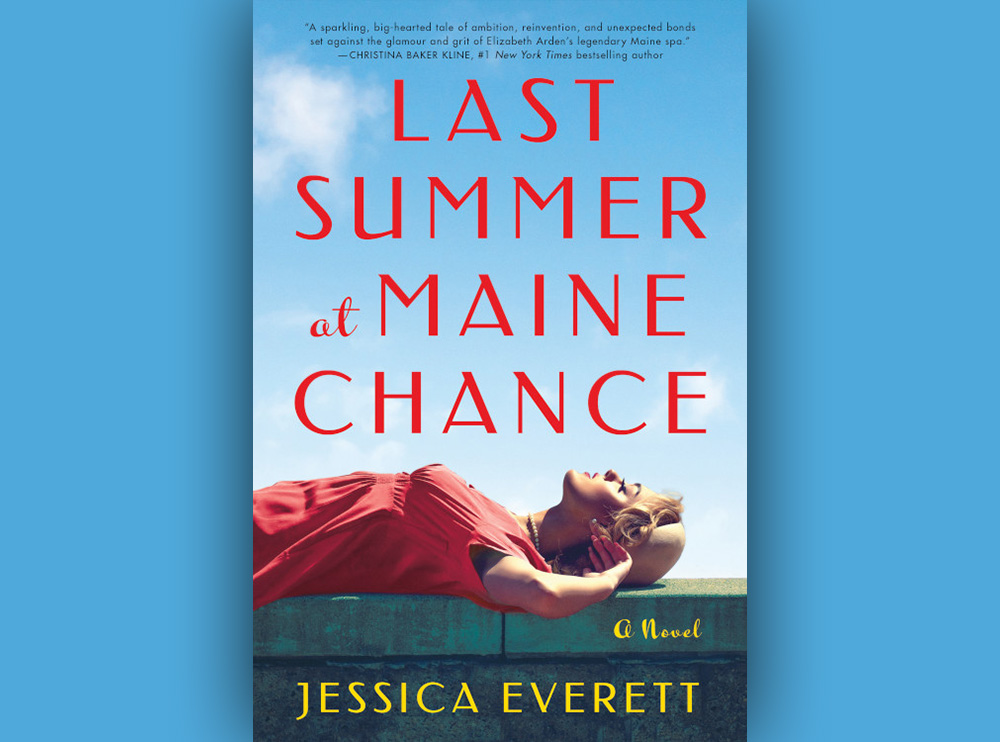
With a pinch of J. Courtney Sullivan’s Maine and a dash of Lessons in Chemistry, Last Summer at Maine Chance transports readers to 1950s Maine, where one summer working at Elizabeth Arden’s spa will teach a young economics student more than any classroom ever could.
Intrigued? Read on to discover the synopsis and an excerpt from Last Summer at Maine Chance by Jessica Everett, which releases on May 12th 2026.
Economics undergrad Cynthia Proctor knows everything about statistical impossibilities. In 1954, women like her from middle-class families do not earn degrees from prestigious New England colleges. When Cynthia receives notice that her scholarship will now be given to a male student, she knows her chances of graduating are slim.
But an invitation to spend the summer lakeside in Maine turns into a job at Elizabeth Arden’s Maine Chance spa, where Cynthia will learn that the best investment of all is herself.
CHAPTER 1: CYNTHIA
Late May 1954
It beggared belief that the ordinary-looking man in front of her held her future in his hands. Nothing in the slope of his slim shoulders or the tilt of his head, only thinly covered in graying hair, suggested the outsize influence he wielded in his chosen field. But one way or another, she needed an answer. Cynthia raised her fist and rapped on the sturdy wooden doorframe.
Professor Avery glanced up from a stack of papers on his large oak desk and waved her in. Even from the doorway, she could see bright-red ink scrawled across the uppermost sheet on the pile. An enormous D+ was circled at the top of the page. Her heart thudded as she stepped closer, silently assuring herself that the grade surely could not belong to her.
“Close the door, please, Miss Proctor,” he said as he gestured to the chair opposite his desk before riffling through the stacks in front of him.
Cynthia smoothed her skirt and lowered herself into the chair.
“You must be wondering why I wanted to see you,” he said, leaning back heavily in his seat.
She had thought of little else since she discovered a note from the professor in her mailbox at the women’s dormitory, requesting she appear at his office the next day.
“Considering you were somewhat involved in the research, I thought it only right to let you to know before you head off for the summer that the article has been accepted for publication by the American Economic Review.”
Researching and writing the article had been a great deal of extra work over the past two semesters, but she had enjoyed every minute of it. When the professor had asked for a volunteer to assist with his paper on the projected economic impact of the planned Maine Turnpike expansion on tourism, she had been both surprised and delighted to have been chosen for the role. What had started out as a way to prove that she could hold her own in a major dominated by male students had turned into a passion project. During the spring semester, she had skipped out on dances, sporting events, and even an occasional lucrative babysitting job in order to devote herself to the research.
She found herself engrossed in the details, like the bold decision to fund the nation’s second superhighway project through bonds instead of public funds, and the innovative and controversial use of asphalt instead of concrete as the paving material. While such things might not make every girl’s imagination soar, Cynthia had found the information provided fertile ground for her own theories of how promising Maine’s economic future could be. Boot factories, textile mills, and even commercial fishing might someday fail, but she could not imagine a day would come when the beauty of her home state would not draw throngs of visitors, at least in the warm months.
Professor Avery had encouraged her to do the grunt work of reading studies and interpreting the data as well as to write the majority of the actual article. She hadn’t minded, though. Not only was the project engrossing, but she was also betting that her work would put her in the running for a paid job as a research assistant to Professor Avery. It was a prestigious post, and one that she needed, financially, if she was to continue her studies. She was all the more pleased that she had a subscription to the magazine and would be able to see the fruits of her labor, and her own name in print.
“That’s wonderful news. I’m delighted to have been involved in something so successful. I hope to be able to assist you in your upcoming projects,” she said.
“Duly noted,” he said, looking pointedly at the pile of papers still requiring his attention. He flicked his glance back to her face. “Is there something else?”
Cynthia pressed her hands against her thighs, damp wicking through the light cotton of her skirt. It was now or never. After all, she was due to leave campus the following day.
“I wondered if you have come to a decision about the research-assistant job?”
He looked up as if surprised by the question. “The paid position for next year?”
“Yes. I applied for it when the job first posted several weeks ago, and I hoped to hear something before I left for the summer.”
“The position has been filled,” he said, picking up his red pen and tapping it on the desk between them.
Her stomach clenched. “May I ask by whom?”
“I don’t suppose he will mind if I share his name. I am told on good authority that being selected to assist me is something students are proud to claim, as I am sure you can attest.” He smiled at her. “Ronald Dryden was given the job.”
She had no firsthand knowledge of Ronald’s bank balance, but if his wardrobe, late-model car, and the trips he reported taking with his family were anything to go by, the stipend from a researcher job would have little impact upon it. What she did know firsthand, from attending several economics classes with him, was that he was a lackluster scholar at best. He often arrived late for class, contributed little of value to discussions, and was ready with excuses when it came to his responsibilities on group assignments.
“I must admit that I am surprised to hear this. I had thought that my work on the article would put me ahead in the running,” she said.
He dropped his pen back onto the desk and leaned forward, propping his elbows on its cluttered surface.
“Surprised? Come, come, now. You’re much too bright to think an opportunity like that would be wasted on a coed when there are young men like Ronald, who will actually be able to make use of the experience in a career.”
“Are you saying that you don’t believe I will be able to make a career in this field myself?” Didn’t the publication of an article she had researched and written prove she had promise?
Professor Avery’s gray eyebrows lifted. “I hardly think it likely. You are a woman, after all. Given your commendable grasp of economic theory, you must admit that women are a poor investment.”
Cynthia stiffened as though she had been slapped. An unwelcome lump formed in her throat. How foolish she had been to think that she would be the exception to the rule. Sadly, no female student at Barlow College had ever been awarded a paid position as a researcher. Heck, they had only begun to allow female-student admittance to the college during the early years of the Depression. Still, she had held out hope that somehow there would be a solution to her predicament. It had been vanishingly unlikely that she would receive a scholarship to attend in the first place. She had buried herself in her studies, forcing the notion that she might not be in a position to complete her degree from her mind, telling herself she had beaten the odds so far. The expression on her professor’s face told her that her luck had run out. Still, she couldn’t risk confronting him or complaining. Careers had been launched by a recommendation from Professor Avery, although she was pretty sure, so far, he’d only recommended men. As a woman in the field of economics, she needed every advantage she could get.
“Are there any other sources of funding that you know of?” she asked. “Is there a paid post for another professor, or even in a different department?”
He removed his glasses and buffed the lenses with a clean handkerchief. Cynthia recognized the gesture as one that preceded an announcement that the majority of the class had performed poorly on an exam. Slowly, he slipped the glasses back on his face and shook his head again.
“Anything of that sort has been assigned months ago. And again, any positions would have been awarded to male students rather than coeds, regardless of their qualifications.”
“So there is nothing available that could help me fund the next two years of my studies?” she asked. “If I don’t find something, I’ll be forced to withdraw from Barlow.”
“Nothing comes to mind. But I have every confidence that a clever girl like you will figure something out.” His gaze moved over her shoulder towards the door.
She glanced behind her and spotted a student from her microeconomics class hovering in the hallway. Her financial woes were not something she wished to discuss with anyone other than her intimates. Most of her fellow students would not have any idea what it was like to rely on financial aid to pay for their college experience. Barlow had a few scholarship students, to be sure, but the vast majority of her classmates came from wealthy families who had never had to wonder how their bills would be paid.
She nodded as if she agreed with his assessment of her resourcefulness and slipped out the door without another word. She didn’t trust herself to speak. A tirade of angry words jostled on the tip of her tongue. Nothing in the study of economics had taught her that women were a poor investment. Her legs wobbled with rage as she moved down the hallway. Her gaze ran over posters and flyers announcing trips to Europe, seaside cottage rentals, and language lessons. Everything listed involved spending money, and lots of it. Nothing whatsoever mentioned a way to earn any.
Cynthia hadn’t arrived at college with an intention to study economics. In fact, she had thought she might study English, with an eye towards a career in journalism. The romantic notion of being a star reporter at a bustling newspaper appealed to her. But when a scheduling challenge led her adviser to suggest she register for Introduction to Economics in her freshman year, her plans took an entirely new tack.
To her surprise, the study of economics provided her with an unexpected lens on the world. So much of life had always felt so tumultuous. No one who had spent much of their childhood witnessing the chaos of a World War would discount the value of predictability. But her studies had shown her that it just might be possible to explain human behavior, and even the way people made decisions that led to their actions. She found that economics provided a practical way to combine her aptitude for mathematics with her interest in history, politics, and psychology. Before that introductory class had ended, she was utterly smitten. Now the chance to make a career of it seemed to be slipping out of her reach.
The lump returned to her throat as she meandered past the stately brick library where she had spent so many hours lost in her studies over the past two years. The weather had turned exceptionally fine after a bitterly cold, snowy Maine winter, and students sat in small groups scattered about the velvety lawn surrounding the building. As she passed by, their easy laughter left her feeling even more isolated.
A surge of determination filled her chest. After all the work she had done to be admitted to Barlow in the first place, she was not going to concede defeat so easily. As the professor had said, a girl like her could surely think of something, couldn’t she? She picked up the pace as she turned in the direction of the women’s dormitory.
CHAPTER 2: CYNTHIA
The room she shared with three other girls had been mostly cleared out. Sharon and Carol had each left earlier in the week for a European vacation and a shopping trip to New York City, respectively. Only Pauline’s bed remained, spread with linens, and her desk, covered with papers, a box of dusting powder, and several half-wilted bouquets from her many admirers. Pauline lay stretched out on her unmade bed, her eyes turned towards the ceiling. She rolled over and propped her face in her hand as Cynthia stepped into the room.
“You look like someone just ran over your dog,” she said, swinging her feet towards the floor and sitting on the edge of the bed. “Does that mean you didn’t get the job?”
If only that were the sole problem. She hadn’t wanted to mention the full extent of her financial troubles to anyone until she was sure how dire they might prove to be. Even though she considered Pauline to be her closest friend at Barlow, she had not yet revealed the precarious nature of her situation. But after the meeting with Professor Avery, she craved Pauline’s support.
Cynthia crossed the room and opened a drawer in her desk. She pulled a sheet of official Barlow letterhead from under-neath a pile of notebooks and extended it to her friend. Pauline took it with the same enthusiasm Cynthia’s mother showed for occupied mousetraps. Cynthia watched as Pauline’s eyes moved back and forth over the brief lines of text.
“Although we have decided to offer our financial support to another deserving student, we wish you well with all of your future endeavors,” she read aloud as she reached the end.
“If they really cared one whit about my future, they would have extended my scholarship,” Cynthia said. She tried to keep the bitter note from her voice but needn’t have worried. Pauline was on her feet, pacing the floor, her manicured hands on her slim hips.

“So, you don’t have a scholarship and you didn’t get the researcher job. Now what?” Pauline asked.
“I don’t know yet. I asked Professor Avery about any other opportunities, but he said they’ve all been filled by male students.”
“But I thought Professor Avery valued your work on that article. How could he not find a spot for you?” Pauline asked.
“Apparently, the problem is my gender, not my ability.”
Pauline’s eyes widened. “What about your parents? Won’t they help if you ask?”
As much as Cynthia valued her friendship with Pauline, it could be painful to be reminded of how different their situations truly were. If her friend weren’t so good- natured, it would have been easy to resent her for her lack of understanding about how the world worked for so many. Pauline’s mother had descended from a Maine lumber baron, and as far as Cynthia could tell, penny-pinching was not within living memory of any of her close relations.
“My parents don’t have the means to assist me. Asking them would just make them feel bad, and it still wouldn’t be of any use.”
“How about if I ask my parents for the money? I know they have it.” Pauline waved a slim hand in the air as if able to brush away the problem with the flick of her wrist. If only it were that easy. Even if Pauline’s parents were so eager to part with large sums of money, her own would die of shame if she was to even consider accepting any kind of a handout. It was simply not the way things were done. Convincing them to allow her to attend college, especially one with a reputation for exclusivity, had been difficult enough. If they were to suspect she had become high-and-mighty and forgotten herself as a result of it, they would order her home even if she could find a way to pay for the rest of her education.
“I appreciate the offer, but I couldn’t possibly ask your parents for money.”
“How would that be any different from asking for a scholarship?” Pauline said.
“It isn’t the same at all. I didn’t ask for a scholarship; I applied for one. There was a lengthy process that wasn’t based on personal connections.”
Pauline shook her head, sending her glossy blond hair spilling about her shoulders. “Mother says that everything is about personal connections. If you won’t allow me to ask them for help, what are you going to do?”
“Even though my parents are going to pitch a fit at the idea of me working, I suppose I shall have to take a job as soon as I can find one and hope that I can earn enough over the summer to pay for at least the next semester.”
“You know, Mount Vernon is a tourist town. I am sure there must be all sorts of jobs available in a place like that. You could still come for the summer like we planned and use some of your time to look for a job. That way your parents won’t even need to know what you’re up to.”
Pauline had a point. Maine had been a tourist destination for decades, and places on the coast or at the lakes were among the most popular. There was a better chance of her finding something in a resort town than there was back home in South Berwick, where the mills were closing down and outsiders rarely ventured unless they had lost their way. And if she was honest, she was not looking forward to heading home in the least. Her breaks from college had become increasingly tedious. Both of her parents had strong opinions about how a woman her age should behave and made sure to remind her at every opportunity. Her father would not approve of her taking a job to earn tuition money any more than he did of her mother working after he’d returned from overseas. She doubted either of her parents would allow her to work at anything other than babysitting, and even if she worked round the clock all summer, there was no way she could earn enough from that.
While her parents were more than willing to inform her and her brother that they did not have much money left over for extras, they had no intention of allowing the outside world to share that knowledge. They lived in dread of the neighbors knowing their business. If she found a job in Mount Vernon, she could simply tell her parents she had been invited to extend her stay for the entire summer with Pauline’s family. It would be the perfect solution to her problem, even if she hated the idea of lying to her parents.
Besides, she enjoyed spending time with Pauline. And, she had to admit, she was more than curious about her friend’s life away from Barlow. The things she shared about her family and their lifestyle were entirely different from what Cynthia had experienced. An even darker thought crossed her mind: If she couldn’t earn enough money to return to school in the fall, it was likely the last time she would get to spend with her friend. She doubted their paths would overlap in the future if she was forced to drop out.
“Are you sure you won’t feel used if I go with you just so I can look for a job?”
“Of course not.” Pauline held up a finger. “But I have no intention of letting you spend all of your time working. There are at least as many eligible young men from good families as there are jobs to be had.”
“If I manage to find a job, I’m not sure I’ll have much time left over for dates.”
Cynthia’s lack of a social life had been a sore trial to Pauline ever since they met. She had done her darnedest to fix her up time and time again, but to no avail. Cynthia had come to college for more than an “MRS degree,” regardless of how hard her friend tried to pair her off.
“Those are my terms. If you want my help in finding a job, you have to accept it for finding a boyfriend as well. And think of how pleased your mother will be if you wind up getting engaged before the summer is up.”
Pauline had a point. Her mother had asked about potential suitors in each and every one of her letters. She prodded her mercilessly during school breaks as to why she had not attracted a boyfriend, given how many young men were enrolled. It was all very tedious. Cynthia wasn’t opposed to falling in love, but she was not at all interested in following in her mother’s footsteps. Still, it would be nice to send letters home that put her mother’s mind a bit more at ease, at least as far as her efforts were concerned. There was no reason not to acquiesce.
“It’s a deal.”