


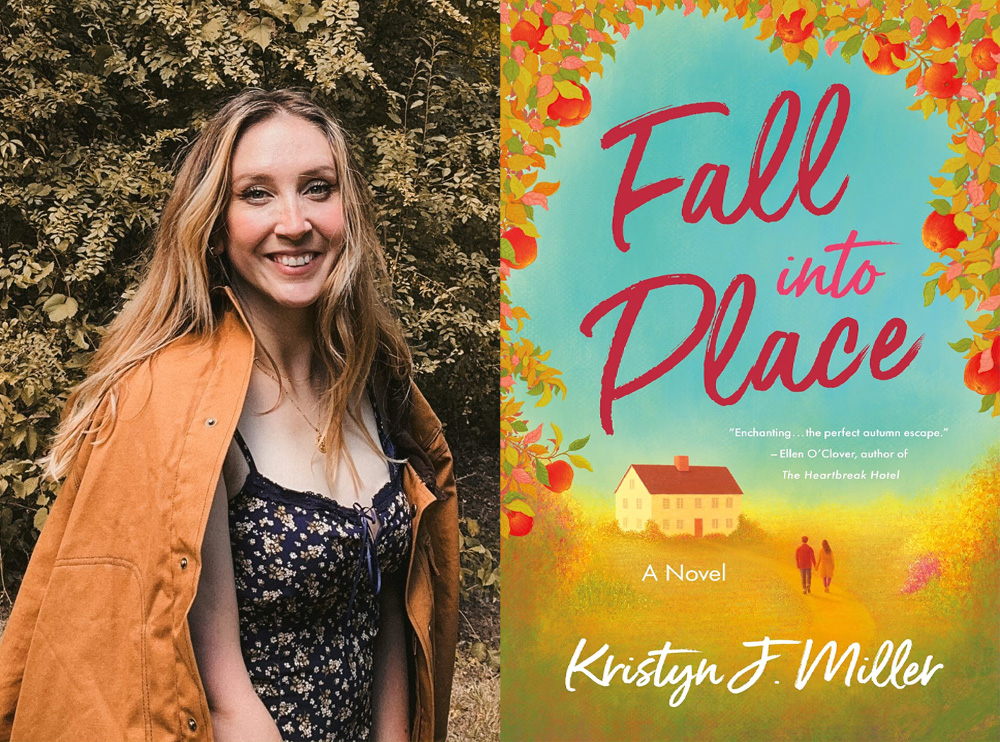
Guest post written by Fall Into Place author Kristyn J. Miller
Kristyn J. Miller is the author of Seven Rules for Breaking Hearts and other novels. A lifelong history nerd with a background in museum work, she finally earned her M.A. in history and museum studies at University of New Hampshire in 2023. In between novels, she spends her free time wandering peat bogs, sampling craft beers, and restoring her old colonial house in rural Maine with her husband.
About Fall Into Place: Lenore’s life is falling apart. Propelled home from Manhattan to rural Vermont to spend one final autumn at her family’s historic apple orchard before it’s sold, Lenore struggles to say goodbye. Callan’s path has been laid out for him for as long as he can remember: live, work, and die in Whitbury, Vermont. He’s taken over for his father as the groundskeeper at Lenore’s family farm, but now that it’s soon to be sold, his future has turned abruptly uncertain. The last thing he needs is a distraction—like Lenore, his best-friend’s sister, showing up out of the blue. Releases September 8th 2026.
I took a literary criticism course during undergrad where we talked about houses. More specifically, what the houses in our favorite stories represent. The consensus was that, in one way or another, a house often parallels a character’s state of mind.
The titular country house in Wuthering Heights is as gloomy and uninviting as Heathcliff himself. The Mojo Dojo Casa House in the Barbie movie is the physical manifestation of the Kens’ takeover of toxic masculinity. Normal People by Sally Rooney uses Marianne and Connell’s respective homes to contrast both their social standings and their family lives.
Of course, any time this sort of analysis comes up, someone in the room is compelled to ask, “Isn’t is possible that the author simply wanted the red curtains to be red?”
When it came to my writing process with Fall into Place, the answer is: kind of.
At the onset, I didn’t have symbolism at the forefront of my mind. A lot of authors don’t. Tolkien, for example, vehemently denied that there was any intentional symbolism in his work, despite many readers noting that Lord of the Rings serves quite readily as an allegory for real-life wars. The clearest explanation is that an author’s experiences shape both what they choose to write about and how they write it, and readers inevitably pick up on that.
In my case, I knew that I wanted to write about an old New England farmhouse long before I knew anything else about Fall into Place. Why? Because I live in an old New England farmhouse.
It’s quite impossible—as a historian especially—to exist in an old house without considering its past. My house is overflowing with evidence of its various custodians throughout the centuries, from handwritten letters in a steamer trunk in the attic to walls insulated with torn-up newspapers from the 1950s. The original builder is mentioned in local history books and buried with his wife at the top of a nearby hill. The whole thing sits a bit crooked, doors that don’t close right and wood paneling that slants sideways, like the house is weary with age. It’s been around a few hundred years, so who can blame it, really?
You probably haven’t read Fall into Place yet, but if you had, all of this would sound familiar.

Slowly, as I built my story around the idea of this farmhouse, the characters took shape.
For Lenore, returning to the house is bittersweet. It’s representative of a family history she has tried to outrun, and it’s likewise irrevocably changed by the loss of her grandmother. Callan, as groundskeeper, has spent the past few years caring for the house. If the house parallels Lenore, then it’s easy to see how his role as groundskeeper parallels their relationship.
Contemporary romance, as genre fiction, is not always subjected to the ‘literary’ treatment. It’s not analyzed and dissected in classrooms the same way classic literature is. But the symbolism exists regardless, even when it’s not necessarily intentional.
The truth is that the farmhouse in Fall into Place shaped the characters as much as they shaped the house. Which is a bit how it works in real life, too, come to think of it. At the end of the day, it doesn’t really matter whether I intended for the house to represent anything. My writing is a direct reflection of where I live, and Lenore, in turn, is a direct reflection of the house that raised her.