


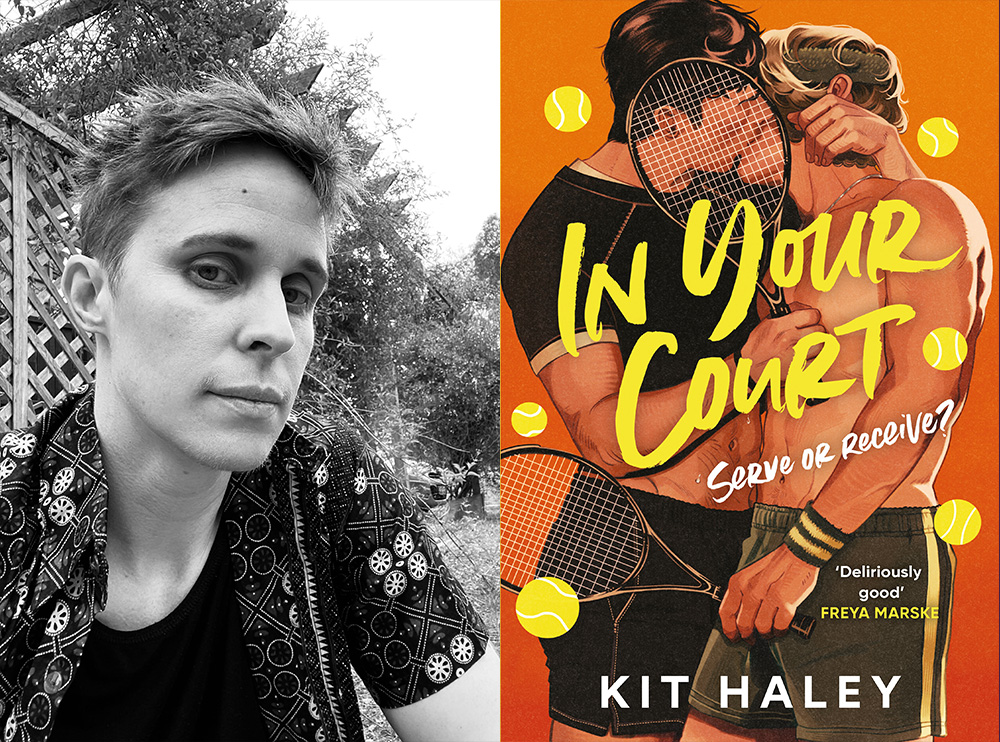
Guest post written by In Your Court author Kit Haley
Kit Haley is a queer author from Australia. A drinker of tea and a liker of dogs, they’re best understood as an obsessive tennis fan and an obsessive romance fan, which turned out to be a very happy pairing.
About In Your Court: An irresistibly sweet and seductive MM sports romance, serving up hot competition, steamy banter and a spicy rivals-to-lovers story.
Now and then, an unexpected piece of media gets big enough to shift culture. Star Wars: A New Hope was expected to flop only to reinvigorate sci-fi for the big screen, take visual effects a leap forward, and invent new ways of merchandising. Lord of the Rings was considered an impossible, expensive risk, only to do the same for fantasy epics twenty years later. Brokeback Mountain took years to get off the ground and was widely derided as the ‘gay cowboy movie’, yet wasn’t only a landmark moment in queer cinema, but also helped transform attitudes about queer love.
Heated Rivalry, or to a lot of people ‘that gay hockey show’, has been just such a piece of media – a book considered even by many fans to be unadaptable for the amount of sex required in telling the story, which has nevertheless become a big enough success to subtly change our cultural world.
A lot of people downplay this fact because it’s a romance and romances are just silly fun for women. They aren’t deep or important or mean anything, and isn’t it all just about sex anyway? As though love and sex have never been motivators for world-changing history. As though emotion and connection and relationships aren’t at the heart of the human experience. And what, in a heteronormative world where straight is the assumed norm, is more meaningful than the depiction of queer love deserving a happy ending?
This is not to say that no queer romance has been popular or successful before. In recent years, Heartstopper and Red, White and Royal Blue have both had broad commercial success and brought new readers to the genre, but Heated Rivalry is on another level. It broke through so explosively that at the end of 2025 no one was talking about anything else. Even people who had never watched or read queer stories—people who had barely engaged with romance at all—were watching. Even my retired parents, who only watch public broadcasting, history documentaries, and motorsports, knew all about it.
In the wake of this, sales of the books the show is based on went through the roof, bringing in a whole new readership who had never read M/M romance before (specifically romance between two men). Those readers then sought recommendations for other romances, publishers were more interested in buying such romances, and now M/M romance is having its moment in the sun. As both an author and reader of queer romance, it’s great to see more people reading, sharing, talking about and buying it. It’s very much a rising tide lifts all boats situation, for the larger the readership, the more publishers will invest.
But unfortunately, things are rarely that simple, and like every other cultural phenomenon, the Heated Rivalry craze has also brought with it some interesting challenges.
Everything is Heated Rivalry now
Check the marketing copy of any M/M romance book and you’ll see it. ‘Heated Rivalry x [something]’. ‘For fans of Heated Rivalry’. ‘The Heated Rivalry of [blank]’. My book, In Your Court, has not been immune to this, with the marketing copy saying, ‘Heated Rivalry meets Challengers in the hottest sports romance of the summer!’
The purpose of these marketing comparisons (or comps as we call them in publishing), is to give readers a sense of what the book will be like based on other books they may have loved, to say if you liked x, you’ll like this too. But with something as successful as Heated Rivalry, the comp is no longer chosen because it’s meaningful, but due to the popularity. Because it will sell. And this oversaturation has made the label meaningless. Books are getting called ‘like Heated Rivalry’ merely for being an M/M romance as though that’s all that makes Heated Rivalry what it is.
This isn’t a new phenomenon. Marketing departments have been reaching for whatever is most popular to sell books forever, but in a genre with few huge breakout successes the problem is magnified. For a while everything was comped to Red, White and Royal Blue to signal ‘queer romance’, then it was all Heartstopper whether the story was a graphic novel and coming-of-age tale or not. Now everything is Heated Rivalry.
In isolation this sounds harmless, sure to just generate scepticism. But before scepticism comes disappointment. In the short term, everyone just wants to sell books, but in the long term the worst thing you can do in marketing is create false expectations, because when those expectations aren’t met, readers review accordingly. Readers going into a book wanting a Heated Rivalry-like experience and getting something totally different are generally going to have a poorer reaction to a book, and be less likely to recommend it to their friends. While if they’d engaged with the book on its own terms, they may have loved it. This means we have a whole slew of M/M romances—already a very small and minimally-funded segment of the romance genre—emerging into the market under unfavourable conditions despite the popularity of the genre at present. A situation sure to inflict a general downward pressure on reviews, ratings and sales.
Everything HAS to be Heated Rivalry now
The flip side of everything being labelled as Heated Rivalry because it sells, is that the kind of romance publishers now want to buy are those that fit the comparison, exactly because it sells. It was already difficult to sell queer romance to traditional publishers because, while the market needs a hundred slightly different variants of the straight hockey romance, it apparently only needs one gay book every now and then. So if they already have a queer book on their list, they’re less likely to buy another. And now the kind of queer romance they’re looking for has also narrowed – not, I hasten to point out, because editors don’t want to buy anything different, but because pointing to similarities between a book they want to buy and the Big Successful Thing is more likely to get agreement from sales teams.
So in many ways, the great success of Heated Rivalry has—sometimes by also being the first or only queer romance people have experienced—redefined what queer romance even means. But this is a broad subgenre. Even the smaller subset of M/M romance is, and should be, an expansive place that grows and celebrates the idea of who men are and how they can love.

This is because while people often denigrate romance novels as being fluffy, pointless fantasies, even the wildest are, at their core, closer to our real lives than most other genres. None of us are ever going on a fantastical adventure or suddenly going to turn into James Bond, but our lives are made of relationships, romantic and otherwise, and relationships are fundamentally what romance novels are about – about growing as a person so you can find or accept love, about communication, about supporting others, about giving people another chance, and learning how you might have misunderstood them by letting yourself see the world through their eyes. As such, romance novels not only provide escapism and encourage empathy, but also enlarge our sense of the possible in our own lives. And in the lives of others.
I like hot young rivals snarking at each other as much as the next reader, and in sports romance I certainly write about them, but M/M romance more broadly shouldn’t have to fit into the Heated Rivalry model to be viable. The rising tide of Heated Rivalry may lift all boats, we have to take care that it doesn’t lift only Heated Rivalry shaped boats.
The trouble with rapidly-growing fandom
Most people don’t just read books in a vacuum. They talk about them, join online groups, post on social media, review on Goodreads, and discuss authors, genre trends and ideas. In short, books have fandoms. Genres and subgenres have fandoms – communities of people with shared interests.
Part of being a fan of something is having opinions about it, discussing the good, the bad, and the Right Way to do things. Some of these aren’t specific to any particular book, rather are broad social debates about the genre in general, about things like representation, authenticity, and equity. Many such debates also have settled answers that are the result of decades of discussion, and when new people join a fandom they tend to drip in slowly enough that they integrate into the existing community, learning about these discussions without each having to be relitigated ad nauseum. But when you get so large a sudden influx of new fans, as has happened with Heated Rivalry bringing so many new readers to the M/M romance community, these new voices can overwhelm the old, and can inadvertently take ill-considered positions as a group. And when challenged on them, have a tendency to back one another up, cementing their ill-considered positions as viable alternatives.
Why is this an issue? Well, examples of the settled debates in the M/M romance space may be illuminating. They include: ‘Can men even write romance?’ and ‘Is [insert facet of gay life here] bad, and so should be left out of romance novels?’ and ‘Should gay men stay out of M/M romance entirely since it was invented by straight women for straight women and is their safe space?’ (The settled answers being ‘yes’, ‘no’ and ‘are you kidding me?’).
You’ll note that these questions all debate the acceptance of the very queer identities the fandom exists to consume – a situation that fetishises queer men into objects of entertainment while denying their participation in their own stories, whether as readers or writers. As such there is nothing but harm to be gained from relitigating these arguments. Or from the emergence of a large group of readers loudly taking a damaging stance, thinking they are defending a beloved show.
Never has the love for queer romance been louder or stronger or more mainstream than it is right now. Nor has the positive depiction of gay sex ever been this accepted and prevalent, which at a time of growing conservatism, surveillance and control, feels important above and beyond any cultural moment. But as with everything that grows tall, Heated Rivalry casts a complicated shadow—not due to what it is so much as to the sheer size of what it has become—and reading, writing and living in that shadow is not without its challenges as well as its joys.