

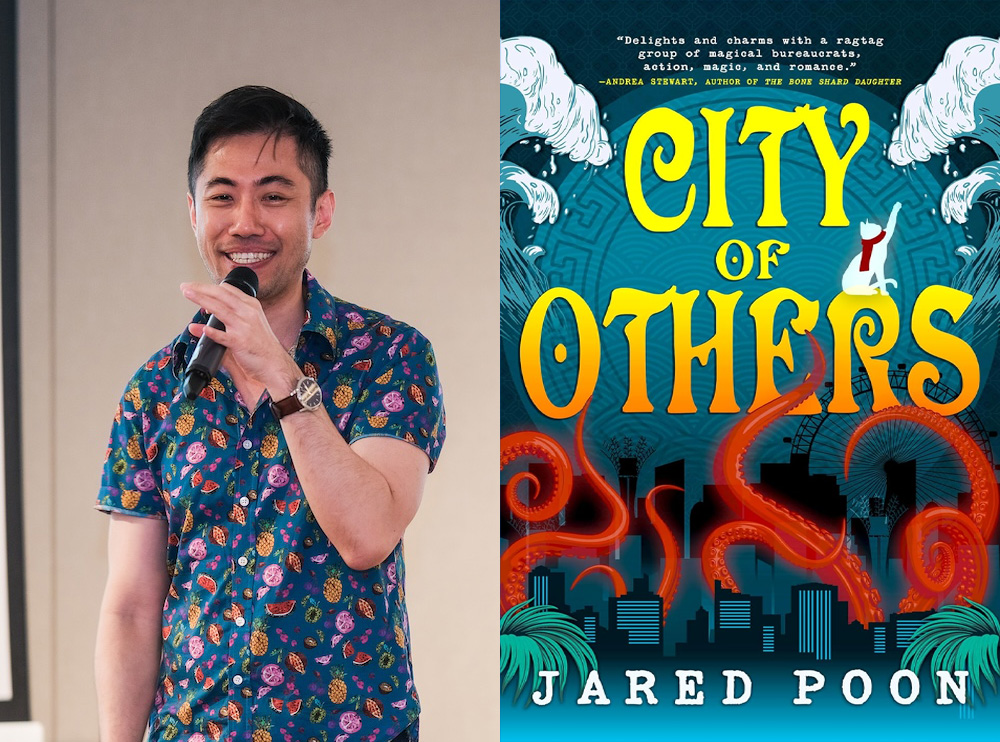
We chat with author Jared Poon about City of Others, which is a charming urban fantasy full of workplace found family, queer romance, and supernatural creatures straight out of Southeast Asian lore.
Hi, Jared! Can you tell our readers a bit about yourself?
Hi! I’m an ex-philosopher, ex-civil servant, forever and always a nerd. By day, I’m an educator and consultant (I know, I know). I’m also a cat parent and the first-time author of City of Others.
When did you first discover your love for writing and stories?
I was the guy who liked writing papers in school, which I understand makes me a freak.
And stories—stories have my heart. I remember, when I was eight or nine, taking the school bus (which was more like a van, here in Singapore) to school and making up tales for my friends about how I was on Mars for the weekend and the adventures I had. They were very jealous.
Then, later on, I fell into bad company with a Dungeons and Dragons crew, with whom I faced monsters and seduced hapless townspeople every day after class. They (the crew, not the monsters or townspeople) are still some of my oldest and best friends, to this day.
Quick lightning round! Tell us:
- The first book you ever remember reading: The Hobbit. I had to make a paper maché diorama for school. The book was amazing. The diorama was not.
- The one that made you want to become an author: I’ll cheat and name not a book, but a show: Glee. It made me realise that fiction can change the way people think about one another, and so change the world. I thought seriously about dropping out of grad school to become a screenwriter
- The one that you can’t stop thinking about: The Darkness that Comes Before, by R Scott Bakker. Some of the commentary on human psychology in that book (and the whole series) probably rewired me permanently.
Your debut novel, City of Others, is out now! If you could only describe it in five words, what would they be?
Bureaucrats manage supernatural. Shenanigans ensue.
What can readers expect?
Expect: Southeast Asian folklore and supernatural ecology. Wholesome romantic relationship where people actually communicate. Awkward family dynamics in particularly Asian flavours. Workplace found family, because sometimes colleagues can really be friends. Very weird magic. Lots of paperwork and angst about working in a large, bureaucratic organisation.
Do not expect: More than four ducks. This isn’t that kind of story.
Where did the inspiration for City of Others come from?
I was a civil servant in the Singapore government for a long time, and writing this book became a way to process that experience—with affection, frustration, and a bit of exorcism.
Were there any moments or characters you really enjoyed writing or exploring?
All of it, to be honest. Writing this was one of the best experiences of my life—you have no idea how much time I spent chuckling to myself as I put Ben and the team through hell.
I did especially enjoy working on Mei, though. She’s the immortal sorceress on the team, gorgeous and perfectly groomed. Her dialogue was very entertaining to write, and I came to realise I had no idea how to dress a woman. So I bugged my fashionable female friends about shoe-scarf-dress combinations, and I hope I ended up with a character who makes readers think “oh, that’s a good colour combination” rather than “why is the government hiring fashion criminals.”
Did you face any challenges whilst writing? How did you overcome them?
The biggest challenge was mental space, I think, and how much writing took up. Growing a world from scratch is, for me, a very consuming thing. At the gym, I’d be thinking about vampires. While teaching a class, I’d be chewing on where in Singapore I could set an epic zombie fight. While having lunch with friends, I might get an idea for jinn factions. And I would have to put a leash on my urge to talk about it, lest I become an example of a “Sir, this is a Wendy’s” moment.
Speaking of space, my cats wouldn’t give me any.
This is your debut novel! What was the road to becoming a published author like for you?
It is! For me, the journey was so much research. I didn’t jump in and start writing like, maybe, a proper creative would have. I looked up books on story structure. I watched a billion videos about plot and character. I went back through a dozen of my favourite books and made tables analysing how they started, where plot threads diverged and merged, how characters were introduced, and so on. I painstakingly typed out many, many chapters from these books, to slow my reading down and absorb how sentences are structured.

I’d been a reader my whole life, but writing took something different. Something new I felt like I had to learn.
And then, once the book was written, the whole process of getting it published was… a process. Luckily, there are wonderful resources (shout out to r/pubtips) laying out the paperwork and process in all its absurd, complicated glory. Good thing I eat paperwork and complicated processes for breakfast.
What’s next for you?
Nerves. With the book just out, what’s next for me is mostly nerves.
Oh, and writing Books 2 and 3 of The DEUS Files.
Lastly, what books are you looking forward to picking up this year?
I have my eye on The Iron Garden Sutra, by AD Sui, The Misfit Caravan, by KD Edwards, Backwoods Banshee, by David Slayton, Aicha, by Soraya Bouazzaoui, and like a dozen more. All books that mix heart, strangeness, and a strong sense of place.
Speculative fiction seems to be stretching outward, and I love it. Honestly, it’s a good year to be a reader.