
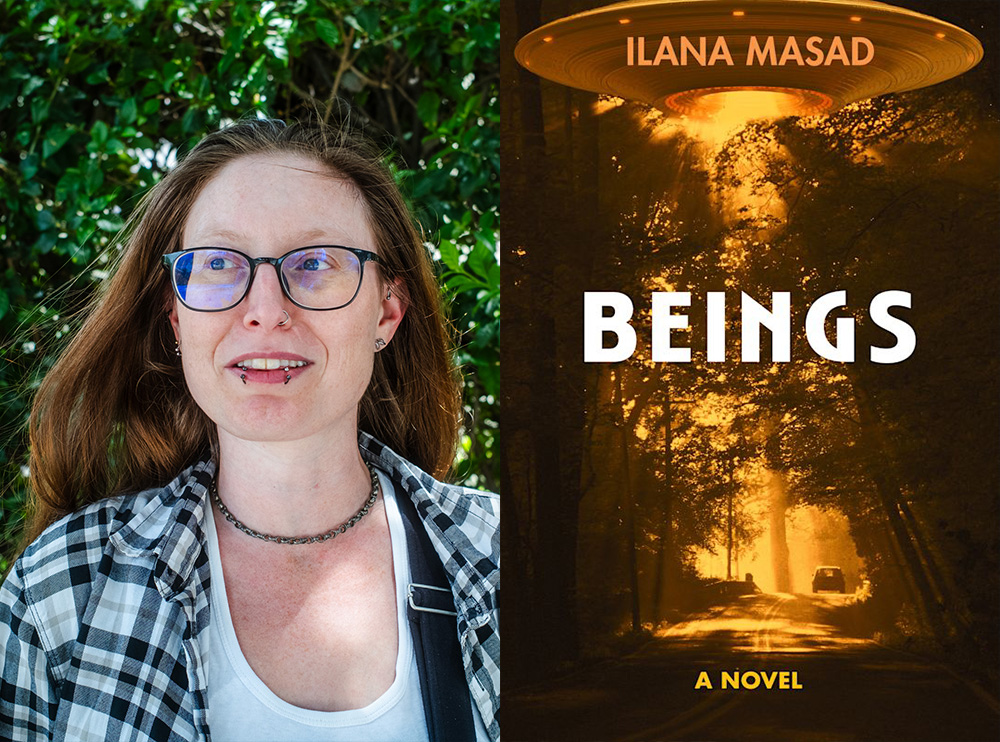
We chat with author Ilana Masad about Beings, which is a new novel based on true events asks whether extraterrestrial life might be what ties us to one another, to history, and to reality itself.
Hi, Ilana! Can you tell our readers a bit about yourself?
Sure thing! I’m a queer novelist and book critic living in Southern California with my partner, our kid, three cats, and a whole lot of books.
When did you first discover your love for writing and stories?
Those feel like two distinct things to me, because as I always say, I’m a reader first and a writer second. I’ve loved stories for as long as I remember being alive. I used to love being read to so much that I didn’t want to learn to read, but once I did, and once I realized that I wouldn’t be hurting my mom’s feelings if I read a book by myself, I started doing that. A lot. My mom’s side of the family lived far away and we’d visit them every six months or so, and some of my favorite childhood memories are of being incredibly jetlagged on one end of the trip or the other and either staying up and reading until 3am or waking up at 3am and not being able to sleep and reading until breakfast.
In terms of writing—I first remember enjoying it when I was in junior high, the one single year I had a cool literature teacher (she wore black and orange tights and sat on her desk in the front of the room; and then she left to get her PhD because, I suspect, she wasn’t getting paid nearly enough to do the incredible work she was doing). She had us write a “novel” in groups, and because, of course, group work most often goes terribly, I ended up finishing this “novel” (it was about fairies, if I recall correctly) the night before the due date, and really enjoying it. Then as a teenager proper I wrote a lot of sad poetry. It wasn’t until the end of high school, though, when I spent a summer writing a (derivative, yet impressively not as bad as it could have been) 200,000 word high fantasy novel that was meant to be the first in a quartet, that I realized how much I not only loved writing, but how much time and dedication and madness I’d be willing to spend on doing it.
Quick lightning round! Tell us:
- The first book you ever remember reading: The first book I remember reading on my own was, alas, the first Harry Potter.
- The one that made you want to become an author: Too many to count! But Tamora Pierce’s Song of the Lioness quartet was definitely a big influence when I was a tween.
- The one that you can’t stop thinking about: This changes all the time because I’m always reading! Right now, I can’t stop thinking about Ursula K. Le Guin’s essays in her collection Words Are My Matter.
Your latest novel, Beings, is out September 23rd! If you could only describe it in five words, what would they be?
- Aliens
- Archives
- Yearning
- Queerness
- Connection
What can readers expect?
Readers can expect three interwoven plotlines, an imagined version of the first alien abductees, a lesbian science fiction writer finding affirmation and community in 1960s Boston, and a modern-day archivist falling in love with the past and trying to understand their present. Readers can expect to question how and why we tell stories and who gets to tell them and what it means to tell stories about other people. Readers can expect, I hope, some suspense around the possibilities of alien encounters and to be titillated by the emerging queer and political consciousness of a young woman. Readers can expect to have a lot of the questions the book raises answered… and also to have the most important questions remain, as they are in life, open.
Where did the inspiration for Beings come from?
It grew out of a lot of places but originally it was learning about the real life people who are considered by many to be the first alien abductees, Barney and Betty Hill. They were an interracial couple, civil servants, activists; they both had prior marriages with other people; and they were in many ways completely and utterly normal. Yet this strange thing happened to them, and while they weren’t keeping it a secret, they also weren’t going around looking for attention. They become public figures not because they chose to but because someone else made that choice for them. And that fascinated me, as did the question of what really happened to them.
Once I figured out that I wanted to write about them, but that I was going to write about them with this self-aware narrator, I knew I had to bring in some other characters as well. I wanted a contemporary-to-the-abductees queer character because what was done to the Hills felt like an outing to me, and that was happening to queer folks at the time as well. And the present-day character of the Archivist was inspired in part by how much archival research I was doing in order to write the other parts of the book.
Were there any moments or characters you really enjoyed writing or exploring?
I had the most fun writing Phyllis, the lesbian science-fiction writer. She was entirely made up—as opposed to the abductee couple, who grew out of real people and to whom I felt an immense amount of responsibility, and as opposed to the Archivist who, while also totally fictional, carries a lot more of my own emotional turmoil inside them. I also loved researching what queer life would have been like for women during that decade and in that place in particular—I feel like we tend to imagine queer history in the U.S. taking place in New York City and in San Francisco and that’s it, but of course we’ve always been everywhere.
I also had a particularly good time imagining Phyllis’s science fiction interests, and was really inspired by the women SF writers of the 1930s, 40s, 50s, and 60s.
Did you face any challenges whilst writing? How did you overcome them?
Oh my gosh, so many challenges! I’m a full time freelancer and was also still in a PhD program when I started writing Beings, so finding the time and energy to write (as opposed to just doing endless research) was a challenge. I applied to and got into a couple of writing retreats—the Yefe Nof Residency near Lake Arrowhead and the Corsicana Residency in Texas—and then my partner also got my family to all go in on a gift card so I could just rent an inexpensive place in a small city a few hours away and create my own little residency. All of that was really helpful because I tend to work well in condensed sessions like that, where I’m away from my regular space and normal routine.

And then there was the emotional challenge—something about writing this book was incredibly painful at times. I found it really scary to write about a time I’d never lived in, and I was very nervous also about writing into the story of people who really existed. I couldn’t bear the thought of exploiting them like so many had done, but at the same time I couldn’t let them go. So I did a lot of research, which was helpful in terms of trying to accurately portray the time period, and
What’s next for you?
Continuing to hustle as a writer, editor, copy editor, and teacher… and getting back to the next novel I’m working on!
Lastly, what books have you enjoyed reading this year? Are there any you’re looking forward to picking up?
SO MANY BOOKS. Here are books that I read this year (and/or am currently reading) that I haven’t written about in my capacity as a critic (you can find my critic stuff here if you’re curious!). In no particular order:
- The Wickedest by Caleb Femi
- The Corner That Held Them by Sylvia Townsend Warner
- For Her Consideration and At Her Service, both by Amy Spalding
- Say Hello to My Little Friend by Jenine Capo Crucet
- The Safekeep by Yael van der Wouden
- The Man Nobody Killed by Elon Green
- Elseship by Tree Abraham
- Meet Me At the Crossroads by Megan Giddings
- The Left Hand of Darkness by Ursula K. Le Guin
- Audition for the Fox by Martin Cahill
- Space Crone by Ursula K. Le Guin (edited by Sarah Shin and So Mayer)
- The Sun Won’t Come Out Tomorrow by Kristen Martin
- This Place Kills Me by Mariko Tamaki and Nicole Goux
- Anathem by Neal Stephenson
- Happy People Don’t Live Here by Amber Sparks
- To The Moon and Back by Eliana Ramage
- I Want to Burn This Place Down by Maris Kreizman
- Writing As A Way of Life by Brian Morton
My TBR is insanely long, and I’m looking forward to all of the books on there and I already gave you a too-long list here!