


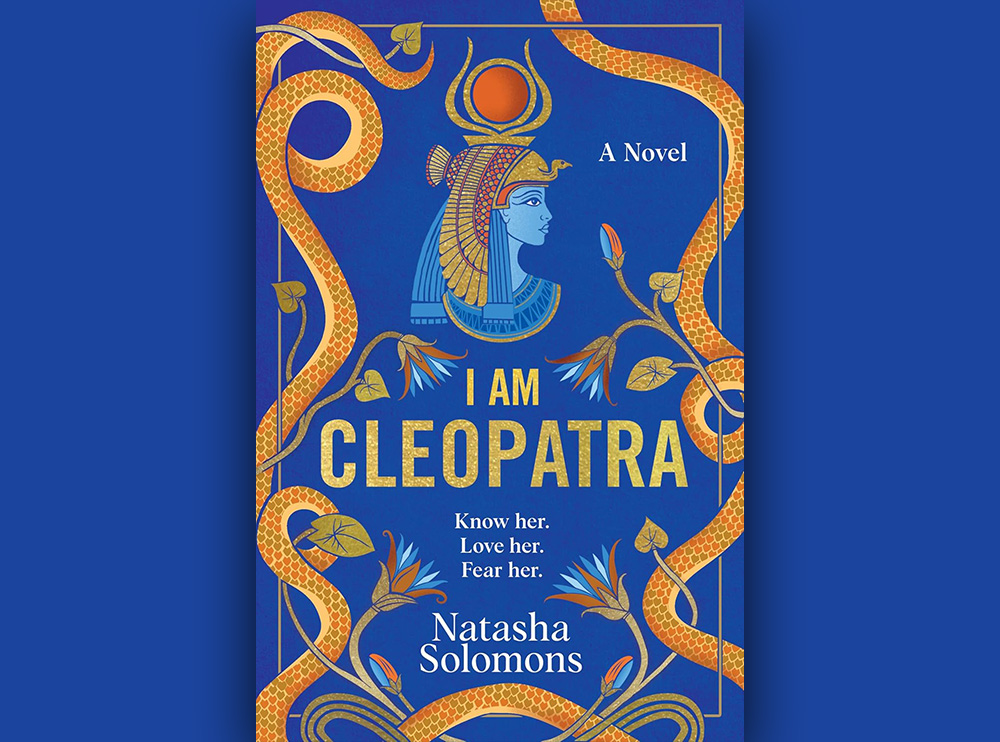
From the internationally bestselling author of Fair Rosaline comes a captivating historical novel—a powerful retelling of the life of one of the most beguiling and misrepresented female figures in history, Cleopatra.
Intrigued? Well read on to discover the synopsis and an excerpt from I Am Cleopatra by Natasha Solomons, which releases on October 21st 2025.
The favored daughter of the Pharaoh, Egyptian Princess Cleopatra spent her childhood hiding amid the scrolls in the great library of Alexandria, dreaming of one day writing her own story.
When her father dies, naming both Cleopatra and her selfish brother Ptolemy as his successors to the throne, danger arises. While the young Queen sails the Nile to greet her people, her brother plots to eliminate her and rule the empire alone.
But while Ptolemy has the power of the kingdom behind him, Cleopatra has her cunning wits. When the great Caesar arrives from Rome, she realizes he could be the key to her salvation—though courting this powerful man could cost her everything.
Can Cleopatra save her life, her throne, and her beloved Egypt and finally write her own history?
Told from the dueling perspectives of Cleopatra and Caesar’s mistress Servilia, I Am Cleopatra is a powerful, addictively readable reimagining of the alluring queen’s life. A modern retelling that goes beyond previous caricatures, I Am Cleopatra is a fascinating portrait of the flesh-and blood-woman behind the great legend. Natasha Solomons’ spellbinding story of female power and fragility, love and loss, fierce friendship and terrible betrayal introduces at last the real Cleopatra in all her glory and vulnerability.
CHAPTER 4
CLEOPATRA
The sacred Buchis bull and my father die on the same night. The aged bull has been sickening for a while.
His perfect white flanks are hollowed, his breath rattles and his black face is speckled with grey. The priests fan him and incense drives away the flies, but even so, the bull-god dies, sloughing off his mortal form, ready for the next. A few hours later, my father joins him in the field of reeds. His face bloated and hands clawing at the air, clutching at life until the end. Yet, it says much about my father that many more people mourn for the bull than for poor Auletes. Both were living gods, but the bull was not damaged by his extravagance and bad decisions. The bull was beautiful and beloved. My father was loved only by me.
I’m winded by my grief, it’s a sudden punch to my belly.
In my eighteen years, I have not felt a pain such as this. I never knew my mother. I assume she was one of the nameless slave girls who drifted through my father’s bed, tumbling over each other like dry leaves. No one spoke of her. Or they didn’t to me. She was no more worthy of mentioning than one of the cats which spew out litters beneath the grain stores. Only, she did not spit out kittens but a princess. Perhaps she died while birthing me, or else she was pensioned off to the countryside. I never asked. Neither her life nor, if she has passed, her death have any meaning for me. I am my father’s girl.
I drift around the palace, my pain a burden I carry from room to room, unable to set down. My smile is painted on my face like one of the gaudy frescoes on the palace walls. I rule through a fog, bewildered and pierced with grief. It dissolves me like a hot knife into the butter of my heart. Charmian won’t leave my side, whispering to me the next duty that I must be seen to perform. Without her reminder, I would stand lost in each room, forgetting why I am there, aware of nothing but the steady throb of my heart. She tethers me to this moment, stops me from drifting away on a tide of loss. We have been together for all of our lives, never parted for longer than a few hours. I know that no one else grieves, they only pretend in a shadow play of feeling. I watch my siblings, they burn incense and offer up prayers, but my little sister stifles a yawn, and my brothers pick their noses as the priests sing. They all three ply others with gold to recite the necessary prayers for Auletes’ soul instead of saying the prayers themselves. And yet, while I’m annoyed by the hollowness of their pretence, I understand why they do not grieve. I was always his favourite.
We are a family of living gods. We are the divine brought to earth like lightning. Our people recognise us as such, fall to their knees and tremble with awe and fear and deafen us with their prayers. We certainly behave as gods – my father murdered my older sister Berenice, and my younger brother’s allies come up with schemes to kill me. These are the acts of wrathful gods, not ordinary men. Only my little sister Arsinoe now regards me with anything approaching affection. She hasn’t tried to murder me, and in our family that is as close as we can get to love. I comforted her when she cried as a baby, and gave her my amulet to teethe upon, the tiny dents she made in the pliant gold more precious to me than any of the inlaid jewels. She is Clytemnestra to my Helen, and even if we weren’t hatched from the same egg, we are still sister goddesses. Yet we are mortal deities. My father died. I bleed and I piss and even the nipping flies ignore my orders to leave me alone. I command neither fire to spring from the rocks, nor water from the clouds.
Even though I’m the only soul who truly grieves for my father, the royal palace is brimming with courtiers performing rituals of mourning in rooms that feel strangely empty without the largeness of my father’s presence, his laughter. Arsinoe and my littlest brother, Ptolemy but always known as Tol, are secluded in the nursery with the priests, praying for his soul. Along the hall my other brother Ptolemy wails and screams in a wild performance of grief. I long to slap him. My hands twitch at my sides. His charade is entirely unnecessary. Everyone knows that my father and his eldest son loathed each other. My father was corpulent and incompetent, and despite his geniality and good humour, he loathed the expression of the worst parts of himself in his eldest son. Despite his aversion, my father had little choice but to declare Ptolemy and I must rule together after his death. The Ptolemies always rule in sibling pairs, our blood unthinned by interlopers and unthreatened by the interest of rival houses. A family united in power. But we two are united only in our loathing of one another.
One afternoon we are married in a farce of love. My slaves dress me in silks and bauble me with jewels and then the priests lead me into the temple, where my younger brother waits, sulking. He doesn’t look at me. His detested sister-bride. At least he doesn’t have his midday meal smeared upon his robes or his face. His nursemaids have cleaned him for our wedding. The priests call out our names and those of our ancestors in song. My sister strews flowers upon the altars, and little Tol leads a procession of holy animals: crocodiles, herons, tame jackals. The animals relieve themselves on the mosaic floors, so the air is thick with the smell of flowers, incense and dung. The heat swells and drips. I glance at my brother-husband, he’s abandoned any pretence of interest and is squashing a column of ants with his toe.
Afterwards we walk out together, keeping a careful distance from one another. We cannot bear for even our fingers to touch. Ptolemy. The young Pharaoh who is now my husband, at least in name. Our courts have always been rivals, his ruled by his eunuch generals, Pothinus and Achillas. They haunt the clear skies of the court like locust clouds. If they could have caused my death by wishing it, then I’d have been sealed inside my tomb long ago.

Our enmity is old and entrenched: their power flows from my brother Ptolemy, mere tributaries fed by his spring.
Pothinus is even fatter than my brother, a plucked and hairless boar, glossy and nicely basted ready for the oven. Achillas is similarly smooth, but he is all angles, and his brown eyes are thatched by thick black eyebrows. He has no other hair on his body, and so I wonder whether he has a slave glue on his eyebrows every morning. The two men are Ptolemy’s creatures, his advisors, his generals, tutors and the conjurers of his nastiest whims. And, they have longed for my death or downfall since my girlhood. They are malevolence clarified into flesh. They were castrated as boys, moulded and created to serve my brother and not be governed by their own needs. They have no desire other than power, cannot lust for man or woman, can neither marry nor father any children. Their incomplete state binds them to my brother. He is the only family they can ever have, their legacy can flow only through him.
These two jackals hunger for my flesh and I cannot tell whether this desire has now transformed into active scheming. As I walk the halls with my new husband, followed by our competing trains of slaves and guards, I wonder if death lurks amongst their smiling faces, ready to slide a dagger into the pliant flesh between my ribs.
As we parade through the palace, a flotilla of thousands of butterflies is released, fluttering around us as we pass. The insects settle on me like colourful curls of ash, landing upon my eyebrows and hair, pinned to my robes like living bejewelled brooches, but there are too many and I long to flick them away. The courtiers sing and shout, pretending Ptolemy and I are lovers, and shower us with good wishes. Their compliments and happy hopes curdle as they reach my ears. I know it’s hollow and I cannot see how this union can possibly last. Ptolemy and I are supposed to be Isis and Osiris: queen of the earth and magic and creator of life, and her lord of death. One cannot exist without the other; they are a perfect pair, day and night. But Ptolemy is no Osiris. We might be a family of divinities but my brother is a terracotta god, hollow and fragile. He has no thoughts of his own, and his skull reverberates with the grisly ambitions of Achillas and Pothinus. When he speaks, I hear their words spew from his mouth. They have schooled him in how to be selfish and decadent and cruel, nurturing his aversion towards me. The tender plant of dislike has flourished into a thriving hatred.
At the end of the hall, abruptly he turns from me, and retreats to his suite of rooms without a word. I release a breath I didn’t know I was holding, the happiest I’ve been for days simply to see him go. His presence is a noxious cloud that pollutes the air of any room he haunts.
I understand the danger I’m in. I’m trapped between my brother’s presence and my father’s absence. One presses against me, a pain squeezing my skull; while I feel the hole my father has left as a hollow space in my chest. He can’t protect me any longer.