


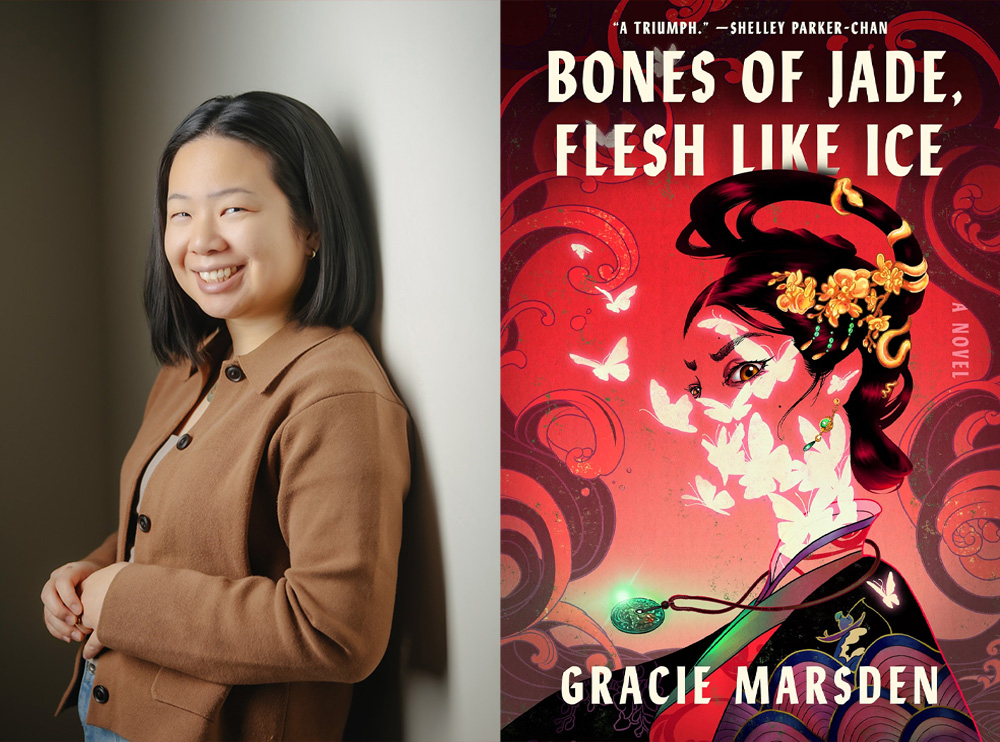
We chat with author Gracie Marsden about Bones of Jade, Flesh Like Ice, which follows a young woman who makes a bargain with a shapeshifting demon who promises her power, if she will give up love—a painful price that sets her on a dark journey in this historical fantasy inspired by Taiwanese myth.
Hi, Gracie! Can you tell our readers a bit about yourself?
I grew up moving A LOT between the US and Taiwan so I’m bilingual, though English is my primary language. By day, I’m the young adult librarian at the Marshall Public Library, and by night, I’m juggling multiple hats as a mother, writer, and crazy cat lady.
When did you first discover your love for writing and stories?
I think I learned early on that stories can connect people, and that is what drove me to literature. I know there are some writers who are content to write for the sake of writing, but for me, a project doesn’t really come to life until there is a reader to interact with it. Connecting with readers is one of my favorite parts of being an author. I want to know the emotions that people experience, the interpretations they walk away with, their favorite and least favorite characters, what moved them.
Quick lightning round! Tell us:
- The first book you ever remember reading: Deltora Quest, Emily Rodda (I’m currently reading it to my children and we love it!)
- The one that made you want to become an author: Eragon, Christopher Paolini
- The one that you can’t stop thinking about: Babel, RF Kuang
Your debut novel, Bones of Jade, Flesh Like Ice, is out November 10th! If you could only describe it in five words, what would they be?
Historical, Taiwanese mythology, violently devastating.
What can readers expect?
My favorite kinds of stories are the ones that make my heart ache, so the stories I write aim to do the same thing. It’s dark and at times graphically violent, so readers will want to check the trigger warnings listed on my website. It’s also a story that uses a fantastical lens to examine the human condition, so readers should expect portrayals of the worst and the best of humanity.
Where did the inspiration for Bones of Jade, Flesh Like Ice come from?
There’s a collection of Taiwanese folktales that I read growing up, and depictions of jing (shape-shifting creatures with a human and animal counterpart) came up again and again. The jing were often involved in blessing people who inadvertently aided them, or cursing people who acted cruelly. My initial idea, back in college, was to write a humorous story about a jing that had an unappealing animal counterpart, so rather than a rabbit or a fox, she had the animal counterpart of a pig.
By the time I got around to writing the story, I was in a very different stage in my life. I was a mother, it was the pandemic, and I was struggling with postpartum depression. Life was, simply, darker—and sothe story evolved, became serious and thoughtful. It focused more on resilience, and human fallibility, and the desire for control.
Were there any moments or characters you really enjoyed writing or exploring?
One of my favorite parts to write was the first chapter, where a jing prophesizes to Yu’er’s parents that they will become rich once their daughters are married, and Yu’er is sold into marriage as a result. This becomes a theme throughout the book, because I was really interested in portraying the power people give to prophecy, and how the choices made as a result of that prophecy are ultimately their—our—responsibility to bear.
I grew up in a very strict religious environment that taught following the prophecies of a religious leader would remove moral accountability for our actions. I wanted to deconstruct that, and explore the idea that human choice has more power than we think it does. Relinquishing choice can feel like a relief, but I believe it is a mistake that robs us of something essentially human. I wanted to confront that in my book.

Did you face any challenges whilst writing? How did you overcome them?
I dealt with a lot of imposter syndrome, particularly of feeling like I wasn’t “Taiwanese enough,” and it’s still something I’m plagued with. One of the ways I’m managing these emotions is by reading more work by Taiwanese Americans, as it helps me to see that I’m not alone in this experience, that there is a wide variety of perspectives and experiences to pull from rather than any single monolithic version, and also helps me learn more about my heritage. My husband and I also travelled to Taiwan earlier this year. Learning more about my culture and where I’m from helps me to feel less disjointed from, and more connected to, my heritage.
This is your debut novel! What was the road to becoming a published author like for you?
The idea for the book came when I was in college in my early twenties, but I didn’t start writing it until closer to my thirties. It took me about two years to write and edit it before I started querying, and I was in the querying trenches for another year before finally signing with my amazing agent, Mary. I think everything up to getting an agent was the most difficult for me. Before signing with Mary, I was pretty sure I would never get a publication deal. After signing with Mary, we sold my book within months and things were a whirlwind from there!
What’s next for you?
I’m working on a gothic horror novel set in Taiwan during the early 2000s. It takes place on Green Island, which is the site of an old political prison during the White Terror, an incredibly dark and bloody part of Taiwanese history where the island was under martial law under the Kuomingtang party after Japanese occupation during World War 2. Part of the reason my husband and I took that trip to Taiwan was to do research specifically on Green Island, so I’m very excited for this project.
Lastly, what books are you looking forward to picking up soon? Any you’ve got your eye on that are releasing in 2027?
Fruit Fly, by Josh Silver, I actually just picked it up at my local indie and it’s sitting on my shelf. For 2027, I’m really excited for Stormraven, by Kelsea Yu, Madder Lake, by Katie Wu, and Hell to Pay, by Kylie Lee Baker.


