


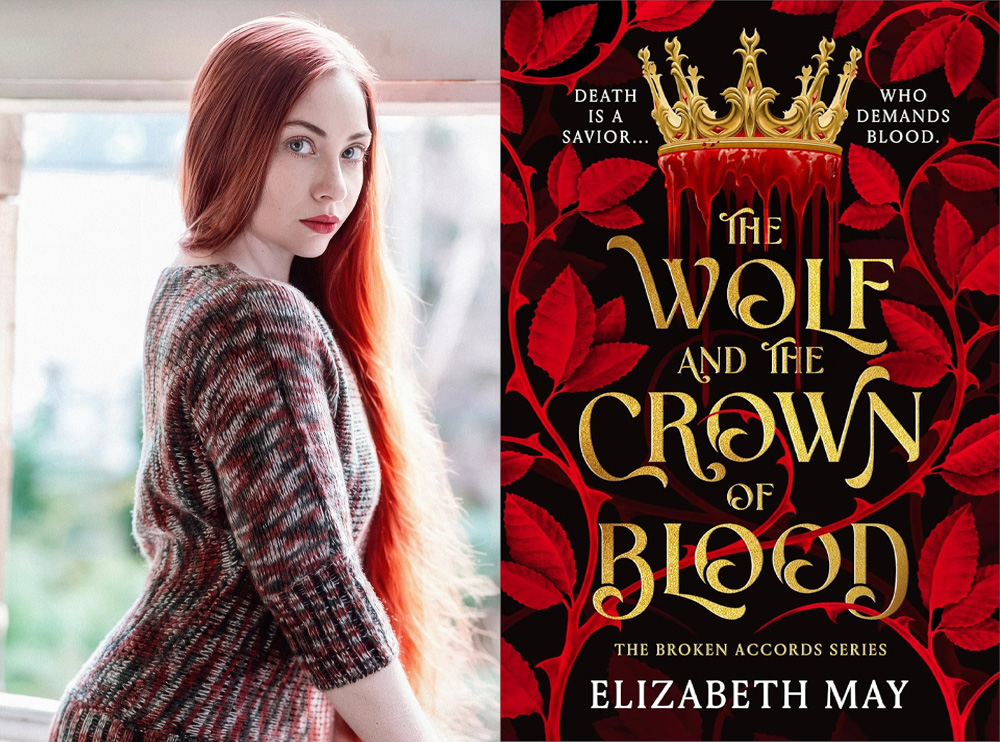
Guest post written by The Wolf and the Crown of Blood author Elizabeth May
Elizabeth May is the Sunday Times bestselling author of To Cage a God, the Seven Devils duology (co-written with Laura Lam), The Falconer series, and romance novels under the pseudonym Katrina Kendrick. Originally from California, Elizabeth holds a Ph.D. from the University of St Andrews. She currently resides on an 18th-century farm in the Scottish countryside with her husband, three cats, and a lively hive of honeybees that live inside the wall of her old farmhouse.
About The Wolf and the Crown of Blood: A princess and a war-weary god met in the ashes of a broken city, forging a pact in blood and sacrifice. Packed with dark fairytale vibes, gothic romance, and tropes like enemies to lovers, forced proximity, death pacts, and villain-gets-the-girl, this is a story where love is as deadly as it is irresistible. Out January 27th 2026.
You can find the heart of a story through subtraction: strip it down to its skeleton and see what you can’t remove without the whole thing dying on the table. Whatever survives the surgery is what the story actually is.
Every single book I’ve ever written has romance in it. It’s my raison d’être, the thing I love most in both reading and writing. But until The Wolf and the Crown of Blood, the romance wasn’t load-bearing. Seven Devils and Seven Mercies has a soft sapphic pairing, but galactic rebellion makes the whole thing work. To Cage a God includes both an MF and a sapphic romance, but the heart of the novel is two sisters challenging a tyrannical empress. And despite three books of romantic development between a fae hunter and her fae lover, The Falconer series’ central plot is a woman defending her homeland against the fae. In each case, you could take out the romance and still have a functional narrative. Thinner, certainly, but standing.
The Wolf and the Crown of Blood is the first time I built the story the other way around: it’s not a fantasy novel with love in it; it’s a romance novel that happens to contain gods.
There’s a tendency in romantasy discourse to assume that if the romance takes precedence over the fantasy, this must be the result of either accident or incompetence. This is genre bias at work. The romantic parts of a novel are often classified as “not plot,” as though “plot” exists solely in the external conflict. This framework presumes that the parts of a book about a kingdom at war are somehow inherently more significant than two people falling in love at the center of it.
But romance has a profound influence on character motivations and development. It alters what a character values, what they fear, what they’re willing to sacrifice. I’ve written apocalypses and rebellions and battles, and I have enough experience to say: sometimes the most interesting thing in a scene is that someone desperately wants to touch someone else and doesn’t know how to process their feelings about it. It’s not a lesser form of tension. That’s just tension doing different work.
So when I began plotting The Wolf and the Crown of Blood, I did something different than usual: I drew from contemporary romance. More specifically, dark romance.
Let me backtrack, because many people know I write historical romance as Katrina Kendrick and might wonder why that subgenre didn’t influence me more directly here. Historical romance often relies on external obstacles: money, class, society, the looming spectre of reputation, arranged marriages, and the threat of ruin. Some historical romance authors have noted the overlap with romantasy for this reason—both genres excel at “these two people can’t be together because the world has constructed barriers between them.”
Contemporary romance lives more in the skull. It might have a B plot (medical bills that need paying, a promotion at stake, etc.), but the romance itself is often defined by inner struggle. In two people who could theoretically be together but aren’t, because something in them won’t allow it yet.
In romantasy, external and internal stakes aren’t separate; they’re nested. A character’s kingdom matters because they care about it. Their desire for the love interest matters because it influences their behaviour, choices, and how they move through their world. This is why I resist framing that positions the fantasy elements as more narratively important than the romance. Both elements are doing work. In a romance-forward novel, a secondary world adds texture to the relationship. It adds consequences, risks, and barriers that might not exist without that scaffolding. In a fantasy-forward book, the romance adds emotional stakes. Neither elements diminish the other—they’re complementary.
Once you accept that the romance-forward structure is intentional, you have to extend the same courtesy to the ones that make people blush on public transit.
So let’s talk about the thorny topic of sex scenes.
In The Wolf and the Crown of Blood, horniness isn’t a reward for getting through the plot. Desire, eroticism, and the struggle of wanting someone are characterisation tools. They perform narrative labour. I realise “the sex scenes have a purpose” can sound like defensive hedging, but that’s not what I’m doing here. My point is that erotic content is another means of storytelling, with its own revelatory capacity that cracks a character open in ways that dialogue and action sometimes can’t.
I enjoy the vulnerability of desire and the negotiation of power and bodies during sex scenes. The way it can be raw and filthy and sometimes cruel, culminating in characters deciding to be known to each other without armour. If a character is willing to show their lover the ugly underbelly of their want, that’s development. If two people negotiate who gets to be on top and what that says about their power dynamic, that’s conflict resolution (or escalation). If their fucking shifts from brutal to tender, that reveals something, too. Bodies don’t lie the way mouths do. What a character wants in bed, what they flinch from, and what they beg for are all data points.
To me, sex is not an intermission that interrupts plot—it is plot. I rarely see people commenting on how an action scene needs to justify its existence. No one asks a battle to earn its page count by proving thematic relevance. Erotic scenes deserve the same assumption of intent.
This brings me back to dark romance.
Dark romance takes eroticism and sharpens it into a weapon. The subgenre says: love is not a reward for becoming palatable; love is what happens when one character accepts another’s damage with eyes wide open. This is where the discourse often gets squeamish, and I understand why. Dark romance plays in morally uncomfortable sandboxes. It asks readers to sit with the discomfort of love not being a moral evaluation. Loving villains who remain villains is part of the genre’s appeal. In dark romance, sometimes love is directed at people who don’t deserve it, and it’s still transformative for the person doing the loving.

The Wolf and the Crown of Blood borrows from this subgenre deliberately.
It has obstacles, certainly. The male main character is a god of war who revels in death and destruction, and he’s sent to execute the heroine. He’s immortal; she’s mortal with an expiration date. Their realms share a violent history the gods remember in granular, bitter detail. This history creates worldbuilding tension. Big stuff!
However, I wanted the interiority and inner struggle of contemporary (dark) romance to be layered beneath those external barriers. I wanted to explore hatred and toxicity and the understanding that wanting each other will probably ruin them both.
And I wanted them to reach across that gap, anyway. Not because the barriers were removed, but because they decided, consciously and repeatedly, that the potential downfall was worth the cost. That wanting this person who represents everything they should hate was more honest than pretending otherwise.
The Wolf and the Crown of Blood is, structurally, a contemporary romance novel wearing a fantasy setting like a very elaborate coat. The real tension lives in the question: What would you do if you fell in love with the person who will inevitably destroy you?
The answer isn’t in the worldbuilding or the lore or the magic system. It’s in the parts of the story about two people deciding, over and over, to reach for each other despite every instinct warning them not to.
Everything else is just a really nice coat.