


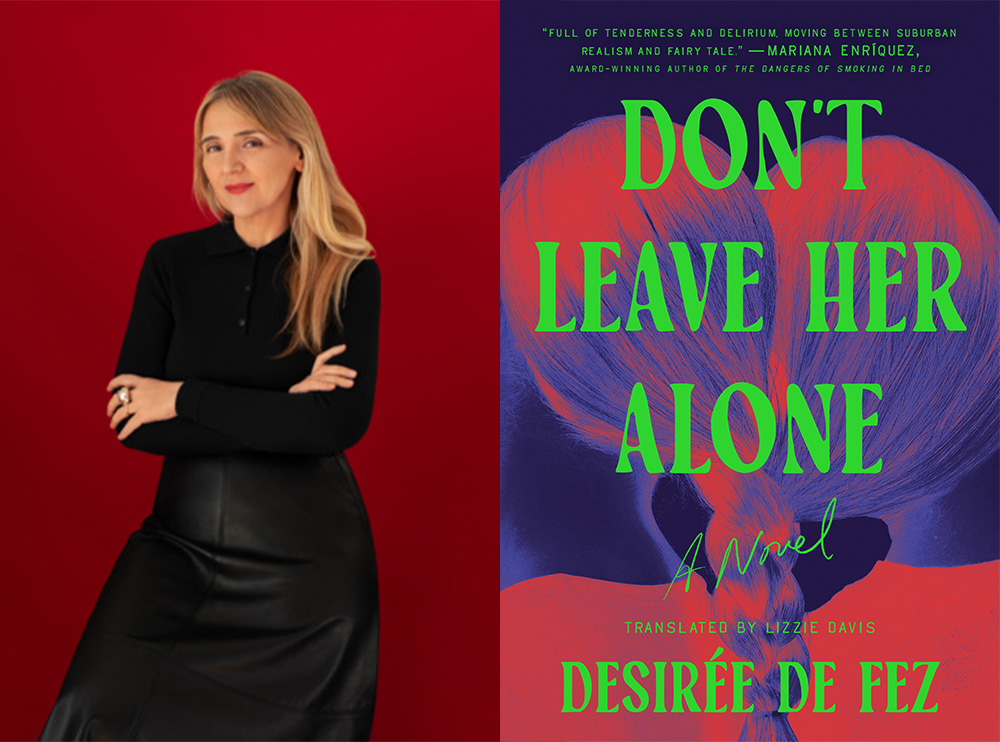
We chat with author Desirée de Fez about Don’t Leave Her Alone, which is an incisive exploration of motherhood that interrogates women’s struggle for autonomy and identity, and ultimately forces the question: What does it take to finally break free?
Hi, Desirée! In your own words, tell us what Don’t Leave Her Alone is about.
Don’t Leave Her Alone is a mix of body horror, love and humor.
It’s a novel about intense family relationships, everyday stress, pressure, and the expectations we place on ourselves. It explores what happens when the fears and anxieties we have kept inside for years suddenly come to the surface.
It tells the story of three women—a mother and her two adult daughters—who share a bond so strong that it slowly begins to suffocate them. Everything changes when Alba, the youngest daughter, who fears being alone, gets trapped in a shopping mall on Christmas Eve. What happens that night affects all three women. The bond that has kept them together—and trapped them—for so long begins to break, releasing the fears they have carried for years in an explosion of love and visceral horror.
This is a horror story, but also a tender and, I hope, funny story about love. It’s about what it means to be a mother, a daughter, a sister, and a woman trying to deal with the anxiety of today’s world.
Alba, Diana, and Carmen are vastly different—both in their personalities and parenting styles—yet by the end of the novel, we discover they are connected by more than the monsters living inside of them. How did you approach writing these complex family dynamics, particularly the relationship between mothers and daughters and between sisters?
With a lot of work, because it was essential for me that, at every moment, it was clear that this story belonged only to them.
On one hand, I wanted the three of them to share the feeling of being exhausted and overwhelmed, even if the reasons behind it were different for each of them. I didn’t want there to be a single external explanation for what happens to them: they are like this because they are alive, because everyday life is difficult, not because they have experienced some specific trauma.
On the other hand, I wanted the bond that connects them—the bond that begins with love but becomes suffocating—to be complex and to be at the center of the story. That meant understanding them deeply and finding a way to show, through them and through what happens when they are together, that the roles of mother, daughter, and sister are incredibly complex and cannot be reduced to simple ideas.
Don’t Leave Her Alone unfolds over just a few days leading up to Christmas. What made the holiday season the perfect backdrop for this story, and did the condensed timeline help heighten the sense of anxiety and tension that permeates the novel?
Yes, that was one of the reasons: I wanted a timeline that would allow for a tightly paced, slice-of-life thriller set over a very short and specific period of time, and the Christmas season was perfect for that. At the same time, it’s a time of year when family tensions, consumerism, and everyday stress tend to become more pronounced, all of which were among the film’s central themes. And, just as importantly, I simply love Christmas –its aesthetic and the stories set during the holiday season. I like to think of Don’t Leave Her Alone as a female-led Barcelona-set take on Charles Dickens’s A Christmas Carol.
Don’t Leave Her Alone is a striking work of contemporary body horror, but at its core it critiques the social expectations placed on mothers, daughters, and women more broadly. What drew you to explore these important and timely themes through the lens of feminist horror?
I have loved horror literature and cinema since I was a child. For me, they have always been a safe place, a space for learning, reflection, and comfort. I have always admired the ability of these genres to talk about the most complex subjects with a wisdom, strength, and courage that other genres sometimes cannot reach.
That is why writing naturally led me towards feminist horror. The codes of fantasy and horror are the ones I know best, and I instinctively turned to them to tell this story about the shared fears experienced by three women who are under pressure from social expectations, the anxiety of everyday life, and their own excessive self-demand.
Alba describes the creature inside her as an octopus-like being with glittery tentacles—a surprisingly beautiful image that nevertheless feels deeply unsettling. How did you come up with the creature’s design? Did any iconic horror film monsters help shape your vision of it?
I think that creature is a blend of all the literary and cinematic monsters I’ve fallen in love with over the years—and there have been many—as well as my fascination with practical effects in film. I wanted those tentacles to be mesmerizing, something beautiful to look at and admire despite the pain they symbolize. I also think that one of my favorite films, Possession by Andrzej Żuławski, has influenced much of what I do. The monster in that film is far darker and more sinister than the one in Don’t Leave Her Alone, but it clearly shares that same tentacled quality and, like my creature, functions as an extension of the protagonist’s psychology.
Not specifically in relation to the tentacles, but another creator I had in mind throughout the process was David Cronenberg, one of my favorite filmmakers and a fundamental influence on this book.
The sequence of chapters where Alba is inside of Splau unfolds like a fever dream, blurring the line between reality and the fantastical. How did you go about creating that eerie, dream-like atmosphere? Was the surreal nature of these scenes intended to reflect Alba’s increasingly fragile emotional state, or does it serve a broader symbolic purpose within the novel?
Finding that atmosphere was one of the most challenging parts of the book, because the idea was to make emptiness and absence themselves feel unsettling. How do you turn an empty shopping mall into a terrifying place through writing?
I have been fascinated by liminal spaces for a long time (and I’m certainly not the only one!), especially by the idea of empty places that were once full of activity as expressions of the unconscious. I wanted to explore that direction. What I didn’t expect was how difficult it would be to write about emptiness itself! Ha ha ha.
In relation to what you mention, that space—the empty shopping mall—begins as a reflection of Alba’s psychology and eventually becomes an expression of a collective unconscious. The idea was to move from something intimate and personal towards a symbolism that could speak to something more collective.
Who are some of your favorite female horror authors, and did you draw inspiration from their books while writing Don’t Leave Her Alone?
There are so many female horror writers I admire! Mary Shelley, Daphne du Maurier, Angela Carter, Anne Rice, Amparo Dávila… But for me, both professionally and personally, it has been essential to read some extraordinary contemporary writers of my time: Mariana Enriquez, Samanta Schweblin, Elaine Vilar Madruga, Carmen Maria Machado, Rachel Yoder, Virginia Feito… Many of them have also done incredible work exploring the body as a map of our unease and as an expression of our fears and concerns. Reading them has been fundamental for me, just as it has been meaningful to be alive at a time when we have seen the emergence of horror and genre films by directors such as Julia Ducournau, Coralie Fargeat, Ana Lily Amirpour, Jennifer Kent, Jane Schoembrun and Carlota Pereda, filmmakers whose themes and preoccupations feel very close to my own.
Given your experience as both a film critic and advisor, if Don’t Leave Her Alone were adapted into a film, who would you cast as Alba, Carmen, and Diana? Why?
Because of my relationship with cinema, I actually have a very clear idea of the cast I would love for Don’t Leave Her Alone if it were ever adapted into a film, ha ha ha! But precisely because I have it so clear in my mind, I’d rather not say it—I don’t want to tempt fate. I prefer to keep dreaming that one day the three wonderful actresses I imagine will become Alba, Carmen, and Diana.
“Tears of Love” by Camela is not only a song that brings all three generations of women together, but also a reoccurring symbol in the novel. What significance does it hold within the broader context of the story? Does it have any personal meaning for you that let you to include it in the novel?
I chose that song because it immediately brought me back to the sounds of the campsite where part of the novel takes place. It is a very popular song in Spain, and it was everywhere at the time when that part of the story is set.

But there is also something personal behind that choice. Like Alba and Diana, my younger sister and I used to spend our summers at a campsite like the one in the novel. When we were little, she played that song all the time, and I hated it because I was older and listened to very different music.
Then something that happens very often happened to me: the things you dislike as a teenager can come back to you as an adult in a completely different way, and you can discover a value in them that you didn’t see before. I have a lot of affection for this song because of that personal story, but also because I think it captures the atmosphere of that part of the novel perfectly.
And because I’m essentially a pop person, I loved the idea of bringing such a popular hit into the book (just as I allowed myself to use commercial brands as an aesthetic element) and making it something important for the story. I found that both beautiful and fun.
Anyway… I love this song.
What are you working on next?
I’m currently writing a screenplay and starting to develop the ideas for my next novel.