

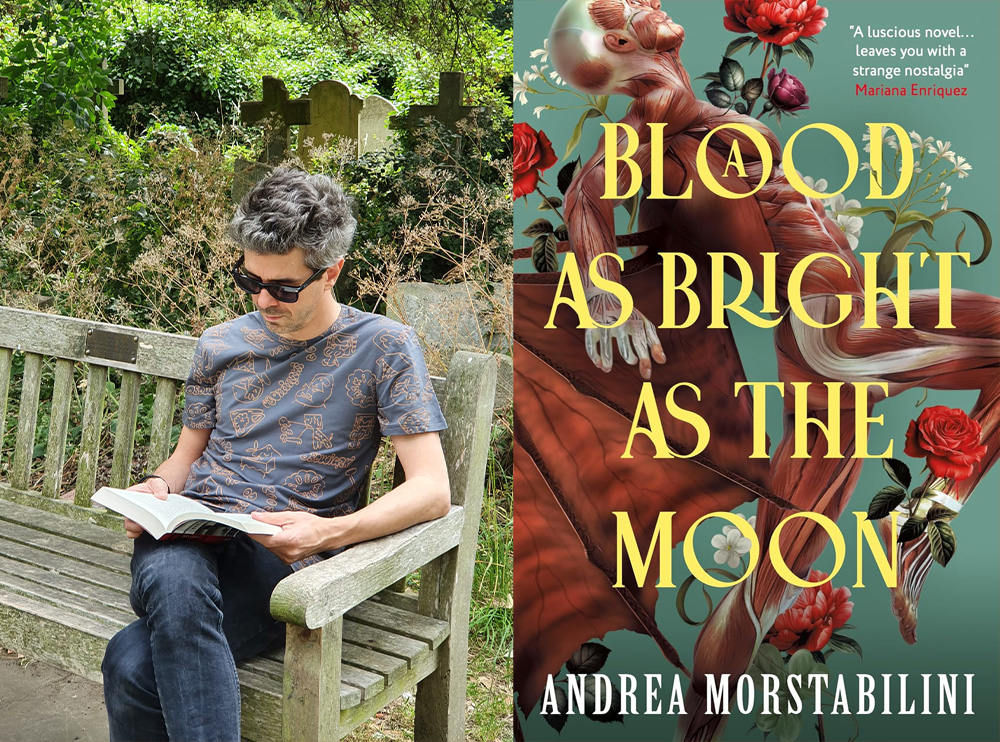
We chat with author Andrea Morstabilini about A Blood as Bright as the Moon, which follows a vampire, who is desperately torn between worlds, and hunted down by a secret society bent on his destruction.
Hi, Andrea! Can you tell our readers a bit about yourself?
Hello! Thank you for having me! Shall I start in Dickensian fashion, “to begin my life with the beginning of my life”? I was born in Lodi, a smallish town in the midst of the Po Valley in Northern Italy. If you’re thinking about sun-drenched olive groves, think again: Lodi is – or at least was, when I was a child and before global warming wreaked havoc on its climate – almost perennially shrouded in mist, something that has perhaps to do with my own literary taste. In university I studied modern literature and wrote my dissertation on the Fantastic in 19th century Italian literature—I guess haunted castles and restless spirits really are a part of my DNA. Nowadays, I live with my husband, mostly in Milan, but sometimes in Kraków too. I’m a writer (duh, obviously) of darkly fantastical speculative fiction and I also work as an editor for an independent publishing house here in Milan.
When did you first discover your love for writing and stories?
If we are to believe my mother’s stories, I’ve always harboured an all-consuming love for writing. I won’t say nothing of my few extant poetic attempts – way too earnest! – but apparently there were also countless stories I made up – and later wrote on a typewriter I begged my parents to buy – when I was a child, all of them inevitably beginning “on a dark and stormy night.” I have no idea why I was drawn to supernatural horror from a very early age, but perhaps there really was something in the mist…
Quick lightning round! Tell us:
- The first book you ever remember reading: This is difficult because there are at least three or four books vying for this distinction in my memory, but I think it might have been The Hobbit.
- The one that made you want to become an author: My decision to become a writer might actually predate my reading it, but Interview with the Vampire had an outsized influence on my literary taste and my life-long obsession with the Gothic.
- The one that you can’t stop thinking about: Our Share of Night by Mariana Enriquez. I read it a couple of years ago when it was published in paperback in the UK and it has haunted me ever since. If you haven’t read, you simply must.
Your latest novel, A Blood as Bright as the Moon, is out now! If you could only describe it in five words, what would they be?
This is, again, really difficult. My husband always tells me that I’m terrible at elevator-pitching when it comes to my own writing, but I’m going with five adjectives: Gothic, gory, nocturnal, fantastical and, in the end, surprisingly sanguine.
What can readers expect?
They can expect vampires – though hopefully of an ilk that’s going to take them by surprise – and crumbling castles, a very wise cat and a ruthless neurosurgeon, a mechanical automaton and slightly steampunky wings built for flying to the Moon. It’s a tale about despair and longing, and about the legacy of shame our society still visits on queer people, and in this regard it’s also a tale of found family and love and hope.
Where did the inspiration for A Blood as Bright as the Moon come from?
I’d been wanting to write a vampire novel for a long time (of course), and I had this idea of the vampire’s unusual circadian rhythm – sleeping during the day and being awake at night – as a metaphor for anxiety and depression. From there, in a flash of inspiration, I decided to weave King Ludwig II’s story into it: Ludwig is such a Romantic, melancholic figure—he built castles, Neuschwanstein chief among them, to escape the brutal vise of reality, and that spoke pitch-perfectly to my protagonist’s, Ambrose, struggle.
Were there any moments or characters you really enjoyed writing or exploring?
I enjoyed very much creating the world Ambrose and the other vampires (moonkin, they call themselves) inhabit, the castle atop the hill with a chapel underground, the hints of a wider society hidden among the shadows, especially in the final stretch: there’s a séance scene set in Greyfriars Kirkyard in Edinburgh that I’m particularly proud of. Same for the segments with Mikołaj, a character that make a late appearance in the novel but who’s absolutely pivotal in Ambrose’s arc. Finally, I had a lot of fun with the bad guys, the members of the Royal Diurnal Society who make their appearance in Part II: they’re bent on destroying all vampires and are a bunch of truly terrible people that was wickedly entertaining to write. Especially because of how Part II ends… but I’m not going to say more.

Did you face any challenges whilst writing? How did you overcome them?
Part II was fiendish. Long segments of it are written and structured like a play (my battered copy of Arthur Miller’s The Crucible was always at hand when I was writing it) and getting the tone and the rhythm right took several different drafts, and a friend who’s also a playwright helped me a great deal.
What’s next for you?
I’m about to hand in the second draft of my new novel, which Titan is going to publish sometimes next year. This one is a beast, almost 600 pages long, a weird, twisted Bildungsroman with, hopefully, some really unexpected turns. (Just a hint: think Piranesi meets The Island of Doctor Moreau.) I’m also in the process of writing a new novel, for the first time with a firmly (gasp!) contemporary setting.
Lastly, what books have you enjoyed reading this year? Are there any you’re looking forward to picking up?
Mariana Enriquez’s new short stories collection, A Sunny Place for Shady People, is desperately beautiful and it has very sharp claws. I can’t recommend it enough. I’ve also loved Ali Smith’s Gliff and a novel published some years ago that I was late in discovering, Swimming in the Dark by Tomasz Jedrowski. As we enter Spooky Season, I have a couple of books lined up that I’m really looking forward to reading: Angel Down by Daniel Kraus and The Little Stranger by Sarah Waters (another instance, I realise, of me being really late to the party).