


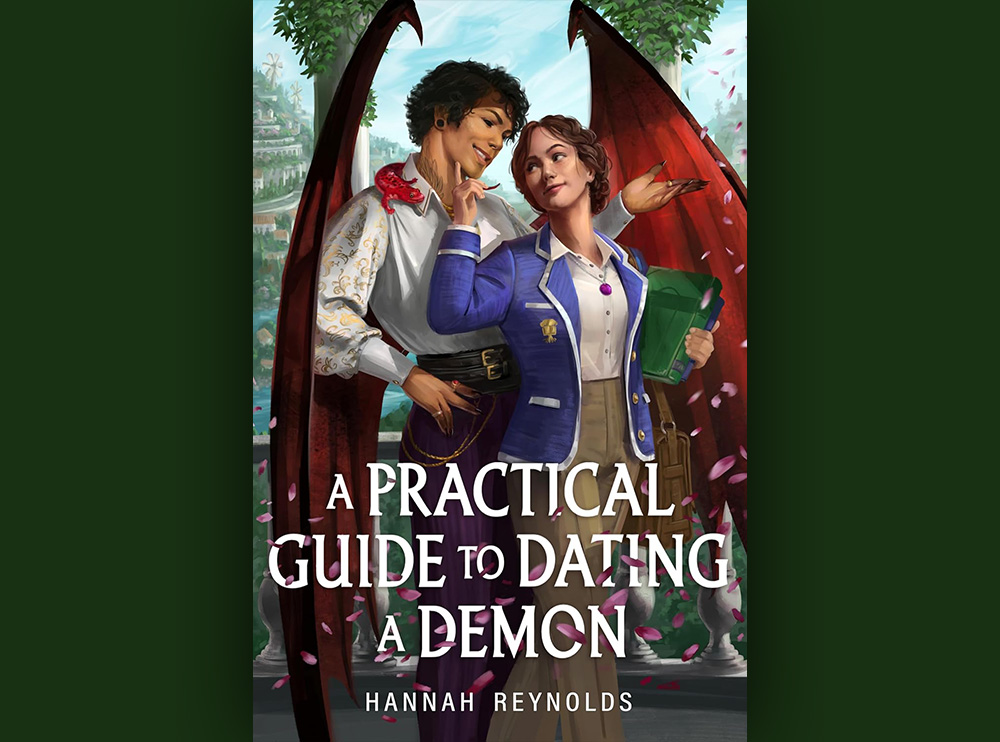
A student finds herself accidentally betrothed to a demon—and investigating his connection to the magical irregularities plaguing her city—in this cozy, whimsical YA romantasy.
Intrigued? Read on to discover the synopsis and an excerpt from A Practical Guide to Dating a Demon by Hannah Reynolds, which releases on February 3rd 2026.
As a scholarship student at the magical Lyceum, Naomi would rather focus on deciphering ancient scrolls than dating. Especially since the only boys asking her out are less interested in a night in Naomi’s company than an introduction to her influential aunt.
So Naomi devises an excuse to turn down her persistent suitors: She claims to be betrothed to a demon.
Her story works perfectly. Until she arrives home one night and finds the demon Daziel lounging in her rooms, insisting he’s her betrothed. Naomi knows he’s lying—after all, the betrothal was never real—but the gorgeous and infuriating demon is surprisingly resistant to her banishing spells. And with his penchant for baking and home décor, it’s not so bad having him around.
Besides, she has other worries—like the ancient scroll she’s trying to translate, and the way the city’s magic has become suddenly unstable. But the more Naomi learns about the scroll, and the more she gets to know Daziel, the more it seems like she might be at the center of something bigger than she could have imagined.
ONE
In the city of Talum, the winds were strong, the magic thick, and everyone knew each other’s business.
My floormate, Leah, nudged me as we crossed campus. It was late in the day—the setting sun painted the Lyceum’s marble buildings a tawny gold, and warblers sung from leafy branches as students laughed and shouted. “Your latest suitor,” Leah said with a wicked grin.
I groaned. Sure enough, a boy in a gray blazer lingered before the open brass gate. Beyond, a land bridge led from the Lyceum’s peninsula to the rest of the island. Everyone crossed here to leave campus, so it was a great place to catch someone. “Let’s hide.”
“Too late.” Leah’s brown eyes were bright, her expression impish. “What number are we up to now?”
“I’m not telling.” We slowed, other students swirling around us. The majority of us wore school-issued blazers made of twill-worsted wool to protect against the winds. They varied in color based on which of the five Lyceum schools we attended, but the gold emblem emblazoned on the breast remained the same—an open book against a stylized tree. Leah and I wore blue, for the School of Humanities, paired with sensible blouses and trousers tucked into sturdy boots.
Leah smirked. “Eight, is it?”
“Seven,” I corrected quickly, as though one fewer were any better. Leah cackled while the boy caught sight of us.
Ephraim was reed-thin with freckles stark against his pale face. We had the same Old Cinnaian language class, and we’d worked together on a project last week. He seemed smart and nice enough, save an irritating habit of second-guessing my work.
“Naomi.” He wiped damp hands on his pants and swallowed hard enough to bob the amulet around his neck. “Hi.”
My father’s advice about confronting mice back home flashed through my mind: They’re more scared of you than you are of them. I suppressed a sigh. “Hey, Ephraim.”
“Well, I’m off.” Leah sounded delighted to leave me in this awkward situation, which would make a good story for her tomorrow. “You two have fun.”
I shot her a pleading look. If she stayed, maybe I’d avoid Ephraim’s inevitable question. “Aren’t we walking home together?”
She shook her head, the crystal studs in her ears glinting in the early-autumn light. “I have a date.”
We’d both been in Talum only a month, but Leah had already gone on more dates than I had in my entire life. Admittedly, I’d been on none. I was torn between admiration and exhaustion at her social life. “Right. See you later.”
“I’ll walk you home.” Ephraim spoke unsmilingly, as though a graver utterance had never been made. He was a serious boy, as all these gray-blazered School of Government boys seemed to be. Their school’s main requirement seemed to be a dour expression and the inability to take a joke—or a hint.
I tried not to sound pained. “Sure.”
We crossed the land bridge over the Lersach River into Issachar Quarter—the Scholars’ Quarter—where students and academics lived in shoulder‑to‑shoulder buildings above bookshops and cheap pubs. I decided to nudge Ephraim and get this over fast. “What’s up?”
“Oh. Uh.” He gave me an appraising look as we turned up Avenue de Bedzin, which cut through Issachar Quarter like an artery. Wind tugged at our clothes. City fashion favored trousers instead of long skirts like back home; without weights in the hem, skirts could easily gust up. People usually wore their hair either short or braided, and I’d bound my own long brown curls in the student style of four braids knotted at the nape.
But despite my best efforts at looking presentable, my ragged shirt had come untucked from my secondhand trousers, and the sole of one boot was half-detached. Even the frayed red string around my wrist looked ready to disintegrate. Like the amulet around my neck, I wore it to protect against demons. Superstition said if it fell off, you were about to meet your spouse.
I hoped Ephraim noticed the bracelet was still securely tied.
He cleared his throat, obviously steeling himself against my dismal appearance. “Are you going with anyone to the graduation festival?”
And there it was.
I wish I could say seven boys had asked me to the Lyceum’s festival because of my dazzling beauty and wit, or for my skill at languages, which had landed me my scholarship.
This was not the case.
“No, Ephraim,” I said tiredly. “I’m not going with anyone to the festival.”
“Really.” Ephraim braced his shoulders. I could almost taste his nervous anticipation. “You’re not?”
“Nope.” The avenue opened onto one of the quarter’s main squares, where loud music and rowdy debates drifted from pubs. We cut across the plaza, passing elderly folk playing games of strategy. Globes of neshem-powered light blazed in wrought iron lamps to hold back the darkness. Children chased each other around the bronze statues at the plaza’s center, which depicted the three primordial beasts of ancient mythology: the Behemoth, a desert-dwelling monster; the Leviathan, a sea serpent with piercing eyes and brilliant scales; and the Ziz, a griffin-like bird with a wingspan capable of blocking out the sun.
Ephraim took my hand and pulled me to a stop, his skin clammy with sweat. “Would you like to go with me?”
Oy. I tugged my hand from his grasp and kept walking. “Thanks, but no.”
Ephraim followed, sounding surprised. “Are you waiting for someone else to ask?”
All the boys did this—they wouldn’t take a simple no for an answer. They’d all pressed on against my every excuse. Well, almost every excuse.
If it hadn’t been so infuriating, it might have been flattering—except I knew it wasn’t me they were interested in. It was an introduction to my aunt—a member of the Great Council—that made them so desperate to bring me to the festival where she would be in attendance.
To deter my unwanted suitors, I’d settled on a stronger deterrent, one girls in my village had used for ages. I’d first dropped it glibly, a sarcastic whim born more out of frustration than expectation it would work. “I can’t go with anyone.”
“Why not?” Ephraim thrust his chin forward.
“Because I’m already spoken for.” Around us, a fresh easterly wind tugged at the fronds of palm trees in the plaza. A few birds took flight, though most remained. A small blue-and-orange kingfisher swiveled its head and looked, I swear, right at me. “I’m betrothed.”
Ephraim looked skeptical. City folk thought eighteen was young for an engagement, except in unusual circumstances. “To whom?”
I smiled sharply. Because my circumstance was most unusual and impossible to argue against. “To a demon.”
I wasn’t, obviously, betrothed to a demon.
The lie was so silly I had a difficult time keeping a straight face each time I told it. I’d been shocked it’d worked, actually. But people don’t mess with demons, especially not city folk. At home, everyone has crossed paths with demons a time or two at the border market, where they traded strange feathers or stones, but Talumizans had almost no exposure.
It’s not like I was an expert. I knew the basics: Demons lived in the vast plains in the center of Ena-Cinnai, between the western port cities, like Naborre, and the Lersach River. Some said demons had their own cities in the desert, carved into towering limestone cliffs. Others said they inhabited the cities of ancient human civilizations who’d dared to press into the wilderness only to pay the price with death and ruin. Since the long-standing treaty between humans and demons prevented us from entering their lands, we knew very little.
Just enough to make us blanch, as Ephraim did now. “A demon?”
“Yes.” I turned onto one of the streets branching off the plaza like spokes on a wheel. It sloped down toward the edge of the island, toward the dorms. “He’s terribly jealous.”
“Huh.” Ephraim sounded stumped. “What’s his name?”
“Um.” No one had ever asked for a name before. I cast about. “It’s Daziel.” Many demons’ names ended in -iel, didn’t they? “The demon Daziel is my betrothed,” I said again, trying to sound convincing.
“How did you meet?”
Wow, this boy really wanted details. Usually, people backed off immediately. I’d never spun an in‑depth story before, and I floundered. “I’m from one of the northwestern plains villages, close to the borderlands. I was . . . out picking flowers . . . and I wandered too close to the wilderness, and there he was. Daziel, my demon betrothed. And we fell madly in love.”
Inwardly, I winced. I was too busy minding my three younger sisters to go out gathering flowers. Plus, I wasn’t stupid enough to linger by the border.
Ephraim, apparently, didn’t have a high enough opinion of my intelligence to find this suspicious. “I didn’t know demons and humans could marry.”
Could humans and demons marry? Another thing to which I had no answer. The grandmothers in my village—some with a knowing gleam in their eyes—had warned us about how seductive demons could be. It wasn’t impossible a village girl had run off with a demon before. “I’m sure it’ll be fine.”
“What do you even talk about? With a demon?” When I glanced at Ephraim with likely wild eyes, he held up his hands. “Sorry. Didn’t mean to pry. Mazel tov. When’s the wedding?”
I let out a sigh of relief. “It’s a long engagement. Not until after I graduate.”
He nodded thoughtfully, then refocused. “So, do you have any single sisters or cousins?”
***
The wind picked up after I ditched Ephraim, chimes pealing out as the eastern breeze strengthened. I’d sailed down the Lersach into Talum a month ago, when gentle, humid winds carried memories of sun-soaked summer days. Now, as autumn edged in, the winds had abandoned their warmth, though I’d been told the bitterly cold Trio Winds wouldn’t arrive until winter.
The winds influenced everything here, from fashion to architecture. Testylier House, my residence hall, was a five-story sandstone building with thick walls to block out the wind. The roof barely sloped so the winds would have difficulty peeling tiles away.
The door to Testylier House bore the same emblem as my jacket—an open book against a tree. Inside the foyer, a few worn but presentable chairs stood by the mailboxes. A desk took up most of the space, behind which the dorm’s guardienne, Madame Hadar, often sat. Her sharp eyes caught everything.
I opened my mailbox, anticipation surging at the sight of a beat‑up packet with Mom’s handwriting. A creamy white envelope, which I ignored, lay alongside it. I ripped open the packet as I started up the stairs to the fifth floor, where I lived with Leah and two other scholarship students.
Two giggling girls came flying around the bend, their arms linked. They wore long coats with flaring skirts, much more fashionable than our school blazers, and kitten heel lace‑up boots I coveted on a soul-deep level. The three of us pulled to an awkward stop.
“Oh, hello.” Élodie bat Amit straightened the sleeves of her royal blue coat. Birra Shachar said nothing, fixing her gaze over my shoulder. They’d piled their hair high and embellished it with jewels and flowers. You’d need wire frames, hair pads, a jar of mousse, and a thousand pins—all of them enchanted—to secure it against the winds. In Talum, the styles of the rich seemed to exist to show they had the resources to be impractical.
My aunt had suggested I befriend girls like these, Talumizans from powerful families, but we had nothing in common, save family members with the same job.
Aunt Tirtzah served as one of the six representatives of the Judahite tribe on the Great Sanhedrin, the highest court in the land. I only grasped how important people considered my aunt when strangers went out of their way to be nice—or invite me to the graduation festival. She had a palatial house on Society Hill, the most exclusive neighborhood in the city. But the house was hers only as long as she served on the Sanhedrin. She wasn’t really wealthy, not like these two. And these girls knew it.
“Hi.” I forced a smile. “How are you two?”
“Great,” Élodie said. “Heading out for the evening.”
“We got invited to a party at the Rocks,” Birra burst out, as though she couldn’t help herself. I tried to keep my stab of jealousy off my face. The Rocks lay on the southern side of the island, and I’d never heard of first-years attending the upperclassman parties there.
“What are you up to?” Élodie asked, scrupulously polite. She was in the School of Government, and I’d have been shocked if she didn’t run for the Sanhedrin herself one day.
“Studying.” If I didn’t maintain high grades, I’d lose my scholarship and be sent home. “I have an Intro to T3 test tomorrow.”
They both winced. Intro to Theurgy and Thaumaturgy Theory was required for first-years and unanimously hated. “Good luck,” Élodie said, and the two of them were gone.
Continuing up the stairs, I skimmed my family’s letters hungrily. Dad reported on his current woodworking project and asked about my classes; Grandma gossiped about neighbors and my sisters; Mom said everyone loved and missed me, reminded me to eat well and get enough sleep, and asked if I’d made friends.
I swallowed hard. I wouldn’t tell my family and worry them, but it hadn’t been easy to adjust to life as a Lyceum student. I loved Talum, and I’d been lucky to bond with the girls on my floor, but I felt out of my depth at school. While I might have been the most dedicated student in my village, I was nothing special at the Lyceum. Dad had tried to warn me, but I’d been too excited to listen.
Dad had grown up in Talum. He’d left at seventeen to become a sailor, to his parents’ dismay, then met my mother on leave in Port Naborre and never gone back. He knew what the city was like—and he had been right. The brightest student in a high plains village was considered deeply mediocre at the fabled Lyceum. I had an ear for languages—my mother’s mother had spoken to me in her singsong southern dialect since I was a child, and I’d picked up foreign tongues from sailors in Port Naborre—but I didn’t have eighteen years of formal study.
Sighing ruefully, I skimmed my sisters’ letters, though the last envelope nagged at me. Better to get it over with fast. I ripped it open.
Dear Naomi,
I am hosting a festive gathering next month, on the 22nd. I will send a carriage for you at six. Please confirm you have an appropriate outfit. If not, I will send something.
Aunt Tirtzah
My stomach clenched. I’d met my aunt only once, and I wasn’t eager to repeat the experience. Also, what did “an appropriate outfit” entail?
A skittering up the stairs distracted me. I had no time for unwanted suitors, a looming exam, and a mouse. Cautiously, I took another step—and saw something glowing red with a long tail whip around the bend.
I blinked. Surely I hadn’t seen a salamander. Salamanders—according to legend—were born from stone calcite burned for seven years in fires built of myrtle wood. They died as soon as they were removed, their blood used to make one impervious to flame. It’d been a long day; I was imagining things.
At the top of the stairs, a worn carpet lined the wooden floor, threadbare from thousands of footsteps over the years. Lights glowed in old-fashioned brass sconces, etched with the standard spell for lighting; the four of us had a schedule for painting them every morning with neshem oil so they didn’t run out of power. At the end of the hall was my favorite detail: stained glass windows depicting olive trees.
Four doors faced each other, leading into matching sets of rooms. As I neared mine, I slowed. Something was off. Light glowed from the crack beneath the door, and I never left my lamps on. A faint scent, like the wind blowing off the desert, made the back of my neck prickle.
Had Leah been home, I’d have knocked on her door, but she was gone, and so were the others—Jelan and Gilli had a late class today. If I was smarter, more cautious, or less tired, I would have called in reinforcements—the gendarme, or a rabbi, or someone from one of the other floors at least. But wasn’t it usually your imagination when you suspected a villain was hiding in your shower? I braced myself and opened the door.
Someone was sitting on the sofa.
The air around him wobbled, distorted like the shimmer above a fire. His bronze skin glowed from within. Perched on his shoulder sat a small, luminous red salamander.
When I entered, he looked up from the book in his lap, which I recognized as a present from my mother: A Household Guide to Demons. His eyes were a pure, glossy black, no whites, no irises. His mouth turned up at the corners. “Hello, darling,” he said, and his voice sounded like smoke, silvery and strange. “Welcome home.”
TWO
Students at the Lyceum of Talum belonged to one of five schools: the School of Science, the School of Humanities, the School of Engineering, the School of Government, or the School of Religious Studies. Each taught students to write new spells and adjust old ones in their specialization. My yearlong scholarship came from the School of Humanities.
Which meant, notably, I had no clue how to defend myself except through biting social commentary and deflective humor. So instead of tossing out a banishment or containment spell, I defaulted to my baser instincts.
I screamed.
The demon winced and covered his ears. The salamander darted beneath the neckline of his crisp white shirt.
“Who are you?” I looked around frantically. It turned out I didn’t own weapons. The living room consisted of soft, pretty things—the thick carpet, several throw pillows and blankets, curtains. I had a lamp with an outrageous fringed shade, but it was on the other side of the room—next to the demon. Besides, it was large and unwieldy and I might be too weak to swing it. “What do you want?”
“I’m Daziel.”
“What?” How did he get in here? I glanced at the mezuzah on my doorframe, which should have kept demons out. It appeared intact. Pressing my palm to my collarbone, I felt the firm disk of my amulet, still there. What had I done wrong? My gaze caught on my mirror, which I’d lugged from a thrift market to the tram and up the stairs. Mom had said I should redo a mirror’s protective castings every six months or keep it covered, and I hadn’t. “Did you come through the mirror? What about the wards?”
“Don’t worry about those,” the demon said, as though I’d been concerned he might get accidentally locked out. “As your betrothed, I have the right to your space.”
My betrothed.
Oh.
This was bad. My mother had told me that naming a demon risked drawing one’s attention. I’d thought I was being clever, but now I realized I’d been very, very stupid.
Taking a deep breath, I studied the demon before me. He looked my age and mostly human, save the fathomless black eyes. Faint lines formed a pattern of shimmery feathers along his neck, disappearing under his shirt collar. His nails were black and came to a point like talons. Gleaming black stones filled the gauges in his ears, and a giant ring with red stones encircled his right pointer finger. No necklace, unlike most Ena-Cinnaians, who wore amulets both for protection and to show our tribal allegiance—like the Naphtali amethyst around my own neck.
A wild demon, I suspected—as intelligent and savvy as a human but chaotic, prone to mischief and capricious behavior.
I tried to remember what A Household Guide to Demons said about ridding one’s home of a wild demon, but I’d barely flipped through the book. I fell back on childhood spells, more superstition than magic, singing a protective song my grandmother had taught me for when I walked alone outside the village.
The demon blinked and didn’t move.
Okay. Fine. Sidling along the wall, I snatched from my bookcase a miniature shofar Dad had given me when I was twelve. When I blew it, the ram’s horn emitted a piercing sound, but the demon didn’t flee.
Instead, he frowned. “You’re very loud.”
The audacity. “You broke into my rooms.” I blew the shofar again, louder. When I tried a third time, no sound came out. I stared at the shofar, betrayed and bewildered, before transferring my gaze to the demon. “What did you do?”
“Do you want the technical explanation about how I stopped the molecules from vibrating?” I couldn’t tell if he was in earnest or teasing me—I thought it might be the latter, but he was too inhuman to read. “I find usually humans don’t.”
“What?” I had no idea what he was talking about. I had no idea what was happening. I had no idea I was so bad in a crisis. “What are you doing here? You can’t just make things not work. That’s—unsettling. And rude.”
“Sorry.” He didn’t sound apologetic; he sounded put out. The little salamander popped out of his shirt and curled up in a ball on his shoulder, resting its narrow head on its hindquarters. Its eyes were as black and glossy as the demon’s. “But I think it’s rude to cast spells to banish shedim with malicious intent when I have none.”
Demons weren’t always malicious, but they might accidentally ruin your life for the entertainment value. Especially wild demons, known for seeking larks and pleasure at any cost.
On the other hand, Ena-Cinnaian demons upheld the same laws of hospitality and good behavior as humans did. They considered themselves scrupulously polite. This demon had called me rude, so maybe I should backpedal. I softened my voice. “Do you mind sharing why you’re here? Is there something I can help you with?”
“I’m visiting.”
Right. Because that was normal, demons visiting the Scholars’ Quarter. “If you need a place to stay, you could try one of the local inns. The Drowned Pelican at the end of the street is supposed to be very nice.”
He turned his gaze to me. Unnervingly, when his onyx eyes moved, iridescent color crossed them like light striking black mother‑of‑pearl. “Why would I stay at an inn instead of here, with my betrothed?”
Unease curdled my stomach. I started shaking my head and didn’t stop. “That’s just a story I tell to get guys off my back.”
“You said ‘I’m already betrothed’ and ‘to the demon Daziel.’ ” He smiled, incisors sharp like a carnivore’s. “We are madly in love.”
A horrible thought burbled up. If this demon’s name really was Daziel, I might have accidentally summoned him. Which could be very bad.
Millennia ago, humans and demons warred. Demons consumed human vitality, and humans bound demons for their power. Demons were pure magic, while humans could only manipulate magic. Spellcasters used bound demons to power letterform magic instead of using neshem crystals as we did today. The demon wars led to the empty cities in the wilderness—and a treaty renewed every twenty years.
Summoning a demon probably wasn’t illegal by itself, though what did I know—it could be against the treaty. It was definitely illegal to bind demons. “You’re not bound to me or anything, are you?”
The demon tilted his head; one of his dark curls fell across his forehead. “Isn’t a betrothal a type of bind?”
“I release you,” I said once hurriedly, then twice more to make sure. “I release you. I release you.” I opened the door to the hallway. “You’re free! I’m so sorry.”
He stared at me. The tiny salamander stared at me. “I was joking. I meant—because it’s a vow? Vows bind you together?”
“Demons joke?” That was almost as startling as anything else. I glanced out the door. What if I lured him outside, like a pesky fly, then ran back inside and closed the door?
He frowned. “Where are you going?”
“Just—a nighttime stroll.” I took a few steps. “Maybe you want to come with me?”
For a moment I didn’t think he’d fall for it, but then he flowed to his feet and followed me over the room’s threshold and into the hall. I backed up to the stairwell. He took another step too, and another. Wow. Okay, this was working. I smiled, tentative relief growing, and he began to smile back.
Then I lurched forward and past him in a mad dash toward my rooms. I slammed the door so hard the clap reverberated up my arms and in my ears.

But I’d done it, the demon’s surprised expression etched into my mind.
Letting out short, fast breaths of relief, I turned the lock. It’d worked. I’d vanquished a demon.
I turned around and saw the demon sitting on the couch.
My mouth dropped open. “You’re kidding me.”
He looked irritated. “That was also rude.”
“It wasn’t—” I swallowed my words. I wasn’t getting into a fight about courtesy. “Look. I’m sure I’m very—flattered—by your attention, but there’s been a misunderstanding. You’re not my betrothed. I don’t want a betrothed! Like, thank you for coming out here, I appreciate you taking the time, but if you could just . . . go, that’d be great.”
His tone and expression were perfectly pleasant, as though this was a normal situation. “We are betrothed.”
Surely this demon didn’t actually think we were engaged?
Okay. If there was a demon in my rooms who wouldn’t leave, I needed to leave. I could go to Madame Hadar, the guardienne. If she didn’t know banishment spells, she should at least know who to contact. I wouldn’t be thrilled to approach her—her nephew had asked me out, and admitting I’d lied about a demon betrothed wouldn’t look great—but needs must.
Or maybe Gilli and Jelan were home by now. I wasn’t used to asking others for help—I was used to being the oldest sister, the one in charge—but this problem was too big for me alone.
I headed back to the door.
“I’m not following you this time.” He sounded worried and sulky, and his arms crossed tightly over his chest.
“Fine.” I felt a little better, a little more in control. It was hard to fear a pouting boy, no matter his species. “But I know better than to stay in my rooms with a demon.” I grabbed my keys and headed out.
Sure enough, the demon Daziel followed, scowling as I knocked on Gilli’s door. “Why are you—”
It swung open. A petite, pretty girl stood there in white loungewear. She’d threaded ribbons through her pigtails and tied them in a bow at the top of her head.
“Naomi, hi,” Gilli said with a sweet smile. When we’d first met during move‑in, I thought her earnestness might grate on me, but she turned out to be inescapably endearing. “What’s up? Want to come in?”
“Thanks.” I felt an awkward shyness. Though I liked Gilli and Jelan, we’d only known each other a month, and we hadn’t spent as much time together as me and Leah; mostly, we were either in separate duos or a group. “I’m having a bit of a night.”
Inside, Jelan sat in an armchair. She wore half her hair shaved and the rest kept in a tight coiled braid. I’d only ever seen her in black, save her red School of Engineering blazer. While Gilli’s family seemed to have some money—her mother was a navigator, a coveted position aboard ships—I suspected Jelan needed every last bit of her scholarship.
“What’s going—” Gilli began, then froze, gaping.
“Hello,” Daziel said.
Gilli shrieked. Jelan grabbed a protective bowl from the bookcase. Speaking in a low, steady tone, she began turning it up and over, as though capturing something inside.
“This is Daziel,” I said.
“I’m Naomi’s betrothed,” Daziel said brightly.
“What?” Gilli said, which was a fair reaction, because it was also mine. Then her face transformed, like a theatergoer’s when the farm boy was revealed to be the prince. “Oh my god. Your demon betrothed.”
Jelan hesitated in her casting.
“He’s not,” I protested. “You guys know it’s a fake excuse.”
“Right,” Gilli said uncertainly, looking back and forth between us. “But . . . he is a demon. Who says he’s your betrothed. And you say you have a demon betrothed.”
“I’m lying! We’re both lying! We’re not betrothed!”
“We are betrothed,” Daziel said cheerfully.
The girls exchanged bewildered glances. Neither Gilli nor Jelan were likely to have practical knowledge of demons. Gilli’s family lived right outside Talum, while Jelan came from the capital city of Maurino, Ena-Cinnai’s southern neighbor. Cities were heavily warded against mazzikin—small spirits—and usually avoided by wild demons, like Daziel, who preferred space and nature. High demons occasionally visited cities for society entertainments or treaty negotiations, but ordinary folk had nothing to do with them. Besides, high demons knew how to behave in human society—they might be more powerful than their kindred, but they were also more predictable, and so not as alarming.
“Can I crash with you tonight?” I asked Gilli. “I can’t figure out how to banish him.”
“Have you tried, um, blowing a shofar and spitting?” Gilli asked.
“The shofar, yeah, but not spitting.”
Daziel looked astonished. “Are you going to spit on me?”
“No?” Gilli responded timidly. Which, also fair. It was one thing to read about spitting on a demon and quite another to spit on a very real one.
“I won’t spit if you leave,” I said. “Which you should, because even if you’re allowed in my rooms, it can’t be proper for you to be in Gilli’s uninvited.”
He frowned, but he couldn’t dispute that, not if he cared about hospitality. “You won’t stay here forever. I can wait at home.”
I almost choked. At home? Meaning my rooms? Presumptuous. “I might stay here tonight, though.”
He scowled, looking as petty as my sister Adina. This felt weirdly reassuring—the more he reminded me of a teenage boy and the less of a strange, magical creature, the more sure-footed I felt. “Since you’re so insistent on avoiding me, even though I came all the way out here to be with you—we could strike a bargain.”
This didn’t assuage my wariness. “What kind of bargain?”
“I don’t think you’re supposed to strike bargains with demons,” Gilli whispered. Jelan shook her head.
He smiled, all sharp teeth and black eyes. Not so human after all. He held out a round red fruit: a pomegranate, which he definitely hadn’t been holding a moment before. “Accept this gift. Then I’ll leave.”
I loved pomegranates. They were high on my list of favorite fruits. But there were a lot of stories about people eating fruit, and I couldn’t remember any ending positively.
“Am I missing something?” I asked my friends. “Because on the surface, this sounds good.” I narrowed my eyes at Daziel. “Is the pomegranate bespelled? Do I have to eat it?”
“It’d be a waste of a perfectly good pomegranate if you didn’t,” Daziel said with some asperity. “But no. And it’s not bespelled. It’s not magical. It’s a pomegranate.”
I glanced at Jelan, for she was one of the smartest people I’d met. “How good are demons at lying?”
“Very good.”
“A rude and baseless stereotype,” Daziel scoffed. “Will you accept it?”
I hesitated. “You’ll leave if I do?”
He nodded.
I took the fruit.
Daziel smiled. And vanished.
Sheer relief descended. It hadn’t been a trick. I hadn’t made a terrible call, dooming myself and my friends. He’d kept his word and left.
“Wow,” Gilli said faintly. She leaned over, her nose close to the pomegranate as she examined it, the lavender bow in her hair fluttering. “Do we eat it?”
“No,” Jelan said.
“No,” I agreed.
“I was just asking.” Gilli made a face, then turned earnest. “Want to stay here tonight?”
I nodded fervently. “Please.”
A few hours later, right before losing consciousness on Gilli’s couch, I reached up to check on my amulet, as I often did, then down to touch the red string tied around my wrist, the one my grandmother had given me before I left home. The one offering protection from demons. The one old story spinners said would fall off when you were about to meet your husband.
It was gone.