


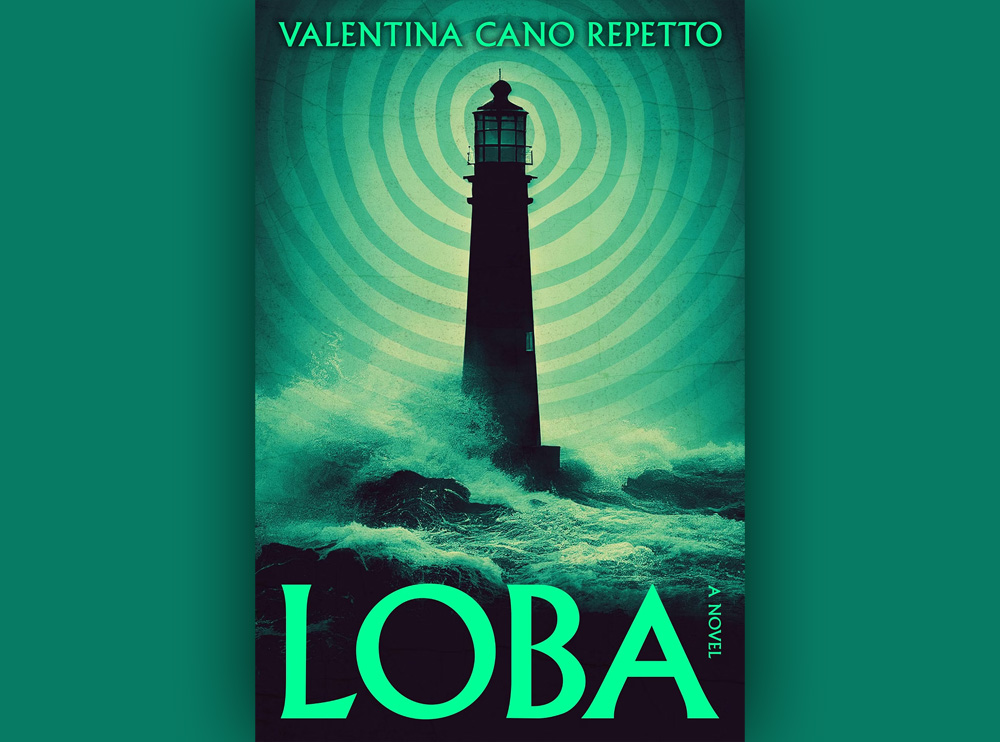
The Hacienda meets The Haunting of Alejandra in this split timeline gothic horror novel set in a remote lighthouse on the edge of Uruguay, following one woman’s escape from an abusive marriage… and into a haunting.
Intrigued? Read on to discover the synopsis and an excerpt from Loba by Valentina Cano Repetto, which is out now.
She’s not the first lighthouse keeper to lose her mind on the shores of Cabo Polonio, but she’s determined to be the first to survive it.
Delmira Torres knows fleeing to Brazil is the only way she’ll be free of her abusive husband. But to get there she’ll need money; it’s why she takes a posting at a lighthouse in Cabo Polonio, Uruguay, a small town where time doesn’t seem to move quite right.
There, she has only a month until her husband and her secrets catch up to her. But the position comes marred by the legend of La Loba, who stalks the lighthouse and the nearby fishing village, and by the spiraling visions that begin to plague Delmira.
A century earlier, Amalia arrives at the same lighthouse. Held captive and desperate to escape her dire situation, her story may hold the answers to Delmira’s torment.
Both of them, desperate for freedom and determined to survive, must find a way to outlive the horrors of Cabo Polonio.
EXCERPT
CHAPTER TWO
Delmira
Cabo Polonio, January 1951
It was just a story, then.
“It’s true,” Jacinto said, the tightness of his smile infiltrating his voice. “Things have happened in the lighthouse. And the man did die strangely.”
Umberto gave his horse a hard pat, making the animal flinch, and nodded to the sea lions. “She knows.”
I lifted my eyes from the horse pawing at the sand to the two men, in time to catch Jacinto’s lifted eyebrows, the attempt at communicating with Umberto without speech.
I flinched. They were hiding something from me. They’d just met me and already thought of me as foolish, like Santiago had from the start.
No, no more. I’d had my fill of men hoarding information that I had just as much of a right to have as they. They could keep their words.
“I have a lot of work to do before nightfall.” I readjusted the bag on my shoulder. “Once again, se̴ñores, thank you for your help.”
I took the final few steps toward the lighthouse door, forcing myself not to stop at the archway even though the sun’s brightness didn’t dent its shadows. At least two more sea lions could have tucked themselves into the nooks by either side of the entrance. The splintering on the door’s wooden surface, like someone had repeatedly kicked at it, wasn’t especially comforting, either.
But nothing roared or lunged and I only had an instant of worry that the lighthouse would be locked before the handle moved under my hand and the door opened.
“Se̴ñora –”
Steps crunched closer but I refused to turn.
“Se̴ñora Torres, stay off the ground floor at night,” Jacinto said, his voice coiled with urgency. “That’s where she appears.”
No, really. That was enough.
I stepped into the lighthouse’s darkness and slammed the door shut behind me.
I exhaled. The heavy pelt of the outside world fell off me.
The silence was so absolute that the sound of the handle clicking into place stuttered along the short corridor to where the cylinder of the lighthouse began.
Walls of cracked white plaster adorned with two kerosene lamps on hooks that could have cut through whale blubber made up a type of office around me. A hobbled and bare wooden table leaned against a corner, whatever chair it’d been paired with having wandered off.
A rather worn basket sat on the table.
With a sigh, I lowered my suitcase, dropped my wicker bag, and stepped closer. Inside, there was a small jar containing olives along with a tin of anchovies. And a note.
“Welcome to Cabo Polonio, muchacha,” it read. “Ask Jacinto to bring you to my place for everything you need…or just to spend a few minutes away from your husband!”
It was signed Mirta.
Rather kind of her, whoever she was, though the last thing I wanted was to build even the thinnest of friendships.
Still, I folded the note with care and tucked it into one of my pockets. I’d not throw any form of kindness away.
The heels on my scuffed leather shoes had worn down to nubs no thicker than my thumb, but each step boomed against the wooden floorboards as I walked toward the lighthouse proper.
It was like a looping nightmare, finding myself back in the same place time and again.
Because it was no different to the other two Santiago had dragged me to before Panela. Brick walls trying to buck off white paint, porthole windows running up the building like buttons, the chains connected to the clockwork mechanism that dangled by the staircase. Everything was identical except for the gaping doorway at the far end revealing a bed’s iron footboard and a section of bare mattress.
The previous keeper had slept down here and climbed up to wind the mechanism every three hours?
“It wasn’t La Loba but a heart attack that got him,” I said. I turned away from the bedroom I’d not be using, to the stairs.
The light streaming down from the lantern room’s windows high above lit on the parts of the spiral staircase’s iron vertebrae. They gleamed liver red, reflecting on the well-worn path of feet that had left the center of each step the scalded black of clam shells.
I could already feel the metal against my back, the cold seeping into me. But I couldn’t rest yet. I had to know that what awaited me at the top of those hundred and thirty-two steps wasn’t beyond my abilities.
I clanged my way up, past the storeroom swollen with kerosene tanks, beyond the control room with the gears and the weight that would awaken the Fresnel lens, and up to the lantern room.
The puzzle of glass that made up the lens towered over me. Thick clear scales and rippling circles, like someone had tossed a stone in water a breath before it froze, all of it encrusted on an oval frame of brass. Its undercarriage and clockwork system, with the hidden brook of mercury that made the lens turn more easily, sat in compartments between the two floors.
Within the glass monstrosity, a trapped oil lamp.
I could see Santiago brushing his knuckles over a crystalline curve of the Panela lens on the day Arturo arrived, hear him praise its design. I remembered the realization that he had never spoken about me as warmly as he did about the lanterns, not even when we were first married.

“You’ll get no fawning from me,” I said and tapped a scale of glass, hard. “But I’ll keep you clean and lit, and you’ll get me out of here. Don’t take it as a request.”
I wiped at my forehead.
The windows that made up the walls of the lantern room seemed to ripple with heat. I glanced at the sun, still encrusted in the center of the sky, and frowned. Noon had come and gone, hadn’t it? It’d already been past it when I stepped off the bus.
A trick of the light, of course. But a peculiar one.
And I would have to be careful with this heat, if it was still this ferocious past noon. I didn’t need to touch the metal railing outside, on the gallery, to know it could be hot enough to leave welts.
Before Arturo had come to the lighthouse, my hands had bubbled with them as I’d stared at the water and considered the leap. The welts had faded and healed, but the blackness in my mind that took me to the gallery was still there.
A shift in sunlight changed the glass’s reflection, pulling at my thoughts and my eyes and revealing a spot of darkness marring the opposite side of the lens. With a frown, I circled the lantern.
For the clap of a heartbeat, I thought it was the previous lighthouse keeper strewn on the metal floor, his cold body left for Santiago, for me, to handle. But it was a pile of rough regulation blankets and a pillow that might once have been white. A kerosene lamp lay on its side by the clumped fabric, along with what looked like every lighthouse logbook I’d ever seen.
The keeper had been sleeping up here.
He had a bed on the ground floor, but he’d spent his nights immersed in light with just a few blankets separating him from wire mesh metal.
Jacinto’s words tried to pry their way through, but I shook my head. This had nothing to do with La Loba and everything to do with a man up in years who couldn’t keep climbing stairs.
With a wince at the noise the lantern room’s metal floor made with each shift of my feet, I picked up the leather-bound ledger and opened it at random. Notations of temperature, weather conditions, winding times, all of it in a tight scrawl Santiago would never have allowed from me. How many hours had he forced me to spend rounding my naturally sharp letters, copying his own so I could manage the logbook and he’d have one less thing to do? He’d have torn the page out if I’d presented him with anything resembling this.
I flipped to the last entry, from two weeks ago.
I frowned.
The writing had deteriorated. It had become illegible, words like a radar’s noise readout, some of the ink splotched and diluted, as if damp.
Something slipped from the back of the ledger to the floor.
A playing card.
It was water-wrinkled and the color of weak tea, the crowned and robed figure holding a sword at the center missing half of its face. There were no numbers or writing on it.
I tucked it back into the logbook.
“All right,” I said, facing the lens once more. “There’s nothing to it but to start. Thirty days and we never have to see each other again.”
The whirlpool of questions on where I’d get the rest of the money and how and how and how tried to topple me, but I side-stepped it. There’d be time enough. There was always enough time for worry.


