


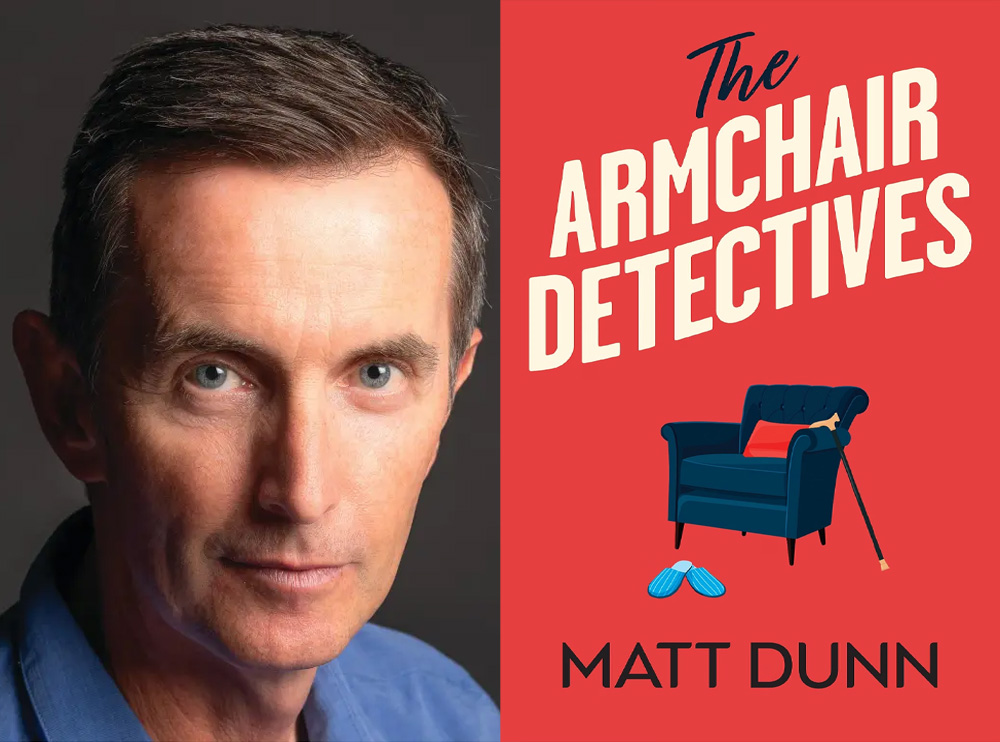
We chat with author Matt Dunn about The Armchair Detectives, which is a hilarious and heartwarming cozy mystery following an octogenarian who covers a dastardly plot inside his nursing home, perfect for fans of Richard Osman and Only Murders in the Building.
Hi Matt! Can you tell our readers a bit about yourself?
I’m an award-losing (nominations: 3, wins: 0) novelist from England, though I spend a lot of time in Spain because it has this thing England doesn’t called ‘good weather’. I’ve been a full-time writer since 2005, with sixteen (and counting) published novels to my name. Previous jobs have included fitness-equipment salesman, headhunter, and even professional lifeguard (think Baywatch but with less of a tan – see my ‘good weather’ comment above), but I much prefer writing for a living (so please keep buying my books). When not writing, you can often find me on the tennis court. Oh, and I collect Avon cologne bottles from the 1960s/70s in the shape of vintage/classic cars (Google them – they’re really cool) and according to my wife have way too many.
When did you first discover your love for writing and stories?
I was thirteen (i.e. a LONG time ago). Every week at school, someone would be asked (though ‘picked on’ was more how we saw it) to write about the most recent sports game we’d played and read it at school assembly – an experience so daunting it sometimes caused teenaged voices to break mid-report. Typically, these tended to be pretty dull (“they scored, then we did, then they scored again…”), demonstrating the literary ‘flair’ you’d expect from spotty pubescent schoolboys, so when it came to my turn I decided to try to liven things up a little by putting a couple of jokes in. To my amazement and delight I got a few laughs, and while in retrospect that might have been because my flies were undone, that reaction was as addictive as crack cocaine (I imagine). There and then I knew that being a comedy writer was what I wanted to do.
Quick lightning round! Tell us:
- The first book I remember reading: Bridie the Bantam (I must have been a toddler, so when I say ‘reading’, I might well mean ‘hearing’). It’s about a hen who finds abandoned eggs and sits on them till (spoiler alert) they hatch. I’m sure the fact that a book about effectively getting all the glory for someone else’s creative process had such an impact on me means something, but I don’t like to think too deeply about what that might be.
- The one that made you want to become an author: Nick Hornby’s High Fidelity – I knew I wanted to write, but I didn’t know what I wanted to write until I read that. Every time I start work on a new novel, I reread it, just to remind me of the level of brilliance I should be aspiring to. Though I’m writing my seventeenth novel now, and I’m still not there.
- The one that you can’t stop thinking about: My current work in progress. As a writer, you’re always ‘on’ (i.e. ‘on’ the lookout for material – situations/snippets of conversations/characters you can incorporate into your books). Sometimes I come up with ideas or jokes or solutions to tricky plot points at the strangest times – the middle of the night, or at the gym, or while out on my bike, or mid-rally – and if I don’t write them down there and then I’ll probably forget them. The ‘notes’ app on my phone is probably the one I use the most. After Amazon (to constantly check my ranking).
Your novel, The Armchair Detectives, is out now! If you could only describe it in five words, what would they be?
Retired spies investigate murders. Ineptly.
What can readers expect?
Octogenarian Martin Maxwell suddenly reveals he used to work for the British government as an undercover operative – a role he’d always kept secret, relying on his cover story of having been a hotel inspector – but because this seems so preposterous, nobody believes him, writing it off as simply the confused thoughts of an old man who’s watched too many 007 movies. Recuperating from a hip replacement operation in Twilight Lodge, a retirement home on the English ‘riviera’, he becomes convinced there’s something suspicious about a couple of recent deaths there. As luck would have it, one of Martin’s fellow residents is his ex-secret service colleague and one-time nemesis Albie (though Albie denies all knowledge of his former life), and as the two of them begin their investigations (reluctantly, in Albie’s case), so begins ‘an absolutely hilarious and heartwarming British cozy mystery, perfect for fans of Richard Osman, Robert Thorogood, Jesse Q. Sutanto and Only Murders in the Building’. According to the reviews.
Where did the inspiration for The Armchair Detectives come from?
I’ve known some family members with age-related memory issues who’ve occasionally believed something they’ve seen on TV is an experience they’ve actually lived through. So, I got to thinking, I could have some fun with a character who may or may not have actually been a spy (though Martin prefers the term ‘operative’), because surely the important thing is if he believes it?
Were there any moments or characters you really enjoyed writing or exploring?
Both Martin and Albie were a joy to spend time with, and the banter between them – with their opposing points of view and levels of enthusiasm to solve what only Martin believes is a series of crimes – almost wrote itself. Martin’s conviction that he knows exactly what to do and how to do it, along with Albie’s reluctance to get involved, allowed me to create what readers have highlighted as some very amusing situations. Especially since Martin’s espionage ‘experience’ and skill set may not be all that it seems. Plus, it was fun trying to get a James Bond-type character to do what he used to do as a younger man when he’s now in his ninth decade!
Did you face any challenges whilst writing? How did you overcome them?
Cozy mysteries are a LOT more complicated to write, plot-wise, than romantic comedies, especially where plausible red herrings and believable plot twists are concerned – you don’t want to give the game away too easily, but you also want readers to have fun (and to do a bit of head-scratching) trying to work out who the murderer is – so I took Stephen King’s advice and read everything I could in this genre to see how the best writers did this. Plus, coming up with ingenious ways to murder people is certainly a challenge – my Google search history would make interesting reading if the police ever had cause to investigate me.

This is your debut novel! What was the road to becoming a published author like for you?
It’s my debut in the cozy crime genre, but I’ve written fourteen romantic comedies previously. I followed the usual route – wrote my first novel (Best Man), sent it off to a variety of agents, then waited for the rejections to come in. I think I might have had thirty-one, though rather than despair and give up, I took the advice they’d occasionally give me in their rejection letters (the best being “read the best-sellers in your genre and see how they achieve their page-turning quality”), then rewrote/kept on submitting, almost until I’d worn out the keyboard on my laptop. Eventually, I secured an agent who believed in the book, and a few months later (and after a LOT more rewriting) got my first publishing deal.
What’s next for you?
I’m deep into writing the third in the Armchair Detective series (and already formulating ideas for books four and five), so more (mis)adventures for Martin and Albie et al. They’re such fun to write/spend time with – something I hope that comes across for the reader.
Lastly, what books are you looking forward to picking up? Any you’ve read so far this year that you’ve enjoyed?
I have the new (not out yet – one of the major benefits of being an author) Nick Hornby novel, Cash Out, on my Kindle, so I’m really looking forward to starting that. And I think John Lanchester’s Look What You Made Me Do has been my favourite of the year so far – wonderfully written, and what a twist!


