


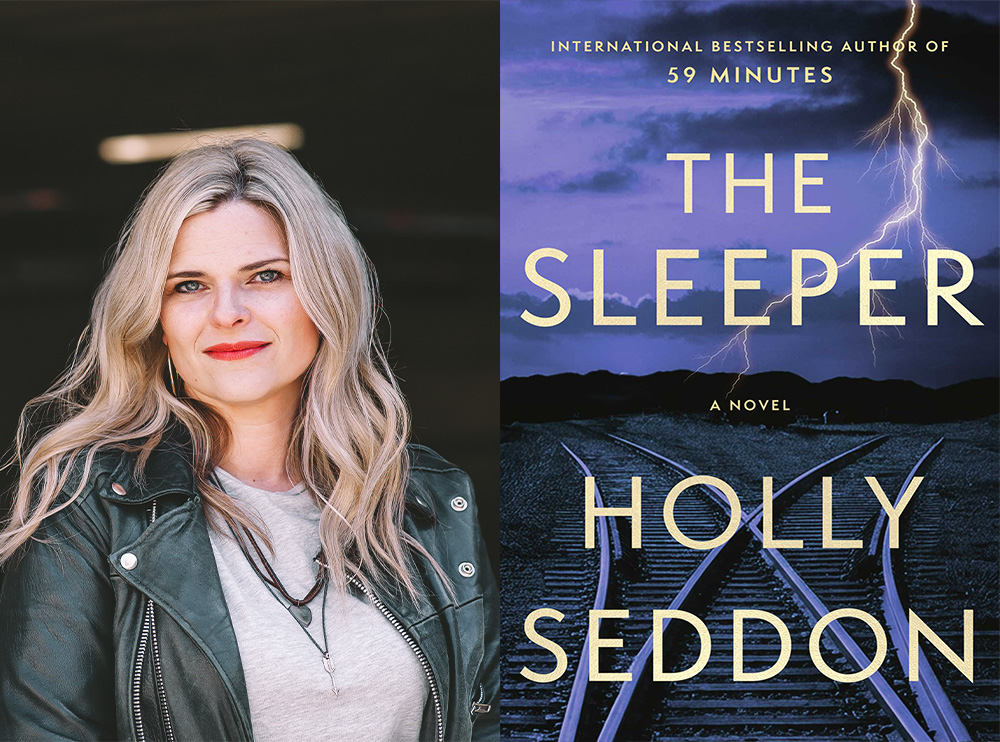
Guest post written by The Sleeper author Holly Seddon
Holly Seddon is the author of several thrillers, including the international bestseller Try Not to Breathe, The Hit List, and 59 Minutes. After growing up in the English countryside obsessed with music and books, Holly worked in London as a journalist and editor. After several years in Amsterdam, she now lives in Kent with her family and writes full time. Find out more at HollySeddon.com and follow her on Instagram and Facebook @HollySeddonAuthor, on TikTok @TheRealHollySeddonAuthor, and on BlueSky @Holly.bsky.social.
About The Sleeper: In this gripping alternate reality thriller by international bestselling author Holly Seddon, one woman must navigate a life that was never meant to be hers in order to uncover unsettling truths about her past and the man she loves—from the author of the “unreal and unforgettable” (Lisa Jewell, New York Times bestselling author) of 59 Minutes. Releases November 17th 2026.
I don’t normally write about superheroes, swashbucklers or spies. My protagonists are ordinary people who find themselves facing extraordinary situations. A teacher who finds her name on a hit list. London commuters and lovers on a romantic break who are caught in the cross-hairs of a nuclear strike…
In my reality slip novel, The Sleeper, protagonist Maya is an ordinary woman who wakes up to find she has slipped from one track of reality to another. She arrives on the other side of a ‘Sliding Doors’ moment where the Berlin Wall never fell, geopolitics veered onto a different course and by 2026, Britain is a Soviet satellite state.
Maya is a librarian, and in our world her biggest battle is against constant job insecurity due to funding cuts. In the new world, she seeks sanctuary in the safest place can imagine – the library. There, she finds the librarians of the new world waging a very different battle – resistance against authoritarianism.
But is that so different? Really?
During World War II, a group of American librarians – alongside archivists and scholars – travelled abroad to gather intelligence from Nazi technical manuals, land surveys and other publication, following just behind the advancing armies and seizing works from bookstores and schools. According to cultural historian Kathy Peiss, and her non-fiction work Information Hunters, these brave people moved through neutral cities combing for enemy texts and shipping the intelligence they found back to the US on microfilm.
When the war stopped, they didn’t. They unearthed looted collections of books hidden in cellars and caves enabling them to document and preserve the works. In a salt mine in central Germany, for example, they found over two million books including some of the contents of the former Prussian State Library.
Caves and mines have a place in The Sleeper too, with resistance groups using an old network of chalk mines in Kent, England to hide themselves and their operations. These are real chalk mines, which I was lucky enough to visit during the writing, and that sheltered thousands of people during air raid bombing in World War II.
In Dunhuang on the edge of the Gobi Desert in China, a network of much older caves was sealed for almost 1,000 years. In 1900, the unofficial guardian of the ‘Thousand Buddha Grottoes’, a Taoist monk, discovered a hidden door leading to a chamber of manuscripts dating back from the 4th to 11th century. It’s impossible to know for sure what led to them being sealed in and guarded…
That’s not the case for ‘The Bad-Ass Librarians of Timbuktu’ and their cache of hidden works. In the 2016 book of the same name, journalist Joshua Hammer tells the story of a brazen heist pulled off by a band of librarians desperate to save 350,000 precious, ancient Arabic texts from Al Qaeda.
There are so many more examples from history of librarians taking great risks to save books and protect the freedom of expression contained within them. But what about the present day?
The American Library Association has tracked censorship across the USA since 1990, compiling data from library professionals and news stories. They used to receive 3-400 reports aka attempts to have a book banned each year. Last year alone, 4,235 unique titles were challenged, the second highest ever documented by ALA.

Of the books challenged, 39% “represent the lived experiences of LGBTQIA+ people and people of color”. This is not happening organically, or in a vacuum. In 2025, 92% of all book challenges were initiated by pressure groups, government officials and decision makers. Less than 3% of challenges originated from individual parents. But this targeted pressure is gaining ground, 66% of the book titles challenged last year were then banned from libraries. Another 920 books were censored via restricted access such as relocation or requiring parental permission. [Data from ALA.org: https://www.ala.org/bbooks/book-ban-data]
And librarians are increasingly under personal attack.
“We’re seeing librarians and library workers coming under attack for providing for the information needs of their communities in a way that serves the information needs of marginalized communities, being attacked for having books on the shelves that reflect the lives and experiences of LGBTQ+ persons, people of color, Black Americans, Indigenous persons,” Deborah Caldwell-Stone, director of the ALA’s Office for Intellectual Freedom told Ed. Magazine. “We’ve even had a number of communities where organizations have demanded that librarians be charged with obscenity or other crimes for having books on the shelves on themes of sex education or sexuality or that address LGBTQ+ themes.”
Seventy years ago, the Freedom to Read Statement was authored by the American Library Association and Association of American Publishers and begins with this statement, as true today as it was then: The freedom to read is essential to our democracy. It is continuously under attack.
The librarians in The Sleeper have to fight back from the underground, in secret, and anyone who agrees with them cannot say so openly. This is not the case for us. We can openly support the librarians of our world. We can join the Unite Against Book Bans Campaign, we can encourage our children to read widely and critically. We can resist organised attempts to control what our children have access to, and how and if they see themselves reflected in the books within their school libraries. And we can use and support our public libraries. The I Love Libraries campaign offers suggestions for getting involved and showing support, including nominating individuals for an I Love My Librarian Award.
My own little efforts? Maya arrives in the alarming new world with a suitcase and a tote bag. The tote bag reads: “I love libraries”.

