


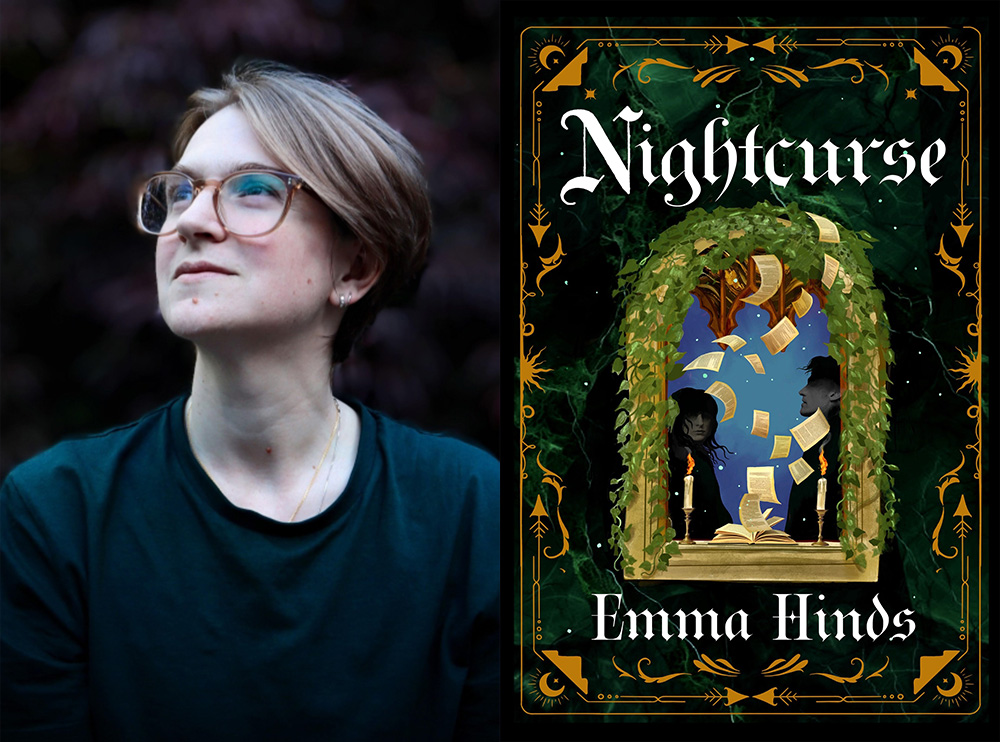
Guest post written by Nightcurse author Emma Hinds
Emma Hinds is a queer writer living and working in Manchester who is passionate about writing queer fantasy that explores the depth of British magical folklore. Emma has a Masters degree in Creative Writing from the University of St Andrews and is the author of adult novels The Knowing and The Quick and the Dead, and the YA novels Witchlore and Nightcurs
About Nightcurse: Hauntingly gorgeous and tender, Emma Hinds’ Nightcurse is both a Gothic mystery and an enemies-to-lovers romance about navigating life and love in the face of death. Out November 10th 2026.
I have a confession to make: I have never read The Secret History by Donna Tartt. This is the book that gothic novelist and dark academia royalty, ST Gibson, described on Substack as ‘the quintessential dark academia book, the load-bearing pillar of the genre.’ Given its exalted position in the genre of dark academia, it would be reasonable for fans to question what business I have writing dark academia novels. As my university professors used to say, ‘Don’t come to the tutorial if you haven’t done the reading.’
Yet something I personally love about dark academia is that it is a broad church. If it were a strangely eerie university course, it could be taught numerous different ways. One of them would, undoubtedly, focus on The Secret History and its thematic fathers, Maurice by E.M. Forster and Brideshead Revisited by Evelyn Waugh. Donna Tartt’s dark academia is focused on the dark, compelling secrets that lie behind the ivy-covered walls of prestigious academic institutions. There are themes of reinvention, of class passing, usually a lonely protagonist is drawn into the alluring schemes of a wealthy upper-class or aristocratic character who brims with charisma and mystery. The darkness discovered within the hallowed halls comes from the dark hearts of the characters, and arguably from the seeping toxicity of oppressive class systems. It is like the fairytale apple. Glossy and delicious, indulgent and spectacular. Ultimately poisonous and ripe for queer stories. When Saltburn exploded into the cultural zeitgeist three years ago, the influence of the collegiate dark academia novel was obvious.
But that is only one version of the dark academia syllabus. My own preferences draw from other sources. As much as I love E.M. Forster and Evelyn Waugh, the fuel to my fire as a dark academia writer comes from the dark academia books that have fed my soul. Each book has a literary family tree, every author has shoulders they are standing on, books that made them the writer they are today. If I could set my own reading list for those loving to study dark academia, or if indeed there was a section in NeverEnd library devoted to it (my own magical library featured in Nightcurse) these are the first books that my librarian protagonist, Emrys Swift, would put on the shelves:
Dr Faustus by Christopher Marlowe. I believe that part of the reason I am always drawn back to dark academia is because of the thrill of danger, of hubris being so dangerous it can literally drag you down to hell. Anyone who has worked in an academic institution, or indeed studied under a certain calibre of professor, has seen a Dr Faustus. An academic so entrenched in their own quest for knowledge that they do not consider the consequences of their actions. It’s also impossible to separate any work of Marlowe from a queer reading. There is a dark tangle of desire and power between Dr Faustus and Mephistopheles, a complexity that has always inspired my own work, because what’s more fun than characters who the reader is never sure are in love or going to kill one another? It’s a chemistry so intense that it has gone on to inspire many other queer re-tellings of the Faust folklore. One of my favourites is the sapphic gothic tale of conjuring, As Many Souls as Stars by Natasha Siegel.
However, I can’t have Dr Faustus on my shelf without its 19th-century ancestor, Frankenstein by Mary Shelley. Often lauded as the mother of science fiction, I think we can also praise Shelley for giving us one of the best dark academia novels of her century. Viktor is a child obsessed with alchemy, the occult forerunner to chemistry, and a student at the university of Ingolstadt when he creates and animates a creature from dead bodies. It is the darkest of academic quests, while also full of pathos for the terrible unnamed and unwanted creature, who himself finds solace and knowledge in literature. It also can’t help but engage with queerness, as Viktor makes himself a father in an entirely non-conformist way. We only need to look at the plethora of queer re-tellings of this tale to guide us as to its importance in Queer literature. Monstrillo by Gerardo Sámano Córdova is a perfect example that also strengthens the connection between dark academia, the gothic and horror novels. For me, it strikes at the heart of the queer gothic novel, the wrestle with being considered an outsider, with fighting to find a place in society. It’s a theme that ends up in all of my work.
The dark academic notion of the spell, experiment, or test subject becoming sentient and complicated is also echoed by another of my favourite dark academia novels of our own century, Piranesi by Susanna Clarke. Where Shelley gives us the point of view of both creator and created, Clarke leaves us with only the created’s limited vision, fighting to understand this strange world he has been made from. Piranesi, like the creature, finds revelation through the written word, understanding who he is and how he came to be through journals. There’s a tale of dark desire there, of a twisted queer narrative of power and abuse in academia, and queer people have always felt connected to the narrative of the outcast. Piranesi battles to understand what has been done to him by society, something so many of us can relate to. There’s a little of Piranesi in my own dear Emrys in Nightcurse, an innocent young man who does not think to go beyond the boundaries of the beautiful house (or library) he has existed in for years. Until he does.
Clarke is also clearly inspired by the great gothic and dark academia trope of books within books, something Shelley utilises as well. I love how Shelley’s use of the Victorian trend for making a novel seem ‘real’ by making it an epistolary account shared by a stranger (the greatest use of the fireside spooky anecdote) actually makes the book itself an arcane object. If the story is true, if the tale Robert Walton recounts is real, then the book is a recipe for how to create monsters! Which leads me to one of my favourite tropes in gothic literature and dark academia. The dangerous book.
I’ve always loved magic books. In my novel Witchlore, Lando and Bastian contend with a grimoire that can only be read with blood. In Nightcurse, Emrys and Aubrey chase down stolen tomes of craven necromancy. In my own life, I even write my novels in a notebook that looks like it contains a formula to raise the dead.

For me, any dark academia shelf must include books about magic books. So keeping my doomed academics and their restless creations company would have to be The All Souls Trilogy by Deborah Harkness and The Historian by Elizabeth Kostova. Both novels not only feature a missing magical manuscript (something that always gives me delight) but the manuscript is Ashmole 782. Elias Ashmole was a real antiquarian and alchemist, who donated his collection to Oxford University with many missing pieces. It is so exciting to me when novelists use real magical history to create their own lore, it’s something that has inspired my own approach to fantasy, using medieval revenant folklore to inspire the revenants in Nightcurse. Similarly, The Historian blends Kostova’s own fantasy of vampires with the real history of Vlad the Impaler as her academics are often literally haunted by a woodcut of a dragon found printed inside relevant books and manuscripts. The queer and homoerotic overtones of anything to do with Dracula practically scream from the page, as people fall helplessly and hopelessly under his thrall. (I have always maintained the position that Count Dracula is a pansexual king).
Yet the thrall in The Historian goes beyond the magic of vampires. It is the magic of books themselves, of knowledge and how we seek it. Something that will draw me to writing dark academia over and over is because, in dark academia, reading changes the characters. In these magical books, transformation happens internally through the acquisition of knowledge (the Creature learns, Piranesi remembers) but it also happens physically, too. In All Souls, Diana physically gains more power from encountering Ashmole, in my own novel Witchlore, Lando’s magic begins to change in response to reading The Lore of Bodies. Characters become something else when they read, and isn’t that the most beautiful metaphor for us all?

If ‘Dark Academia 101’ was on a syllabus at Demdike library and Emrys Swift was responsible for building a collection of books to support it, likely my dear seventeen-year-old dead librarian would pull books from down the ages to go along with the few of the favourites that I have suggested here. I think, since he is still only seventeen, he would also make sure that Northern Lights by Philip Pullman had a spot. A book about the trials of mysterious and deadly academic researchers, Lord Asriel and Mrs Coulter, but also about a child on a quest to find someone beloved to her. She’s equipped with a magical tool that only she can ‘read,’ and, in the course of the series, she finds someone she loves from a different world to her. I think Emrys would definitely relate to that and certainly understand how it feels to live in an academic institution and not be taken seriously!
The library of dark academia is broad, and every day new tomes are added. There is marvellous diversity inside it, and whilst all these books and authors might never fit neatly under one common descriptor, I do think that a single communal factor we all share is this: dark academia embraces the possibility of transformation. I believe it’s why it is so compelling to us queer readers and writers, because queer academia takes all of us on a journey and embraces all the possibilities of social or magical evolution. Not only inside the pages, following in the footsteps of beloved characters towards revelation or ruin, but also once the pages have been read. When all the magic has been learned, and all the secrets uncovered, and the darkness has been faced. Maybe, when the book is closed, we will be different too. Then, we might have been changed too. Maybe we will also never be the same again.

