


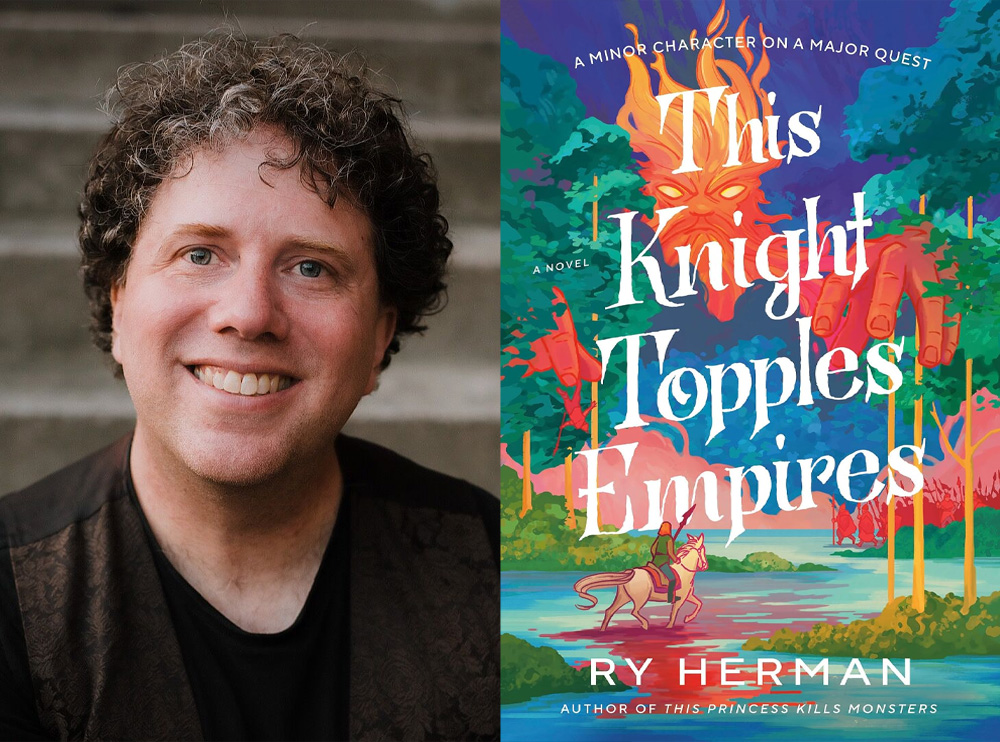
We chat with author Ry Herman about This Knight Topples Empires, which is a raucous, tongue-in-cheek spin on the Eastern European fairy tale “The Girl Who Pretended to Be a Boy,” where a knight attempts to thwart an invasion, save the most beautiful woman in the world, and finally get away from their sisters.
Hi, Ry! Can you tell our readers a bit about yourself?
I was born in New Jersey, but I live in Edinburgh, Scotland now. Edinburgh could make a good case for being the most beautiful city in the world, so I’m pretty happy about that. Fantasy is my favorite genre, especially queer fantasy, but I’ll read just about anything. I’m fond of dyeing my hair interesting colors, and I will always attempt to befriend any cat I come across in the street.
When did you first discover your love for writing and stories?
My love of stories probably goes back to my parents reading to me as a child—fairy tales, The Phantom Tollbooth, The Chronicles of Narnia, all the classics. My love of writing, however, I can attribute to rage, spite, and Dungeons & Dragons.
I played my first D&D game at the age of six. I was visiting my older cousins and they were eager to introduce me and my brother to this wonderful new game they’d discovered. After spending the entire day painstakingly learning the complicated rules of first edition Advanced Dungeons and Dragons and rolling up a first-level wizard, I proceeded with my companions into the only dungeon my cousins owned. The Tomb of Horrors.
If you’re not familiar with the Tomb of Horrors, it’s a legendarily difficult and deadly dungeon designed for characters about a million times more powerful than a wizard with a single spell. We all died horribly within the first few minutes. I was, to put it mildly, furious. And driven to prove I could do better.
So I elected myself the new Dungeon Master, spent the whole of the next day designing my own adventure that didn’t involve instantaneous death, and brought my brother and cousins through it. It might not stand the test of time as my finest work (although the encounter with the tapdancing mosquitos was judged to be very memorable), but it was the first time I realized that if I wanted a good story, I could make one up myself.
Never underestimate the anger of a six year old as a motivating factor.
Quick lightning round! Tell us:
- The first book you ever remember reading: Harold and the Purple Crayon by Crockett Johnson
- The one that made you want to become an author: Rosencrantz and Guildenstern are Dead by Tom Stoppard (I started off writing plays)
- The one that you can’t stop thinking about: Hild by Nicola Griffith
Your latest novel, This Knight Topples Empires, is out November 3rd! If you could only describe it in five words, what would they be?
Mediocre knight rescues shapeshifting princess
What can readers expect?
Fun fairy tale adventures, fraught sibling dynamics, queer romance, and magic gone awkwardly wrong.
Jules is a minor knight with the useless magical power of making flowers bloom. Their quest to untangle an assassination plot leads them into a series of botched disguises and perilous mishaps, not to mention an inconvenient crush on the most sought-after princess in the world. But fortunately, Jules has help from their many, many sisters. And also an extremely opinionated talking horse.
Where did the inspiration for This Knight Topples Empires come from?
While reading through a whole lot of obscure fairy tales, I discovered that there’s a worldwide tradition of stories where a woman disguises herself as a man, has adventures, marries a princess, and then gets magically transformed into the man she was pretending to be. Some of these stories are thousands of years old!
There’s a wide variety in the ways that the stories approach the material. In some of them, the princess becomes homicidally upset when she learns that she’s married a woman in disguise. But in others, the princess is, let’s say, surprisingly cool with it. There’s even a fairy tale called “Florinda” where the princess acts like she’s won the lottery when she finds out.
However, as I read more and more of them, I realized that while the basic storyline sounds very trans-positive, they usually aren’t. A couple of them are, to be fair, with the main character acknowledged as having been a man all along—that’s far from being a new, modern concept. But in most of them, almost all of them, the final magical transformation seems to happen to solely ensure that the story has a “proper” ending. And I couldn’t help but think that had to be a disappointment for all the princesses like the one in “Florinda.”
I began to wonder what would happen if you tried that kind of gender-reversal magic on someone who was outside the gender binary altogether. What would the end of the story look like then? So I took the weirdest and most convoluted of the stories—a Romanian fairy tale best known in English as “The Girl Who Pretended to Be a Boy”—and decided to mess around with it until I found the answer.
Were there any moments or characters you really enjoyed writing or exploring?
Princess Ilyana the Golden may have been my favorite character to write. She was blessed (cursed?) by a fairy to speak using polite language at all times, and she does her best to circumvent this at every opportunity. Just after her would be Sunbeam, the aged and wise magical talking horse who suffers from every possible ailment, real or imaginary.

My favorite moment to write was the jousting scene. Heavily armored knights barelling towards each other on warhorses, weapons raised, but with the odd intent of not killing each other. It’s a weird sport.
Did you face any challenges whilst writing? How did you overcome them?
While I was working on the book, I began to suffer from boughts of extreme, debilitating anxiety. I couldn’t do much of anything, and my writing fell by the wayside for a while. It’s a problem I’ve had before, on and off. Fortunately, I live in Scotland, where healthcare is available even for people who make their living writing fantasy books. A combination of Cognitive Behavioral Therapy and medication helped get me back to a state where I could write again. And, you know, enjoy life in general.
What’s next for you?
I’m currently working on my next book, This Fairy Stabs Everyone. As you might guess from the title, it’s set in the same world as This Knight Topples Empires, but it focuses on different characters and is a stand-alone rather than a direct sequel. A stab-happy fairy and a studious sorceress are forced to team up to rescue children from the Land of Ice and Darkness. It’s very loosely based on the Kalevala, an epic poem recounting the myths and folktales of Finland.
Lastly, what books are you looking forward to picking up soon? Any you’ve got your eye on that are releasing in 2027?
So many! For ones I’m planning to pick up soon, a few of them would be She’s a Doll by Barbara Truelove, Traitor’s Nest by Frances Hardinge, As You Wake, Break the Shell by Becky Chambers, and Green City Wars by Adrian Tchaikovsky.
For 2027 releases, there’s A Devil of a Crime by T. Kingfisher, The Fox in Winter by Antonia Hodgson, Floralinda by Tamsyn Muir, and Emily Wilde’s History of Dark Faerie by Heather Fawcett.

