


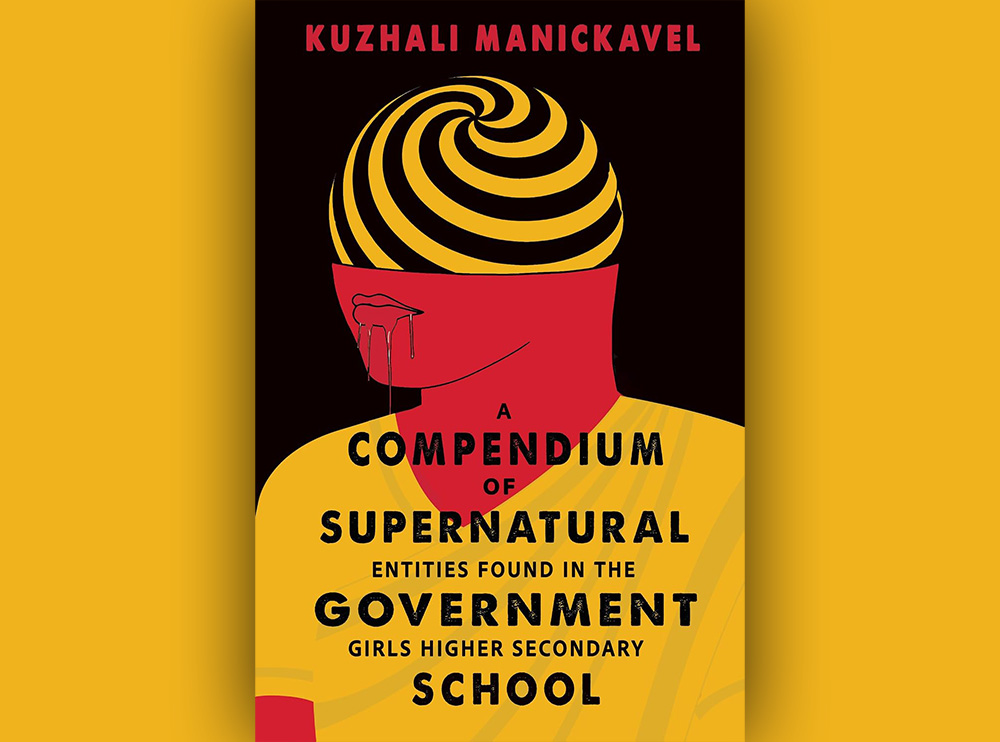
A boundary-pushing fantasy that blends magical realism with dark academia, perfect for fans of Bunny by Mona Awad and Motherthing by Ainslie Hogarth.
Intrigued? Read on to discover the synopsis and an excerpt from A Compendium of Supernatural Entities Found in the Government Girls Higher Secondary School by Kuzhali Manickavel, which is out now.
In the oppressive heat of a small Tamil Nadu town, strange happenings are common. And the local government secondary school is teeming with supernatural entities.
For Thamarai, an outsider considered strange by her peers, life is dreary and frustrating. She endures nosy neighbours and incomprehensible tuition classes. She despises the way her lecherous English teacher harasses the other girls in her grade. But when Thamarai finds a mysterious notebook full of descriptions of the school’s paranormal phenomena, she wonders if it may hold the key to escape…
EXCERPT
Introduction
The Government Girls Higher Secondary School – or GGHSS – is one of the most supernaturally infected places in the known and unknown world. Western concepts of the supernatural should not be used as a framework while exploring, documenting, or archiving the paranormal here; the entities of the GGHSS are decidedly unWestern, and cannot be measured by Western definitions.
The Association for Moral Upliftment and Universal Friendship (AMUUF) takes great pleasure in being the first officially recognized body to endeavour to categorize and catalogue the many supernatural entities that exist within the realm of the GGHSS. With our dynamic team of researchers, archivists and volunteers, AMUUF has achieved great things in the area of supernatural categorization. However, the monumental task of creating this compendium has not been without its challenges. Many volunteers, particularly those who have been raised in the Western school of thought, become confused as to how to identify supernatural phenomena if they do not fall into familiar slots like “vampire”, “haunted house”, or “Satan”. This situation is made doubly difficult by the fact that many volunteers know only one language: English. This monolingual handicap severely limits the words, sounds, and ideas they have at their disposal; however, it need not hamper them in doing their job. We have always encouraged such individuals to view absolutely everything as supernatural, and work backwards from there. For example, if one comes across a chair, one should understand that it can also be an undead carnivorous bird at rest, or a community hall haunted by paranormal mushrooms. One must never assume it is just a chair.
Even today, many of the paranormal phenomena of the GGHSS remain undocumented. It pains us to note that a number of entries are either incomplete or totally blank, simply because the researcher/archivist/volunteer didn’t feel like completing the task at hand. For example, the entries for a number of small, deceased gods, for the Giant Scrub Typhus Mites, and for the Ammapettai Fire Lizards could have been completed quite easily. However, the Ammapettai Fire Lizards entry has nothing more than a rough description of the entity’s toes, while the entry for the Giant Scrub Typhus Mites is made up of the words “The Giant Scrub Typhus Mite is…”, followed by at least twenty blank pages.
This brings us to our next problem. There is a good deal of documentation in this compendium that has been entirely made up, as a “joke”. While AMUUF is loath to point fingers, it cannot be denied that a majority of those accused are from our volunteer base. The task of removing these entries is a daunting one and continues to be a drain on our resources.
Despite the many challenges that we continue to face in our epic endeavour, AMUUF cordially invites you to be a part of this monumental work. Should you encounter a supernatural influence that is not listed here, feel free to make detailed notes of your experience in the pages provided at the back of this compendium. Notes should include clearly labelled diagrams, maps, lists, and bagged/sealed specimens. Please do not use ballpoint pen. Kindly include any and all discharge summaries or death certificates if applicable.
***
The bus entered the town, and instantly, Thamarai forgot where she had come from. Her old life seemed to fade away, leaving behind a vacuum that was already filling up with this new town’s witchy sunlight, smoke, and relentless holiness. She had been here before, when she was younger, but all she could remember from that trip was the heat, the crowds at the temple, and the priest who had conned her family out of five hundred rupees. This town would now be home for the foreseeable future.
There was no transition period, no time to work through the shock of being unceremoniously transplanted. Thamarai settled in quickly and quietly. Her new life was not terrible, but it was lonely and insignificant, dotted with only a few special occasions that involved wearing coloured dress or eating ice cream. Her parents had gotten work in two different towns so Thamarai had been sent to stay with an unmarried aunt, who provided her meals and slept in the hall at night. Thamarai attended the local government school for girls, as well as tuitions for maths, physics, and chemistry. She went to the temple on Fridays and watched the weekly televised Tamil movie on Sundays. Hers was an ordinary life, no different from any other local girl’s life.
Thamarai did not know her aunt well, but they soon settled into a routine that Thamarai found comforting. Her aunt was brisk and plump, always talking, always moving. She would watch the Sunday evening movies with Thamarai, every so often bringing out a small treat: a bar of chocolate, a bag of chips, a packet of Maggi, and on one occasion, a small glass bottle of Coke. She was sweet and unintrusive, and Thamarai decided she mostly liked her—except for her eyes, which were always hidden under round white reflections in her thick glasses. Thamarai had never actually seen her aunt’s eyes, and if she thought about this too much, it scared her.
Thamarai herself was an unremarkable girl: skinny, with good teeth and thin hair. She was not pretty, but in her new school, she often got compliments from the girls because she looked like a boy. Not like a boy play-acting as a girl; to them she seemed like an actual shy, mysterious, and violent boy. It was a quality that made girls stare at her. They would sometimes touch her cheek or shyly hold her hand. They would blush or become flustered when Thamarai smiled at them. Thamarai decided this was the best aspect of her new life. She liked to see what happened when she held a gaze for too long, or absent-mindedly touched someone and let her hand linger.
Thamarai was constantly falling in love. In school, she fell in love with sports girls, bold girls, repressed conservative girls, orthodox girls, mixed-caste girls, and homely girls. She would think about these girls all the time, looking at them covertly during class, and cringing each time one of them said or did something that shattered Thamarai’s beautiful idea of her. She fell in love in an intense and alarming way that would consume her completely, and then die away after a few days.
Thamarai even fell in love with the girls who made fun of her. They laughed at the parting in her hair, which was always crooked, no matter how hard she tried to straighten it. They laughed at the fact that she never put turmeric on her face or wore bangles. They laughed at her hands, which were always covered in ink even when she hadn’t touched her pen, and they laughed at her school uniform, which for some reason always smelled like kerosene.
For the most part, Thamarai liked the new town. It initially seemed harmless, like a very old house. But strange things began to happen to her. Sometimes it was just unlucky strangeness: a pig would get its head stuck in the spokes of her cycle or a family of ravens would consecutively poop on her head. Other events were inexplicable: a crowd of children who all had hands where their heads should have been had once chased her while she cycled to school. Another time, while fishing in her bag for her pen, she had repeatedly pulled out handfuls of old teeth which tried to bury themselves into her palm like they were shy. There was the young man who had grabbed her arm at the railway crossing and then dissolved into a cloud of reddish dust. Another day, she had been alone at home when she had stumbled into a wall and remained stuck inside it for the whole afternoon.
And of course there was the incident with the old woman at maths tuition, which Thamarai did not like to think about.
The very first of Thamarai’s supernatural experiences took place a couple of weeks after moving, on her first day of 9th standard. There had been no room for her in the classroom, so she had been relegated to sitting on the floor in the doorway. No one spoke to her, but everyone stared at her. She looked like them, but she was clearly not one of them; she was too well-nourished to be one of these girls—these girls with their anaemia, their fluoride-stained teeth, and their holes in their hearts.

She spent most of that day looking at the empty assembly ground that stretched hopelessly in front of the classroom. She memorized the pockmarks and scratches on the wall in front of her–the one crack that looked like a horse’s head, the other that looked like a laughing clown. She counted the tiny holes in the floor and the mounds of dust that lay nestled at the bottom of the door.
Feeling the stares of the girls around her, she decided to rummage through her bag like she was searching for something important. Inside was a cheap, plastic raincoat, a geometry box, her unused rough notebook, her new textbooks… and something else. She frowned as she gingerly pulled out a very old and dusty botany record notebook.
She had never seen it before. Its binding was falling apart but somehow the book seemed to be holding itself together. Thamarai looked around her, to see if someone had put it in her bag by accident. A prank maybe?
She opened the notebook and saw intricate transectional sketches. These were not the usual drawings of shoe flowers and seed germination. Some of the diagrams looked like young girls and others looked like gigantic insects. The text portions almost read like botanical entries, except that they included warnings and danger rankings.
It’s just a book, she said to herself. I am not afraid of it. I’m not afraid of anything here. She leaned over and placed the notebook on the floor, next to the wall. Someone would eventually pick it up and deal with it.
She went back to staring outside.
Sometime later, when she looked in her bag again, there was the notebook, nestled under her plastic raincoat. For the next half hour, she kept putting the notebook on the floor against the wall, and it kept reappearing in her bag when she wasn’t looking.
She decided she would toss it in the drainage canal on her way home.
But after school, as she slowed her pace near the canal, someone chased her away, saying it was dangerous, and didn’t she have enough sense to stay away from places like that?
No matter what she tried, she could not get rid of the notebook. It became a silent, permanent fixture in her bag.