

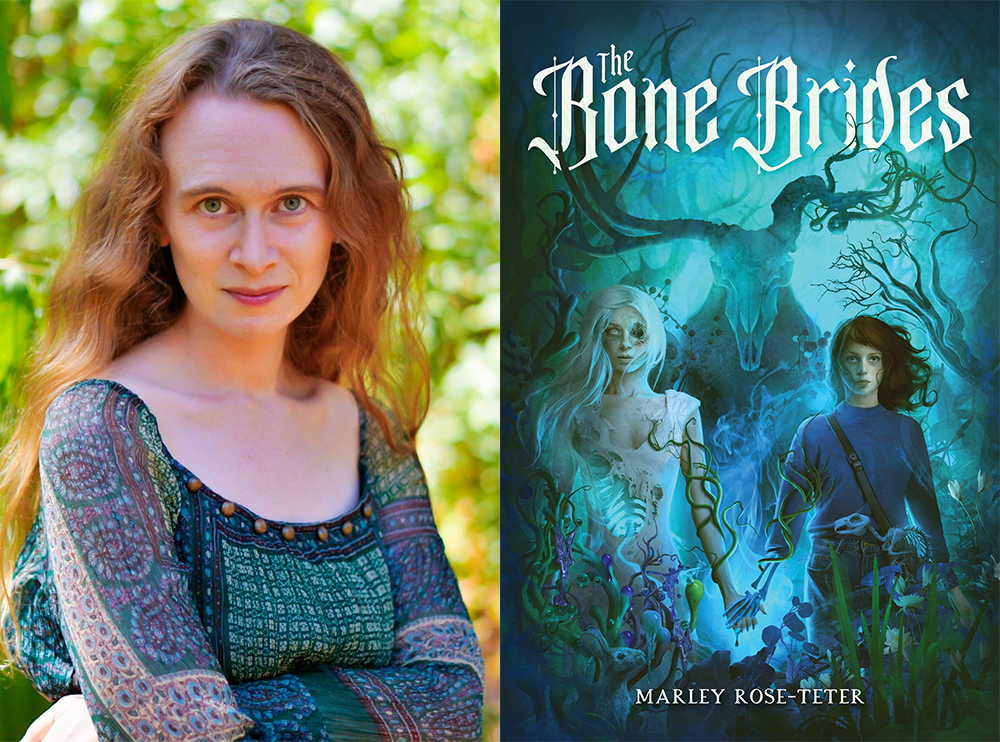
Guest post written by The Bone Brides author Marley Rose-Teter
Marley Rose-Teter lives in the Santa Cruz mountains with her partner, child, any number of house-rabbit friends, and a garage full of Halloween decorations. When not writing, she can be found directing local theatre or speaking at anime conventions. She goes at everything she does with her whole heart and strives always to be a bride married to amazement. The Bone Brides is her debut novel.
About The Bone Brides: A grieving girl must rescue her changeling girlfriend from the fae queen in this whimsical fantasy that’s Guillermo del Toro meets Studio Ghibli. Released September 29th 2026.
Here is some irony for you:
As I sit to write this article for World Mental Health Day, I am at the tail-end of a week in which stress and anxiety have left me exhausted out of my mind, overheated, dizzy, and stumbling every ten minutes to the toilet. Gross. The message my body is sending could not be clearer: It is time to rest! Yet when the last-minute opportunity to write about mental health landed in my inbox this morning, I abandoned rest to work on it, even while my own mental health continued to knock around my brain like some sort of poltergeist banging on the walls of the house, ignored despite every object it had thrown in my path to stop me.
Why? Am I really just that bad at saying no? No. (Ha! But also, since we’re being too-honest-for-Instagram here, yes? But also—) It’s because mental health awareness is, in fact, one of the primary reasons I write the stories I do, and why I write those stories specifically for teenagers, whose depression and anxiety are so often belittled as “just teen angst.” It’s because there is something I have to say now that I wish I could have heard when I was a teen.
When I was 14 years old, I was deeply depressed. An upperclassman advised me that “If you’re always depressed, people will get tired of you. People get bored of hearing about depression.” She spoke from a place of experience, having dealt with depression herself, so I took her advice to heart. I would not be boring, I decided, stuffing my depression behind cheerful words and forced smiles. I would be positivity and light. Anyone who knew me as a teen will tell you that I wasn’t a dreadfully good actress…but by the time I became an adult, I’d at least gotten proficient at keeping quiet about the bad days, when my body was lead and the world felt meaningless. Even with close friends, I would wait until the worst of a depressed period had passed before mentioning—briefly and in the past tense—that I’d been having a rough time.
We’re all familiar with the motivational posters hung on classroom walls, the images littering the Internet that say Change your thoughts and you change your world.
You will be exactly as happy as you decide to be.
Choose joy.
As if it’s a choice. (They will make you think it’s a choice.)
This idea, that depression is a failing that only serves to exasperate and bore the people around you is precisely what Nola, the main character of my debut novel The Bone Brides, spends the book working to unlearn.
Oh— Did I mention that it was the lead-up to The Bone Brides’s publication that made me fall so ill this past week? I have dreamt of being a published author for 30 years, yet when I finally achieved that dream, I spent a week barely cognizant of the world at all because my emotions had so overwhelmed me.
I love talking about The Bone Brides. It’s a fun book to talk about! Its whimsical-yet-spooky aesthetic—compared to a marriage of Hayao Miyazaki and Guillermo del Toro—is full of delightfully weird novelties, like eyeless horses and ghost bees and a temperamental skeleton bunny who is not-so-secretly my favorite character in the book. I love, when discussing The Bone Brides, to focus on the relationship between main characters Nola and Lumi, two queer girls—one human and one faery changeling—whose love and support for each other never waver. I would like to see more books in which girls get to love each other like that.

But the heart of the book? The poltergeist banging on its walls?
Three years prior to the story’s beginning, Nola loses her father to suicide. Her mother is deeply depressed, and Nola’s friends get bored of hearing about her grief. The pain of those losses—the father she loved, the friends who didn’t really love her, the mom who’s so lost in her own sadness that she can’t be much of a mother—hollows Nola out, convincing her that she must always be smiling if she wants to be loved.
Then she meets Lumi.
What could be a simple love story is complicated by the fact that Lumi is a faery changeling running away both from the human mother who wants to kill her and eldritch monsters who want to return her to her own realm. When Lumi is abducted, Nola has to enter a bizarre and terrifying otherworld where she nonetheless continues to smile…until her body starts literally falling apart, magic made metaphor. (And, uh, weirdly similar to my past week.) From there, Nola must grow, learning to accept her sadness and even take strength from it.
I dedicated The Bone Brides to “the sad girls.” I wrote it because I wanted to tell readers—especially teens, and especially teens today, dealing with the onslaught of social media that shows only the highlight reels of others’ lives—that you can be sad and still be a good person. You can be sad and still be loveable and loved. You can even be someone who, upon achieving her lifelong dream, is made embarrassingly sick by her too-big-too-much emotions—
Yes, you can even be that person and still put good things out into the world. No smiles required.