


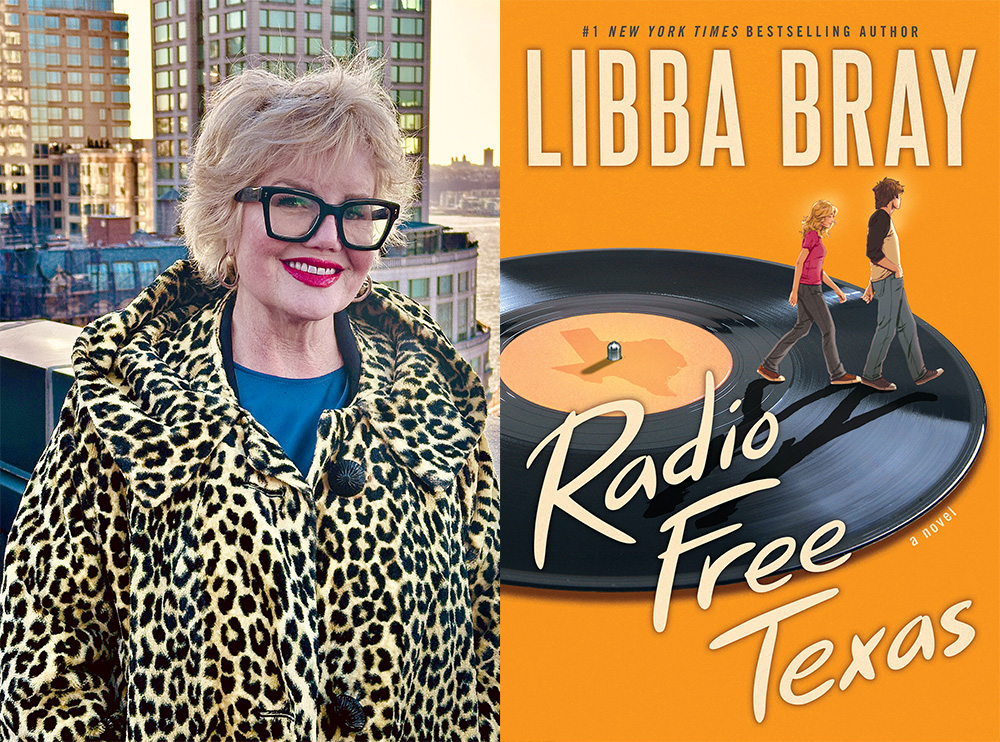
We chat with author Libba Bray about Radio Free Texas, which is a story of love, rock n’ roll, and sex (in that order) in 1980s Texas.
Hi, Libba! Welcome back! What have you been up to the past year since we last spoke for the release of Under the Same Stars?
Has it been a year? My God, where have I been? Where are my keys? Did I remember to shower and change my underwear?
Well, howdy, y’all! Thanks for taking the time to talk with me. Much appreciated!
Well, besides emptying a dog three times a day, I have been working on a new book, a gothic, historical, spooky thing that I describe as “Succession meets The Haunting of Hill House.” I’ve also laying down some words on a 1990’s NYC-set, YA urban fantasy that I describe as “Buffy meets Desperately Seeking Susan.” So…I’ve just been coming up with clever loglines, it would seem: “It’s a plate of spaghetti told through a Patricia Highsmith lens.” “It’s The Berenstain Bears with serial killers.” “It’s Apocalypse Now…but as a jukebox musical. Can’t wait for the choreo for Total Eclipse of the Heart of Darkness.” Wait, can I make a career out of just coming up with loglines?
Oh, also, I got married.
Your latest novel, Radio Free Texas, is out now! If you could only describe it in five words, what would they be?
Oooh! (That doesn’t count as one of the words. Or does it?) Music. Love. Rebellion. Heartbreak. Texas. (If I had a sixth, it would be KrogerSheetCake, all one word.)
What can readers expect?
Excellent pagination. I pride myself on that. Tough for a girl who nearly failed math.
The novel is a celebration of music, friendship, and the bittersweetness of growing up. I hope readers who loved movies like Almost Famous, Dazed and Confused, Say Anything and books in the vein of Nick Hornby or Stephen Chbosky will find connective tissue in Radio Free Texas (which my autocorrect just tried to make into Radium Free Texas. “Come for the music! Stay for the glow-in-the-dark clean-up party!” Go home, Autocorrect. You’re drunk.)
Where did the inspiration for Radio Free Texas come from?
This is, in many ways, the most autobiographical book I’ve written in that it is set in small-town Texas in the 1980s and it is all about music—how it shapes us, expresses our emotions for us, connects us to others, challenges our status quo, and becomes the soundtrack for our lives.
I first had the idea for this book twenty-five years ago and foolishly thought it would be a cakewalk to write since it echoed so much of my own adolescence. Well, in the immortal words of Han Solo, “Don’t get cocky, kid.” I could not get under the skin of this thing. So I’d shelve it and come back to it here and there, figure out a thing or two. But still: Not there yet. Then, a few years ago, I recalled taking my son to see Where the Wild Things Are. He was about ten or eleven at the time. And during the movie, he began to SOB. I leaned in and said, “Hey, Bud, what’s making you so sad.” He looked at me and said, “It’s just so hard to grow up.” Dagger. To. The. Heart. I thought, Yeah. Yeah, Bud. And it never stops happening, because we never stop coming of age.
That was when I found the heart of the novel. I realized that I wanted to write a love letter to growing up and to music and how the latter helps us with the aches and pains of the former.
Were there any moments or characters you really enjoyed writing or exploring?
I enjoyed discovering the “who” behind every one of these characters. I write to understand the human condition which includes coming to a better understanding of myself. That said, I really enjoyed writing the relationship between Bowie and Marlon. Here is this kid, Bowie, whose father abandoned him, and there’s Marlon, this larger-than-life, outlaw DJ character who likes having a willing apprentice in Bowie. The music brings them together, bonds them, and ultimately, forces them both to stop pretending and undertake the lifelong work of being. The relationship gives Bowie purpose, and it gives Marlon a chance to be a bigger man. I particularly liked writing the New Year’s Eve scene between the two of them.
RFT is arguably the most heart-on-my-sleeve book I’ve written. I mentioned above that it took me twenty-five years to write this and that’s because I really needed to age into it. I needed to have the time and distance necessary to write compassionately but honestly about these very real people. No heroes. No villains. Just ordinary folks trying to do their best to evolve and find meaning in their lives.
With it set in the 80s, what makes this story relevant for YA readers today?
I’m so glad you asked! I feel for teens today because they have grown up in the panopticon of social media. It’s hard enough to build a self as a teenager without being bombarded constantly by Image, capital I, connected to capitalism and hustle culture or with the fear that if you do something stupid or cringey—which, I would argue, is a necessary rite of passage in those years—you might be filmed and have it uploaded within seconds for the whole world to see and comment upon. I find this stuff hard to navigate as an adult; I can’t imagine having to do that as an emerging person. My hope is that by setting the story in a time before phones, AI, the Internet (when radio was the Internet), it might allow them a safe distance from which to engage with the coming-of-age story and all that encompasses.
Did you face any challenges whilst writing? How did you overcome them?
Believe it or not, I actually turned this book in two months ahead of schedule. That’s beyond belief for me, like the Jets winning the Super Bowl.
Was there a soundtrack to writing for Radio Free Texas?
Sorry to disappoint, but I write to this boring Brain Wave app that plays the kind of tonal noise that I’m sure is the sort of thing rogue governments use to program contract killers. I used to be able to write to music but I find these days that I can’t—I’ll end up getting too into the music! However, every chapter in the book is a song title, chosen for a specific reason, so I suppose there is an inherent soundtrack. I really hope readers will discover some artists that perhaps they didn’t know about before, like Klaus Nomi and Television.
What do you hope readers might take away from it?
Well, besides possibly an introduction to the many wonderful bands and musicians mentioned in the book, I hope they come away with the feeling that they will be okay. That all of those late-night confessions of the soul that they carry around, the truths they are afraid to share might just be the things that shape and save them and help them find where they belong. I want them to know that they are driving the bus and they will not drive it over the edge. I mean, I drove to Dallas to see The Police in concert the night before my SAT which resulted in the score you might expect. But I seem to have managed okay.
What’s next for you?
A sandwich. I am very hungry.
Lastly, what books are you looking forward to picking up? Any you’ve read so far this year that you’ve enjoyed?
Oh my gosh, so many! Some I’ve read and enjoyed so far this year: Children of Owl by Darcie Little Badger. In Between Days by Camryn Garrett. Flamer by Mike Curato. Orchid Girls by Gayle Forman. The Pools by Emily Lockhart. Snow by John Banville. Meet Me in the Garden by Nina LaCour. Everything’s Not Lost by Frederick Joseph. I’m looking forward to reading Hanif Abdurraqib’s They Can’t Kill Us Till They Kill Us, George Saunders’ Vigil, and and re-reading The Writing Life by Annie Dillard (RIP).

For research, I’ve been reading The Ledger and the Chain: How Domestic Slave Traders Shaped America by Joshua D. Rothman. The Conjuring of America: Mojos, Mermaids, Medicine, and 400 Years of Black Women’s Magic by Lindsey Stewart. And I’m making my way through Eric Foner’s Reconstruction: America’s Unfinished Revolution 1863-1877.
I usually start my morning by reading some Mary Oliver poems and close out the day by listening to Buddhist teachings by Jack Kornfield or Pema Chodron. I, too, am a work in progress.