

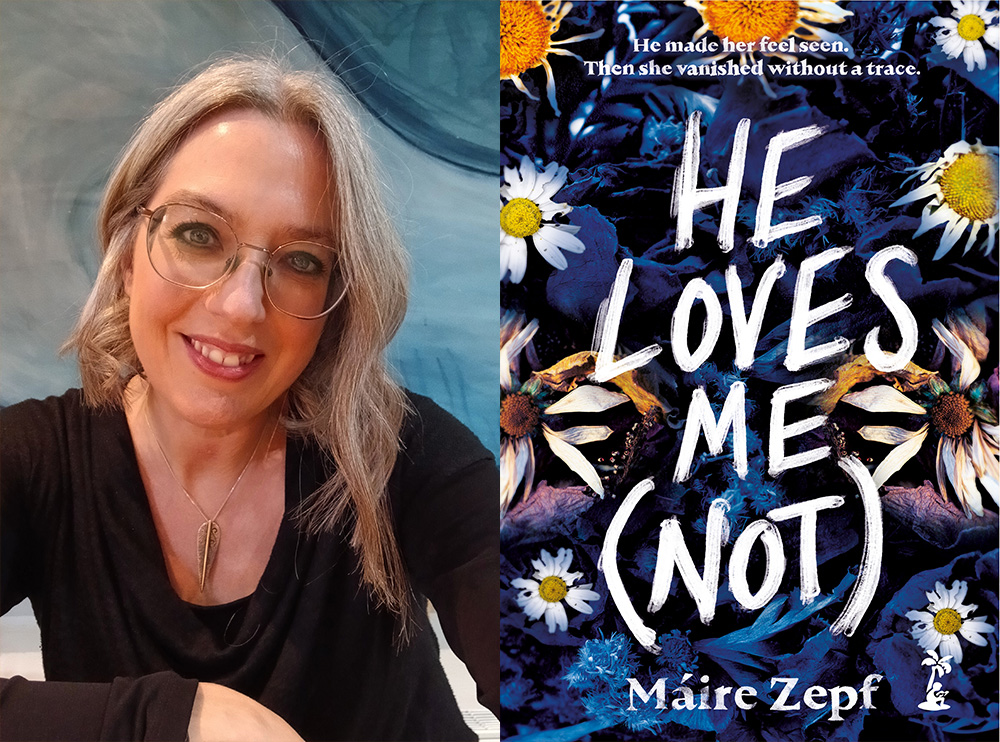
Guest post written by He Love Me (Not) author Máire Zepf
Máire Zepf has written over 16 books for children, from picture books to YA fiction. She has won the Children’s Books Ireland Children’s Book of the Year Award, 5 Literature Association of Ireland Children’s Book Awards and 2 international White Ravens among many others. Máire lives in Co. Down and she loves sea-swimming and crisps.
About He Love Me (Not): A chilling YA thriller told in verse about online romance, obsession, and the dangers hiding behind a screen. Releases on October 8th 2026.
Being a teenager is seriously intense. So it’s no surprise that YA books contain some of the most high-stakes, fast-paced, in-your-face, vividly full-colour narratives in literature. Let’s be honest – we love the drama.
YA doesn’t do soft-focus, long, reflective looks back from middle-age. It plunges us headfirst into messy, painful happening-to-me-right-now storylines and doesn’t blink. YA will break your heart, bring you out in a cold sweat, put you through the emotional ringer. It can be an emotional workout.
And when that YA hit comes in the form of a verse novel, the power is turbo-charged. With all the excess words stripped away, we’re left with condensed action, concentrated characterisation and distilled emotion. The pace quickens. A few carefully chosen words can land with enormous force. Potent stuff indeed. Perhaps this is one reason why even reluctant teen readers can find themselves devouring verse novels and coming back asking for more.
Dark and difficult themes are part of the DNA of YA, and the verse novel form offers something extra in the telling of these challenging tales. Grief, abuse, self-harm, crime, addiction, illness – these are thorny subjects, difficult to handle in fiction and even harder to get right.
Trauma in real life is rarely experience in a neat, linear sequence. Memories can be fragmented. Emotions can arrive suddenly and unexpectedly. The past can crash into the present. So it makes sense that verse can offer a particularly powerful way of representing these experiences. Narrative can jump. A poem might fracture across the page when a character is frightened. Text might shrink or spread out. Repetition can echo an intrusive thought. White space can say something when words are simply not enough.
This was my experience of writing He Loves Me (Not) – a chilling verse novel that tackles the darkest of subjects. The ability to play with rhythm, repetition, line breaks and shape made the telling flow in a way that felt instinctive and true to the raw emotion of the story. The form allowed me not just to tell the story, but to reflect something of what it feels like to be inside it.
But it also got me wondering. What is it that dark themes and YA literature are such common – and, clearly, beloved – bedfellows? What is it about young adults that draws them to towards painful , frightening and sometimes deeply disturbing subjects?

Of course, some young people are actually experiencing ferociously difficult and destabilising life experiences in real time. For them, there can be enormous comfort in seeing something of themselves on the page: the chance to stand outside their own experience for a while, to find language for something that may feel impossible to articulate, and to discover that they are not alone. Fiction can open conversations about things that the adults in their lives may struggle to talk about openly.
But I think there is something else going on, too. There is something about this life stage – a drive to push the bar and see how far it will go. To test out the extremes. To imagine ourselves into them, try them on for size. Adolescence is a time of world-expanding, empathy-boosting emotional exploration into uncharted waters. Books can provide a safe place to do that exploring.
We can be terrified without actually being in danger. We can experience grief without having lost someone. We can inhabit another person’s trauma without having lived it ourselves. We can ask, “What would I do?” without having to find out the hard way.
And perhaps that is one of the great gifts of YA fiction. It doesn’t protect young readers from the dark. Instead, it takes them there – and trusts them to find their way through. Because in YA, there is always hope. Always. Even in my own chilling thriller, which spares absolutely no punches.