


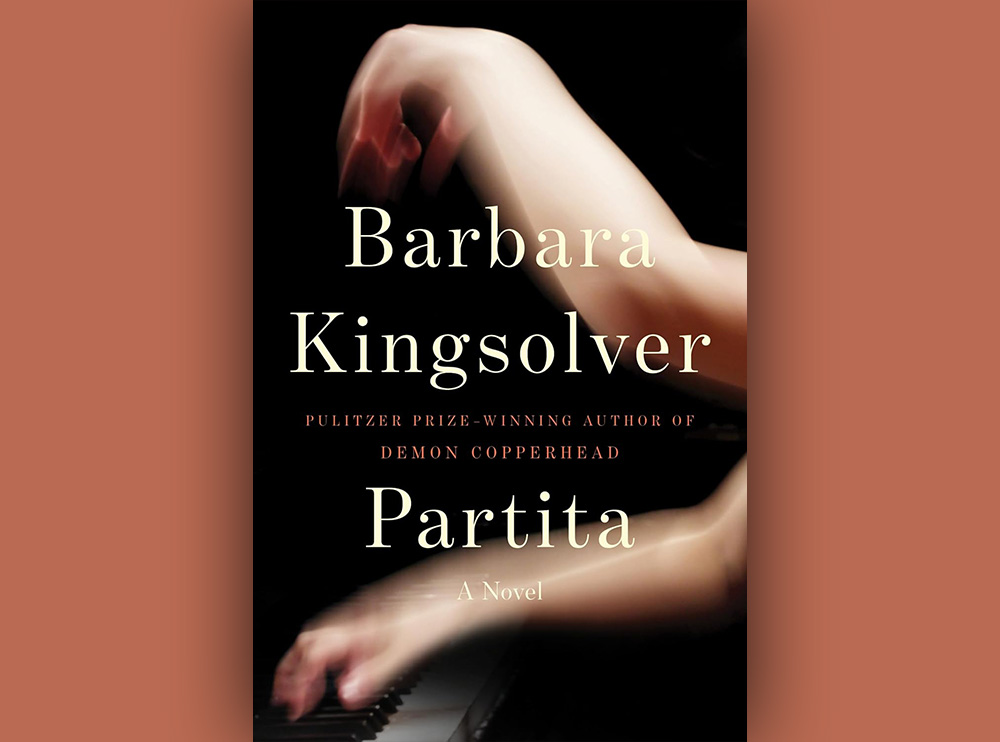

One of the greatest wordsmiths in American contemporary fiction, Barbara Kingsolver, is back this fall with her tenth novel, Partita, proving she still has a lot left to say after 2022’s Pulitzer Prize-winning Demon Copperhead.
Livia Cable (née Bohusz) lives a simple life with her husband in rural Tennessee. Charlie works the family farmland while Livia teaches piano to the locals. Between lessons, and in the early morning hours when sleep evades her, she also faces the overwhelming task of sorting through her recently deceased mother’s home. Stacked top to bottom with decades of detritus, the process brings back difficult memories of her upbringing and her beloved brother, Cyrus, who left the world far too early in a way Livia still cannot make sense of.
This daily routine is interrupted one Sunday by an unexpected call, dragging the excruciating pain of the past even more so back into the present. Sigurd, a long lost love, is staying a few hours away in Nashville. He has been thinking about Livia and wants to see her. But for what possible reason, with all these years between them?
When they last spoke, nearly thirty years ago, Livia was on the path to a very different life. She was the most promising classical pianist in her program at the Indiana University School of Music. She fell in love with Sigurd, a passionate activist who showed her the world through a brand new lens. And she certainly never dreamed of moving back home. However, as Kingsolver shows us all too well, our lives don’t always turn out the way we hope.
Moving back and forth between Livia’s present and her past, Partita tells this story through a careful construction of musical movements. Each section is labeled, ranging from prelude and overture to allemande and fugue, chosen to reflect the tone and content of that portion of Livia’s story. A listening list of the pieces referenced throughout is even provided at the beginning of the book. As Livia works to perfect the challenging but beloved “Ondine” from Maurice Ravel’s Gaspard de la Nuit, for example, the reader can listen for themself, adding another dimension to the reading experience.
Beyond the music, this novel is about the depth of human relationships, both familial and romantic. Kingsolver makes a meaningful choice to frame the story with the death of Livia’s brother. This is where the novel literally begins and it remains an unbreakable thread woven throughout. It is an achingly accurate portrayal of the profundity of such loss and the way a family—each member individually and as a whole—is never the same after.
This is paralleled by another type of loss. Partita is also a story of the one who got away, raising the dangerous question of how life might look today if things had gone differently in the past. The present day portion of the novel begins on the day after Sigurd called. Each section is another day as Livia labors over the decision of whether or not to see him again. Rationally she knows there’s no need after all these years, especially considering the fallout of their relationship on her life, yet she still craves him in some inexplicable way. As she ponders this choice, their history unfolds in the alternating chapters of the past, amplifying the impact of their brief relationship on the storyline of her life.
Readers will feel the love Kingsolver poured into this novel. Did you know she too grew up in a rural, working-class family learning to play classical music—and still plays the piano today? No wonder she has such a gift: putting into words the emotions of a powerful piece, capturing the cadence, translating how the music both sparks and satiates.
Partita is masterfully written, from the composition as a whole down to the sentence level. In the end, it is a reflection on—or perhaps more accurately a reckoning with—the ghosts of one’s past. Livia must face the ways her parents, her brother, her lover, and her music have all shaped her life. But it is also a beautiful reminder that all of our lives are infinitely more complex than they may appear on the surface. Every human experience contains multitudes.
In short, I believe the message here is that life itself is a partita and it is a message worth receiving. As Kingsolver tells us, “When I told him it was a partita, I had to explain then what that is, a composition made of a lot of parts with different paces and moods. A partita will never be all happy rondos, or all andantes in a minor key. You’ll usually have a prelude, a thrilling allemande, maybe a slow, sexy sarabande—the contrast is the point. The parts are all different, and the artist’s work is to make them all add up to a something that feels whole.”

Partita is available from Amazon, Barnes & Noble, Bookshop.org, and other good book retailers, like your local bookstore, as of October 6th 2026.
Will you be picking up Partita? Tell us in the comments below!
Synopsis
The story of a brief, passionate, life-changing love affair, wrapped up in what might be the greatest romance of all: our eternal human longing for art and beauty.
Livia Cable has made her peace with her marriage and modest livelihood in the farm country where she grew up, until a shocking phone call from an old lover shakes her to the core. Decades earlier, this man knew her as Livia Bohusz, a music conservatory student estranged from her home and family, uncertain of anything except her passion for music and promise as an extraordinary pianist. His request, now, to see her again stirs up ghosts she’s kept at bay for a lifetime.
Shifting between past and present, Livia’s decision to meet or reject the reunion means confronting step by step, in memories framed as musical dances, the experiences of childhood loss, abandonment, self-immolating passion, and perilous attachment to a man who broke her belief in love and ruptured the course of her life.
With razor-sharp acuity and deep affection, Pulitzer Prize winner Barbara Kingsolver’s unforgettable new novel reflects on class barriers, the risks of ambition, and the timeless, life-changing power of art.