


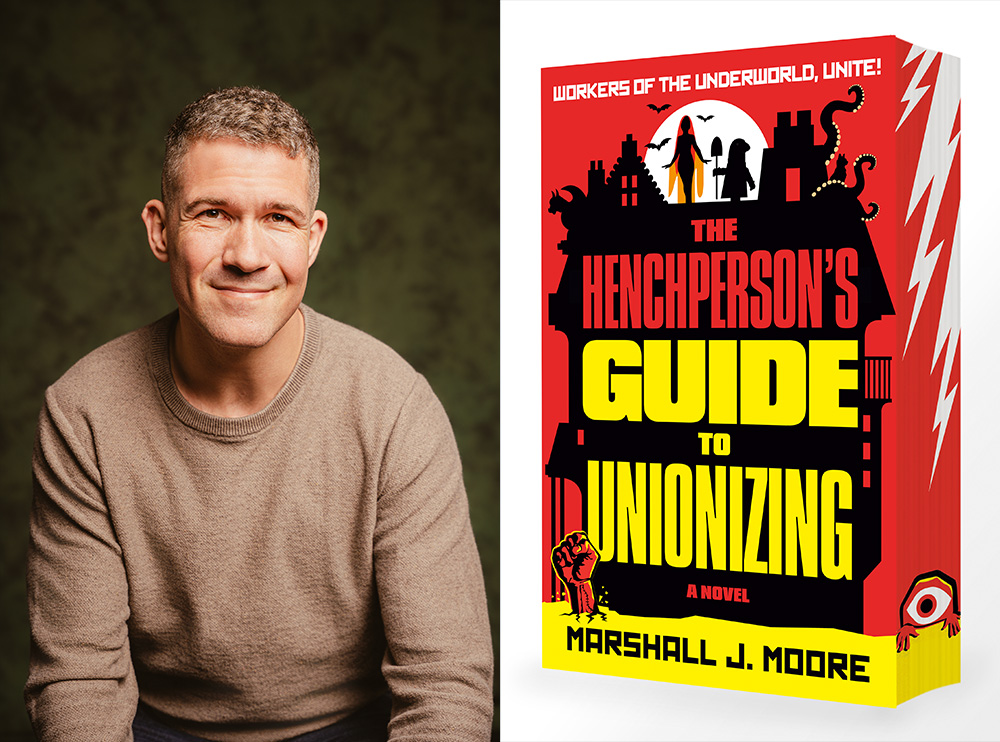
We chat with author Marshall J. Moore about The Henchperson’s Guide to Unionizing, which follows follows Igor, the long-suffering assistant to a mad scientist, who moves with his mad scientist boss into a crumbling manor already occupied by a centuries-old vampire and his discontented bride, plus a witch and her feline familiar. As their masters clash and conspire, Igor, Cornelia, and Grimalkin form an unlikely bond—and begin to wonder whether they deserve more from their lives than servitude.
Hi, Marshall! Can you tell our readers a bit about yourself?
I’m an award-winning author and professional martial artist who’s travelled to thirty countries, sold teapots to Jackie Chan, and was once tracked down by a bounty hunter for owing $300 in late fees to the Los Angeles Public Library.
When did you first discover your love for writing and stories?
I think I’ve always been a storyteller, courtesy of my parents. My dad was an avid saltwater sportsman who loved spinning tales of his adventures on the high seas, while my mom read to me every night when I was a kid. They passed that love of story on to me, and pretty much as soon as I learned to read I started to write stories of my own.
Quick lightning round! Tell us:
- The first book you ever remember reading: All of the Calvin & Hobbes We had the complete set, and I spent countless hours as a kid diving into them, going on adventures to Mars or hiding from mutant killer snow goons with Calvin and his trusty tiger Hobbes.
- The one that made you want to become an author: IN THE FORESTS OF THE NIGHT by Amelia Atwater-Rhodes. I vividly recall being ten years old and seeing her book in the Scholastic catalogue, with a big text bubble by it proclaiming that “The author wrote this when she was only thirteen!” I thought “Wait, maybe I can be a published author by the time I’m thirteen.” As it turns out, I was off by more than twenty years, but that Scholastic catalogue listing first planted the idea that I too could be an author one day.
- The one that you can’t stop thinking about: I reread THE LORD OF THE RINGS every single year, and it only gets more poignant and moving each time. These last several years in particular I find myself extremely moved by The Scouring of the Shire, and the Hobbits’ grief over finding the home they’ve fought for has not gone untouched by the War of the Ring—but I also take courage in their determination to defend their home from evil, and in the growth and healing of the Shire in the trilogy’s final chapter.
Your latest novel, The Henchperson’s Guide to Unionizing, is out now! If you could only describe it in five words, what would they be?
Found family, stolen body parts.
What can readers expect?
THE HENCHPERSON’S GUIDE TO UNIONIZING follows Igor, a mad scientist’s lab assistant, as he teams up with a witch’s cat and a vampire’s wife to stop their masters from bringing about the end of the world while simultaneously breaking free of their toxic workplace relationships. Readers can expect spooky vibes, wry humor, social commentary, and a surprising amount of warmth and heart. Also loose eyeballs, hordes of rats, eldritch monstrosities, and angry mobs wielding torches and pitchforks.
Where did the inspiration for The Henchperson’s Guide to Unionizing come from?
I like to say that this book is “Horrible Bosses meets What We Do in the Shadows,” both of which are pretty apt comparisons, but the real inspiration for this book is a sense of class solidarity with everyone who’s ever worked at a thankless, tedious menial job, particularly one where their labor is constantly overlooked. It’s easy to transpose the behaviors and personalities of a bad boss onto literal monsters, and in so doing make their henchpeople the ultimate underdogs who need to come together to discover their mutual worth and dignity.
Were there any moments or characters you really enjoyed writing or exploring?
Basically any scene where I could take a classic moment or image from Gothic horror and shift it ever so slightly so that we see it from the henchpeople’s perspective was a ton of fun to write. The mob of angry townsfolk storming the castlewhere Igor and the Doctor are conducting their grand experiment, the vampire Count’s grandiose self-introcuction being undercut by his thoroughly unimpressed bride, and the witch summoning an interdimensional monster from a pentagram were all my chances to pay homage to the horror imagery I adore.
Did you face any challenges whilst writing? How did you overcome them?
I think the biggest challenge with HENCHPERSON’S was the pacing. It’s got three main characters (the henchpeople) but is told exclusively from Igor’s perspective, so I had to find a way to balance everyone’s various subplots while maintaining a sense of forward momentum that also connected them all.

The answer, I discovered, was the same thing which united my monsters and their henchpeople in the first place: the ever-present threat of the nearby villagers catching on to their nefarious plans and forming an angry mob to drive them out of town. The more each of the various plotlines progressed, the more suspicious and hostile the villagers became, allowing me to use the townsfolk and their nascent mob violence as a mounting pressure to drive the story forward.
What’s next for you?
Travel and conventions to promote HENCHPERSON’S GUIDE, edits on my next book, and drafting the one after that.
Lastly, what books are you looking forward to picking up? Any you’ve read so far this year that you’ve enjoyed?
Space fantasy is one of my absolute favorite subgenres, and I’ve heard nothing but good things about Jesse Aragon’s THE DEMON STAR. As for ones I’ve already read and enjoyed this year, Joe Hill’s KING SORROW is a genre-blending masterpiece of epic contemporary dark fantasy horror.