

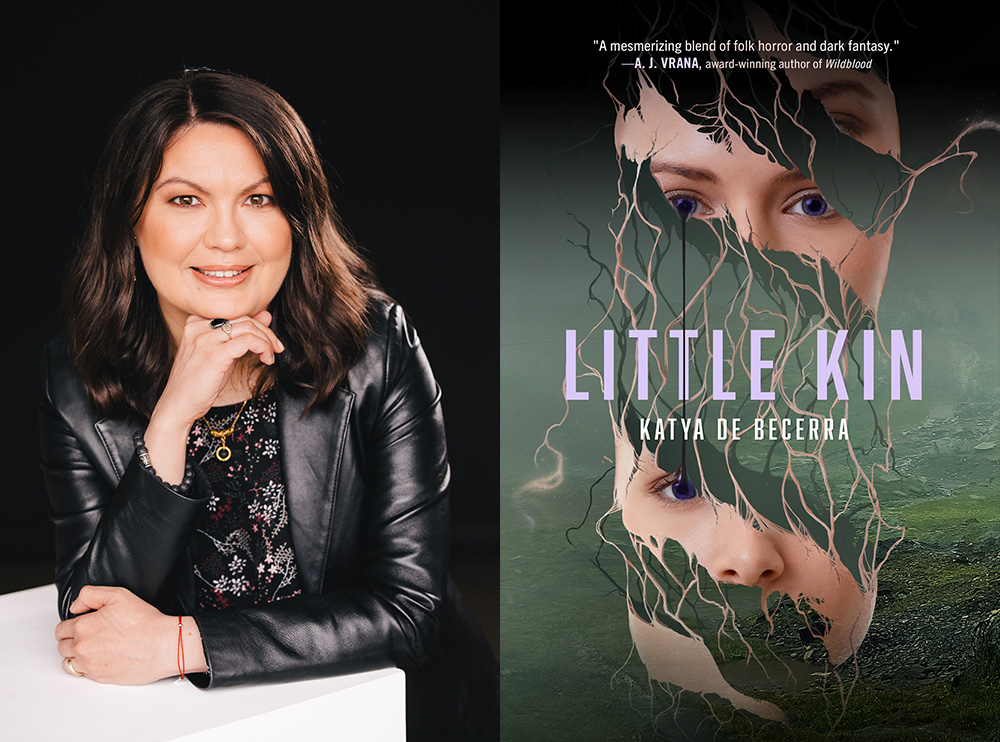
Guest post written by Little Kin author Katya de Becerra
Katya de Becerra writes atmospheric horror and mystery featuring determined characters, complicated families and enigmatic places. She is most known for When Ghosts Call Us Home, which earned two starred reviews, multiple Best of 2023 listings, won the Aurealis and Shadows Awards, and is shortlisted for the 2026 Trinity Schools Book Award. Katya’s adult debut, Little Kin, is coming in 2026 with Blackstone Publishing.
About Little Kin: A haunting island. A broken covenant. A woman who must survive both. Perfect for fans of Heather Fawcett, T. Kingfisher, and Ari Aster’s Midsommar, Little Kin is a chilling, folkloric tale of survival and belonging. Released September 22nd 2026.
One of the first things anthropology taught me is that people rarely do things “for no reason.”
If a community leaves offerings by a particular tree, avoids certain places after dark, or refuses to name something or to speak of it directly, there is almost always cultural logic behind the practice. The longer I spent studying people and their stories, the more I realized that folklore and ritual aren’t relics of a superstitious past. They are enduring ways of making sense of uncertainty, danger, grief, and belonging.
That’s one particular reason I love folk horror. Unlike many horror subgenres, folk horror begins with a question anthropologists ask all the time: Why do people believe this?
I started my anthropological training more than twenty years ago as an undergrad, learning about Margaret Mead, Bronislaw Malinowski and other pioneers of the discipline, though unlike them, my own fieldwork took place a bit closer to home. After all, fascinating things can be learned by observing the familiar, and by studying oneself. Perhaps that’s why my anthropological research is fundamentally about identity, belonging, and resilience: the stories people tell about themselves, the identities they embrace (or resist), and the ways they navigate institutions and communities that reward some and marginalise others. Looking back, many of the questions that would later find their way into my fiction were already there: where do we belong, who gets to define us, and how do we hold on to ourselves while finding our place in the world?
Folk horror is effective in delivering unease because it emerges from social systems rather than random evil. Out of all horror subgenres, it is also perhaps the most anthropological—because it’s often less about supernatural threats and more about the unsettling power of customs, rituals, and collective beliefs. When an outsider encounter a community radically unlikely their own, their rules and customs can seem irrational, while from inside the culture those make perfect sense.
Often, in folk horror narratives we’re placed in the position of an outsider trying to make sense of a community whose worldview operates according to a completely different logic. For example, in The Wicker Man, Sergeant Howie arrives on Summerisle convinced that the islanders’ customs are irrational and morally wrong, while the community sees its rituals as necessary for survival and prosperity. In Midsommar, Dani and her friends initially interpret the Hårga’s ceremonies as bizarre and horrifying, yet for the people performing them they are expressions of grief, continuity, and collective identity. Even in The Ritual, where the threat is more monstrous than communal, the villagers’ accommodation of ancient forces emerges from a cultural framework that has developed over generations. The horror arises not because the community lacks logic, but because its logic is internally coherent. What appears monstrous from the outside often makes perfect sense from within, forcing both protagonist and reader to confront the unsettling possibility that reality depends on where, and with whom, we stand.
In my adult folk horror debut Little Kin, the monster is only part of the story. The real source of unease is Rothagisht itself: an isolated island community whose people have spent generations building their lives around ancient covenants, ritual obligations, and rules that make perfect sense to them—even when they appear bizarre or terrifying to outsiders.
At the heart of Little Kin is Cassini, a cultural anthropologist who travels to Rothagisht after inheriting a house from an aunt she never knew. Accustomed to making sense of the world through research, observation, and evidence, Cass soon finds herself in a place where folklore seems woven into everyday life and ancient customs are followed with unsettling devotion. As she investigates her family history and the island’s traditions, she becomes increasingly entangled in a community bound together by blood, memory, and ritual. What begins as a search for answers soon turns into a deeper question of identity and belonging: not simply who Cass is, but whether some places have the power to claim us long before we even know they exist.

As an anthropologist myself, I wanted to see the world of Rothagisht through Cass’s eyes and to have Cass try and make sense of customs that challenge everything she believes about the world. So, before I ‘designed’ Rothagisht’s monstrous flora and fauna, I asked myself a question: what kind of society would create monsters like that, live alongside them, and perhaps even depend on them? The answers to those questions ultimately shaped Little Kin far more than the monsters themselves.
As both an anthropologist and an immigrant, I’ve spent much of my life thinking about belonging. Moving between countries taught me that belonging is rarely as simple as being born somewhere or claiming a particular identity. It’s something we negotiate constantly through relationships, memories, stories, and the communities that accept us—or refuse to. Those questions sit at the core of Cass’s journey in Little Kin. She arrives on Rothagisht as an outsider searching for answers about her family, only to discover that belonging can be both a gift and a burden. Like many of us, she longs to be part of something larger than herself. The real question becomes not whether she belongs, but what she is willing to sacrifice in order to belong—and whether some invitations are more dangerous than they first appear.
Folk horror will never stop to fascinate me. Beneath the monsters, the rituals, and the strange landscapes, it asks some of our oldest and most human questions: Who are we? Where do we belong? What stories do we inherit, and what do those stories demand in return?
In Little Kin the monsters may draw us into the darkness, but the real horror—and wonder—comes from the possibility that we might finally find the place we belong, only to discover the price of claiming it.