

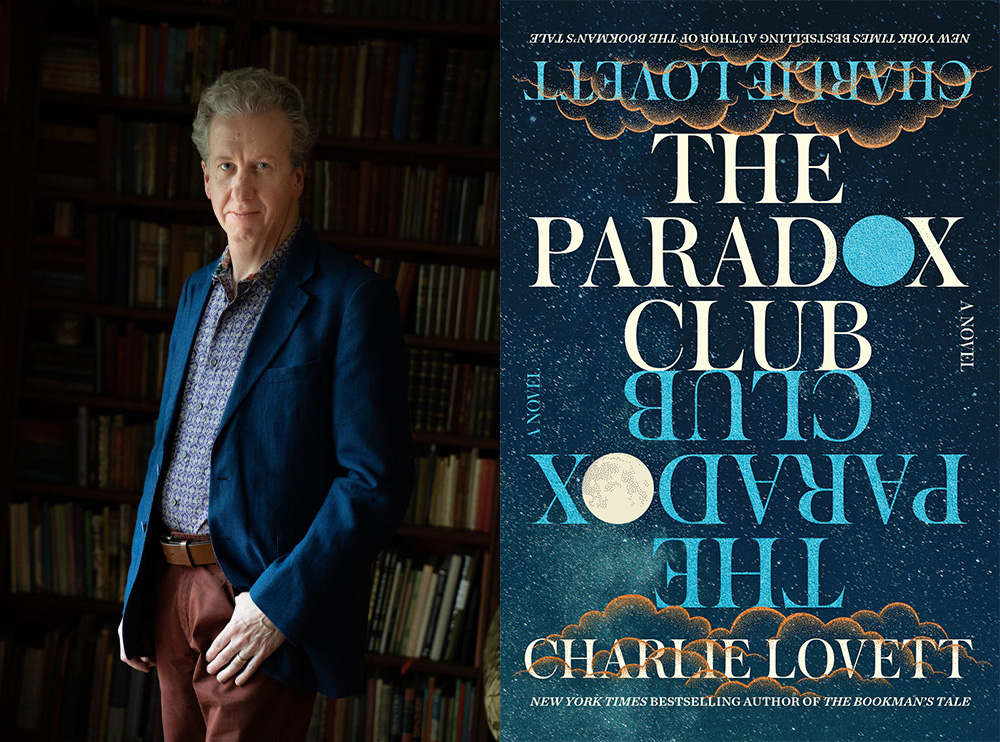
We chat with author Charlie Lovett about The Paradox Club, which is a lightning-paced mystery about a brilliant yet troubled young woman and her connection to a secret society where knowledge is power—and her father’s research is the key to its most dangerous secret.
Hi, Charlie! Can you tell our readers a bit about yourself?
I’ve been an antiquarian bookseller, teacher, actor, playwright, independent scholar, and book collector specializing in the works of Lewis Carroll. These days I write novels, still dabble in playwrighting, continue to build my book collection, and write on Carroll. My wife and I spend a few weeks each year in our English country cottage and lots of time with our three-year-old grandson, Theo.
When did you first discover your love for writing and stories?
I think it began with reading as a child. I always liked the idea of storytelling and as I grew up I imagined what it would be like to be the person on the other side of the book. Even in high school and college I enjoyed creative writing and by the time I was in my late twenties I was publishing nonfiction. But from those early days of writing stories and publishing academic work, I always wanted to write a novel. It took a few tries to get there, but The Paradox Club is my sixth novel with a major publisher.
Quick lightning round! Tell us:
- The first book you ever remember reading: The first book I remember reading myself was Go, Dog. Go! The first chapter book I remember being read to me was From the Mixed-Up Files of Mrs. Basil E. Frankweiler—which I sill love.
- The one that made you want to become an author: Every book I’ve ever read, but what pops into my head is The Chronicles of Narnia.
- The one that you can’t stop thinking about: Again, so many, but the two I return to again and again are A. S. Byatt’s Possession and Michael Chabon’s The Adventures of Cavalier and Clay.
Your latest novel, The Paradox Club, is out now! If you could only describe it in five words, what would they be?
Surprising, tender, mysterious, dangerous, genre-defying.
What can readers expect?
While there are some elements common to my previous novels (yes, there are old books in The Paradox Club), this is a real departure for me. It’s been categorized as thriller, mystery, sci-fi, speculative fiction, and literary fiction, so I think our use of the word genre-bending in the description is apt. But at the core of all the bizarre stuff that happens in this novel is the relationship between Tess Maxwell and her father Harry. The scenes where Harry, who is a brilliant astrophysicist, teaches Tess about life by teaching her about science undergird the whole novel and, I hope, will resonate with readers. So while The Paradox Club is certainly a wild ride, it’s supported by characters and relationships.
Where did the inspiration for The Paradox Club come from?
I was sitting on my back porch during COVID and thinking back to this old console radio from the 1940s we had in our attic when I was growing up. I could remember the smell of the vacuum tubes warming up. And I thought—what if you had a radio like that and when you turned it on, you heard the programming from the time it was manufactured? That didn’t exactly happen in the book, but it was the doorway through which I entered. And while I didn’t consciously set out to write a book about fathers, I’m sure the fact that my father had recently passed away was part of what led me to create the central relationship between Tess and Harry. They have long conversations at their summer house on a lake; my dad and I used to have long conversations in front of the fireplace at our summer cabin in the mountains. Tess and I both had father who were academics and who valued their books. That can’t all be a coincidence, right?
Were there any moments or characters you really enjoyed writing or exploring?
The Tess and Harry scenes were my favorites because I got to do two things that I love. Since they talk about science, I had to do some research—being careful to keep the science at a level that both twelve-year-old Tess and my readers would understand (and that I could understand!). Then I got to write dialog, a talent I honed through years of playwriting. And, of course, I got to use those scenes to build this wonderful relationship between Harry and Tess. One of my favorite scenes to write was the one in which we hear the story that Harry told Tess over and over during her childhood. It was inspired by stories I used to tell my godson when we were trying to get him to take a nap. I’m looking forward to seeing what he thinks of the “Ogre” story.

Did you face any challenges whilst writing? How did you overcome them?
This book evolved in a way different from anything I’ve written. I wrote about half of it and then, though I thought I knew more or less how it would end, I couldn’t see how to get there. So I set it aside, not sure I would ever return. I’d never done that before so far into a draft. Then I wrote another book, which my publisher passed on; my agent dropped me; and my grandson was born. I figured my writing life was done and I was ready for a new chapter. But then I found a new agent and he asked what I had sitting in my proverbial drawer. I sent him the first half of The Paradox Club and he loved it and encouraged me to finish it. Now, two-and-a-half years later, I understood how the second half of the novel should unfold. It took me that long to figue out what was going on with Tess, but once I did the floodgates opened and I finished the book in a couple of months.
What’s next for you?
I’ve completed a draft of a new novel, so time will tell if that will be my next publishing adventure. I’m also curating two major exhibtions on Lewis Carroll. One, at Reynolda House Museum of American Art, will open in March 2028, and will focus on visual interpretations of Alice in Wonderland. The other, at the Grolier Club in New York in 2032, will celebrated Carroll’s bicentennial.
Lastly, what books are you looking forward to picking up? Any you’ve read so far this year that you’ve enjoyed?
I’ve read a lot of thrillers lately—they just appeal to me in the summer when the weather is hot and I want to curl up in airconditioning. I’ve read several by Shari Lapena, whom I interviewed on my podcast a few years ago. Her latest, Getting Away with Murder, is a great read. I also devoured the latest by Anthony Horowitz, A Deadly Episode. When we are in England I like to read books set there, and this summer I especially enjoyed my friend Patti Callahan Henry’s The Lost Book of Flora Lea. My friend Virginia Evans gave me a copy of Project Hail Mary and I polished it off in a single day. I’m interviewing two authors in the next few weeks (although I retired my podcast, Inside the Writer’s Studio, when my grandson was born, I still interview authors on stage from time to time). I’m especially excited to pick up Bonnie Garmus’s Peck & Peck as I prep to interview her in October. I loved Lessons in Chemistry. And Sam Kean is a new author to me but his work sounds amazing, including his latest, The Museum of Lost Things. I’ll be in conversation with him in NYC in September.