


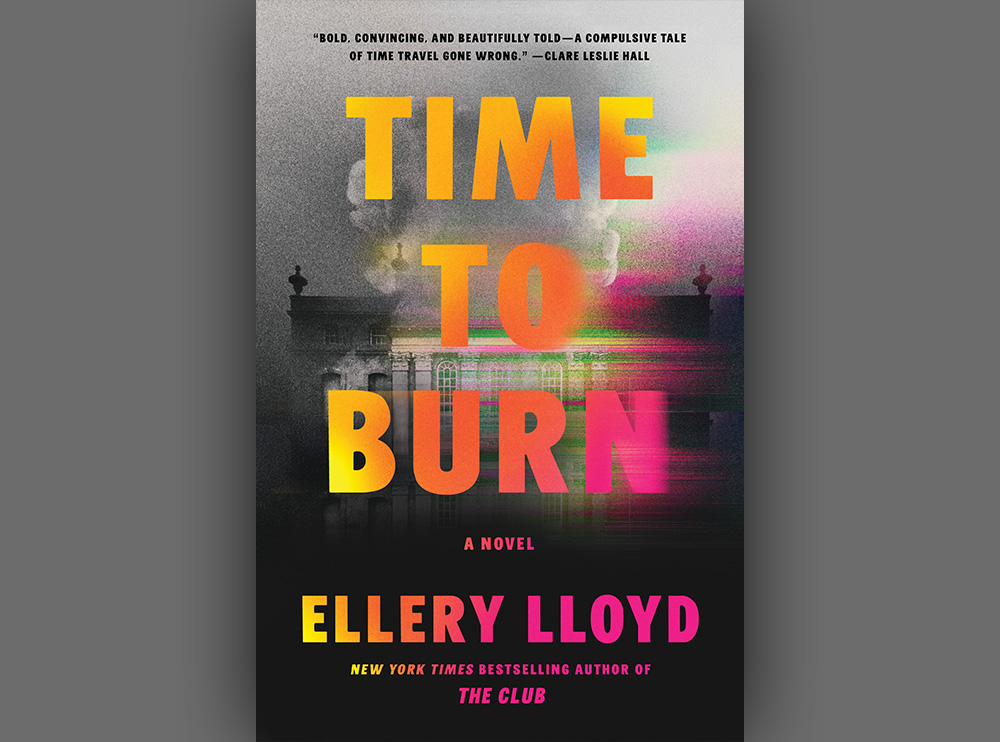
From the New York Times bestselling author of The Club comes a gripping mystery about time travel tourism and the dangerous consequences which ensue when the privileged make the past their playground.
Intrigued? Read on to discover the synopsis and an excerpt from Time to Burn by Ellery Lloyd, which releases on August 4th 2026.
Mercurial tech entrepreneur Inigo Frank has perfected commercial time travel, though it is tightly regulated and so expensive that it’s open only to the very wealthiest.
His company, Tempus Tours, has so far been approved for just one route: a journey back to London in 1941, to the days of the Blitz, allowing the super-rich to experience the awesome sights and sounds of the aerial bombardment of the capital during World War II. It’s a slick operation—routes across the wartime city are meticulously plotted, guides are extensively trained, and rules for the time tourists are strictly enforced.
To immortalize his achievement, Frank enlists award-winning filmmaker Phoebe Hunt to create a fly-on-the-wall documentary. On her first day shadowing Inigo, she is set to witness the return of a billionaire property developer and his family from their trip to the past. But instead of their awe-filled return, she captures the group arriving bloodied and traumatized, with one of their number missing.
Not only that, but Phoebe recognizes the missing woman, and knows not only that she’s not who she claims to be but that she has every reason to harbor a grudge against her. And as events begin to unravel in the present day, it seems increasingly clear that she had sinister motives for returning to the past—and that people close to Phoebe are in danger.
Phoebe must race to untangle the truth—before past and the future are rewritten.
With this inventive, propulsive and genre-bending page turner, the bestselling author of The Club and The Final Act of Juliette Willoughby once again delivers an enthralling tale of legacy and wealth, history and technology with a gripping mystery at its core.
EXCERPT
Tom Walker checked his watch. It was eight forty-five p.m. The restaurant was beginning to fill up now. At the bar, a man in a dinner jacket was pulling out a tall stool for his glamorous date in her blush satin evening dress. On the stage, an older man in shirtsleeves was arranging chairs for the band. At the next table, two men in uniform were making desultory conversation, evidently waiting for someone else to join them. Tom made brief eye contact with a woman in furs being shown across the room and looked away. Pretty much everyone was smoking.
Almost on tiptoes, his arms crossed behind his back, a very young waiter with sharply parted red hair and a freckled face was eagerly monitoring the room for a signal, a gesture. The doors to the kitchen swung on their hinges, back and forth, back and forth. Champagne corks popped. Voices rose and fell. At the far end of the bar, a member of the band blew a one-handed flurry of notes on his trumpet for a small circle of admirers, then struck a pose. As new arrivals made their way downstairs, they checked their reflections in the mirrors that lined the walls, straightening up, adjusting their expressions.
It was Saturday night.
They were in the Café de Paris, located underneath the Rialto on Coventry Street, just off Leicester Square, accessed down a long flight of stairs between the entrances to the cinema and the Lyons Tea House next door. Said to have been modeled on the ballroom of the Titanic, it was billed as the safest and liveliest nightspot in London, twenty feet underground.
There were five people at Tom’s table, two other men, two women, all of them here, with varying degrees of enthusiasm, for a lavish seventy-fifth birthday celebration. They had finished their starters and were awaiting their main courses. He had suggested they not wait to order their desserts or linger for coffee. In less than an hour’s time the table at which they were all sitting would no longer exist. In less than an hour’s time a considerable proportion of the people in this restaurant would be dead. Already, in the streets above them, the air raid sirens had started to wail.
The date was 8 March 1941. Right in the middle of the Blitz.
At precisely nine forty, just as the band—Ken “Snakehips” Johnson and his West Indian Orchestra—started up their second number, a pair of 110-pound bombs would come crashing through the ceiling above them. The first would fail to explode, spilling its contents across the dance floor. The second would detonate directly in front of the stage—about two feet from where Tom was now sitting—killing Ken Johnson and his saxophonist, as well as the café’s headwaiter and at least thirty-three others. Dozens more would be seriously injured. Almost miraculously, all the cabaret dancers—currently flitting around the room in a riot of feathers and sequins—would escape unharmed. One of the hardest things to process, on your first trip back in time, was that all of this was real. That this was no VR simulation. All these people who had been dead for decades were as alive as you were now.
That someone born in 1920 was all of a sudden younger than you.
This was the third trip to the past on which Tom had served as a guide for Tempus Tours. The first had been a picnic on the South Downs in August 1940, an anniversary gift from a recently retired hedge fund CEO’s wife to her history-buff husband, the Battle of Britain thundering on overhead, Tom pointing out which puff of white smoke, which plume of spiraling black, was what. The second had been a trip to 8 May 1945, with a gang of Silicon Valley billionaires, to experience the celebrations marking the end of the war in Europe, to witness Churchill waving to the crowds from a balcony in Whitehall, to observe him pulling that famous double V sign, to mingle on Piccadilly with the joyous throng.
Tonight was going to be very different. Tonight—at the client’s insistence—was to offer a whole new level of spectacle and, along with it, risk.
All through their meal, the woman on Tom’s left—Sasha Lavrova, the wife of Luke Allen, the son of tonight’s host, birthday boy Harry Allen—had been quiet, withdrawn even. Several times Tom had spotted Sasha—an elegant brunette dressed in a flowing black gown, a brightly embroidered silk stole around her shoulders—staring thoughtfully at the group of Canadians in blue air force uniforms sitting with their female companions at the next table over. All of them in high spirits, ordering bottle after bottle of champagne, laughing and talking at once. Not one could have been older than twenty-five. “What would happen,” Sasha finally asked Tom, “if we warned them?”
He smiled, patiently. Despite the weeks of training everyone had to go through, the lectures on the ethics and physics of time travel, the reams of legal documents they had all signed, the waivers ensuring Tempus couldn’t be sued in case of injury or psychological harm, on every trip so far someone had asked him a version of the same question: Was it possible to rewrite history?
Yes, was the simple answer. Nothing about the past unfolding around them was fixed, and nothing about the future that would follow was preordained. Nor was there anything magical about time travel itself—the basic mechanics of it were not even really all that complicated, once you understood them.
Of course what most people really wanted to know, when they asked that question, was not whether changing the past was possible but what the consequences would be. That was trickier to answer.
One thing that would happen, Tom reflected, was that Tempus Tours would be shut down and fined into oblivion. If the company or one of its guides was found guilty of failing to observe the Regulation of Time Travel Act, or of not ensuring their customers understood the law, there would be extensive jail time for everyone involved.
It was also rather harder to change the course of history than most people assumed.
Whenever, during the course of training, someone asked why Tempus did not use its technology to kill Hitler or prevent the Kennedy assassination, the obvious response was: How? It was a time machine that Tempus operated, transporting guests from a single central London location. It was not a teleporter.
Tom was conscious he had still not answered Sasha’s question.
“The first problem,” he said, “is how you are going to get them to believe you. If you march over there and announce you’re a time traveler with a message from the future, or a stranger who’s had a chilling premonition, how seriously are they likely to take you? Also, listen.” He paused, raising his hand a little to stop Sasha from replying. “Do you hear that?”
Sasha cocked her head. Faintly but distinctly, even over the hubbub of the room, muffled thumps could be heard.
“Those are bombs out there. Thirty thousand incendiary devices will land on this city before dawn. So many people will be injured that in two hours’ time, Charing Cross Hospital is going to run out of field dressings. So when you warn those people they aren’t safe here, even if you do manage to persuade them of that, where do you think they’ll go? Out onto the streets, in the blackout?”
“You’re saying it’s not even worth trying to save them?” Sasha asked.
“What I am saying is that they’re already dead. Even if they do survive tonight, when we return to the present none of the other people in this room will be alive. We’re amongst ghosts.”
At the other side of the table, Harry was bickering with Beatrice— his much younger, much posher girlfriend—about whether or not tonight was actually his birthday. “The eighth of March,” Harry kept saying, irritation audible in his gravelly voice. “That’s my birthday. That’s always been my birthday. Why do you think I’m paying a fortune for this jaunt if it’s not my fucking birthday?”
Blonde, skinny, brittle, and clearly not averse to an argument, Beatrice was standing her ground.
“A birthday,” she was saying, her accent clipped, her enunciation precise, “commemorates, each year, the day of your birth.”
“Exactly,” said Harry emphatically, stabbing the table with a triumphant finger.
“My point being,” she continued, equally emphatically, “that you aren’t going to be born for nearly a decade, so this is not technically your birthday at all.”
Harry’s son, Luke, visibly bored, a little puffy-eyed, his bow tie starting to come loose on his starched white collar, drained his glass of champagne and tapped the top of it for a refill from the waiter.
Tom checked his wristwatch. “We need to go,” he said.
Luke yawned and straightened up in his seat. Sasha touched his upper arm and leaned in to whisper something in his ear. Harry folded up his napkin and chucked it on the table. Beatrice glanced at him, then nervously across at the stairs.
“And you’re absolutely certain this is safe?” she demanded, a catch in her voice. Throughout the preparation process, Beatrice had made it clear this trip had not been her idea, that she was only doing it to keep Harry happy and because he’d insisted. Previously, Tom had assumed she’d rather they had spent the money on a party or a holiday. Only now did it dawn upon him how scared she was, beneath that spiky facade.
“It’s just like we talked about during the briefings,” Tom reminded her, in as soothing a tone as he could muster given the urgency of the situation. “Nothing is ever one hundred percent safe, but if we stick exactly to the schedule the risk is negligible. As you know, Tempus’s team of archivists has been preparing our route for months. Consulting the local civil defense incident register. Checking street-by-street, through the London County Council bomb damage maps, reading the Fire Brigade’s situation reports. Cross-referencing these with the eye-witness accounts of civilians, ambulance drivers, firemen, from the Imperial War Museum archives. Taking what information they can from hospital admission records, about who got hurt, how, and where. Plotting our itinerary down to the smallest detail. If you stand where you are meant to stand, and move when you are supposed to move, and listen carefully when I give you instructions, none of this is any more dangerous than crossing the road on any given day. Considerably less so, in fact.”
“Oh, come on,” said Luke, perhaps enjoying Beatrice’s alarm a little. Smirking slightly, he turned in his chair to face Tom. “I’m sure that’s what they tell you to say, but how can that possibly be true, given everything going on up there?”
“In the sense that when you cross the road, under normal circumstances, you have no idea what is going to come speeding around the corner. Tonight, in contrast, because all of this is a matter of historical record, you do. We know exactly what time each of the bombs that will fall on our path back to King William Street is going to land, and precisely what damage it will do. We know what kind of bombs they are, their type and weight. We know which will explode and which will fail to. We know which buildings are going to be damaged and how. We know, at least for the particular parts of central London we’ll be crossing, every recorded location where injuries and fatalities will occur. A lot of hard work, by a lot of very clever people, has gone into this trip.”
Tom paused, for effect. “Which is how we at Tempus Tours are able to offer you front-row tickets to the greatest and deadliest firework display there has ever been.”
He had already signaled to the waiter for the bill.
On the far side of the room, looking a little unsettled by the chaos outside, brushing something—was it rain or plaster dust?—from the shoulders of his coat, Ken “Snakehips” Johnson had arrived and was making his way down the grand staircase. There was a stir in the crowd as people noticed him. Johnson passed the headwaiter and said something to him. Both men checked their watches. Perhaps the exchange had been about the time the band was meant to start, who was here and who was yet to arrive. There was a fresh sense of expectation in the room, a different energy. Already people were taking their places around the edges of the dance floor, men with their hands rested lightly on their partners’ waists, women practicing brief sequences of steps.
Someone crossed the stage to adjust a mic stand. The crowd mistook him for one of the band, and for a moment, the room fell almost silent. In that lull, the thump of an explosion sounded, much louder and closer than any before. Someone laughed, nervously. Conversations resumed.
It was nine twenty. Now it really was time to go.
“Stay close,” said Tom, as they ascended to the street. About halfway up the stairs something went off nearby, and he flinched despite himself. He turned to address them all.
“Right. This is it,” he said as he led them out onto Coventry Street. He turned on his torch, its bulb shrouded in a paper cap, as per blackout rules.
“We’re heading east. It’ll be dark and uneven underfoot, so keep close to me and be careful where you’re stepping. Watch for debris. Remain mindful of the edge of the pavement. You’re going to see flames on the horizon and black smoke in the sky, and you will hear the German bombers. It’s a clear night, not much wind, perfect bombing weather. Buckingham Palace has already been hit, Westminster Abbey, St. James’s Palace, Waterloo Station. The glow visible on the skyline to the east is the Glico Petroleum Works in West Ham, which was hit about ten minutes ago and will be burning for days. Which is helpful for us because that’s the direction we need to be heading in. It’s going to be about an hour’s brisk walk. The aperture opens at midnight, and only for a brief window, so we all need to be in position by then. Is everyone clear?”
Tom flashed up the torch’s beam briefly to illuminate each of his group’s faces. One by one they nodded. Only Harry Allen looked uncomplicatedly excited for what was about to happen. Beatrice, her face set in a grimace, kept glancing nervously upwards. Sasha was holding hands with Luke, tightly. They all wrapped their coats—specially tailored, period appropriate—around themselves. Tom turned up his collar.
“Everybody ready?” Tom asked. They all nodded again.

It was one of those odd little etiquette things, on a trip like this, the way as a guide you pretended not to know much about your guests, never quite acknowledging but also never quite forgetting how wealthy, how influential, they were.
Harry, the East End lad done spectacularly good, the self-made property mogul, the birthday boy (even if it was indeed a good few years until he’d actually be born, in a small terraced house in Poplar, a few miles east of here).
His girlfriend, Beatrice, who at thirty-eight was just six years older than his only son. The granddaughter of Albert Downing, one of the city’s great postwar developers, a man who at this very moment was somewhere out there hatching plans to buy up bomb sites on the cheap, plans that would reshape London’s skyline, laying the groundwork for his own property fortune. The fortune that in a few decades’ time would be sending her to the sort of boarding school that had its own lake and stables. Of all the party, Tom had found her hardest to warm to. Tapping away at her phone, yawning, she had made it very clear how uninterested she was in any of the history lessons the group had been given (Sasha and Harry had been the keenest students; Luke for the most part had at least stayed awake).
Things that had been clearly explained multiple times, Beatrice would suddenly rankle at, as if they had just been sprung on her. Providing a 1941-appropriate outfit she’d actually wear was a nightmare. Despite being told repeatedly that they should all remain as inconspicuous as possible, tonight she had taken one look at her potted shrimp starter and sent it back. Only an irritated intervention by Harry had prevented her, when her steak arrived rarer than ordered, from calling the waiter back to complain again. Nerves may have explained some of her behavior, but Tom was not convinced they excused all of it.
Then there was Luke, Harry’s son, constant tabloid fodder due to his many trips to rehab, his multiple failed business ventures (a tequila bar in Mayfair, a tequila brand, a tequila-flavored vape), his high-profile broken engagements (to a glamour model, a fitness influencer, a very upmarket estate agent).
His wife, Sasha, the daughter of a Belarusian oligarch.
They were an almost comically attractive couple. Sasha with her cheekbones, full lips, her large green eyes. Luke with that mop of white-blond hair, slicked back tonight, the dimpled chin, the gym-pumped torso, the seemingly permanent slight pout.
It was Luke—who had turned up for the trip this morning thoroughly hungover, whose eyes when he took off his shades had resembled a pair of bloodshot pickled eggs—who had explained to Tom why this particular trip appealed to Harry. His father had always been a history nut, the Second World War a lifelong obsession. He was the kind of dad who insists you sit with him at eight years old and watch the whole of The World at War. Who reads eight-hundred-page books about the siege of Stalingrad on holiday. On his fortieth, Harry had paid for himself to go up in a real Spitfire. For his fiftieth, Luke told Tom, Harry had dragged his ex-wife and son around northern France on a weeklong tour of Second World War battlefields. In a way, thought Tom, what was a trip like this one but that same impulse, taken to its logical extreme?
Tempus hadn’t chosen this era as their first tour destination by accident. If they weren’t allowed to offer trips back to the Roman Empire—even a man as persuasive as founder Inigo Frank knew the government regulator could only be pushed so far—World War II was a smart second-best. There was something about war—this war especially, with its clear-cut good guys to root for and bad guys to hate— that obsessed people who could afford a trip like this. Mainly powerful men willing to pay a fortune just to feel something. Anything.
As they passed the doorman of the Café de Paris, they bobbed their heads and thanked him. Then they stepped out into the night.
“Oh my God,” Beatrice said, a new note of terror in her voice. “What are we doing?”
Tom had spent years reading about the Blitz. He had studied history at university, this period for his PhD. As an aviation buff, he knew how to distinguish the sound of different German bomber engines—a Heinkel from a Junkers from a Dornier. He had heard in old newsreel footage the stutter of antiaircraft fire, watched their crews aiming, straining to make out their target, as searchlights criss-crossed the underlit clouds. Nothing had prepared him for the sheer volume of this, though.
Organ-shaking. Nerve-juddering. Eyeball-quivering.
Each explosion—sharply painful to the eardrums—following on so closely from the one before that it was impossible to finish a thought. Like your very thoughts had been scrambled in your skull, every organ in your body jumbled around beneath your skin. The explosions almost preferable to the sound that returned every time they faded, the relentless inescapable drone of engines overhead, bomber after bomber after bomber.
Tom took a deep breath, then another. These people were relying on him. He took two steps further down the street and stumbled over something. A moment later, the sky lit up and he could see what it was. A split sandbag, lying in the middle of the pavement. Overhead a fantastic chandelier of falling incendiaries. In all directions the horizon ablaze, the heavens a mass of roiling smoke.
“Jesus Christ,” said Harry, the delight audible in his voice. “It looks like the fucking sky is on fire.”
A searchlight paused mid-sweep, and Tom could make out the shape of a plane, hung in silhouette against the clouds. Across the sky, arcs of antiaircraft fire rose from several positions, trying to catch the bomber—too slow, too late. Now the empty street was brightly lit, every shadow sharp-edged as noon, then suddenly darkness again.
Everywhere, from all directions at once, rose the sound of sirens. It was as if the whole city was a wounded animal, howling.
Tom had to admit, London was putting on one hell of a show.
At the end of the road a car was attempting a three-point turn, the driver’s face pale and panicked, the wheels of the car jouncing over scattered debris on the surface of the road. Something landed a few streets away and even the car windows seemed to shiver.
Tom forced himself to focus. East: That was where they should be heading. Up Long Acre, past Covent Garden, past Lincoln’s Inn Fields, down Chancery Lane. The impulse he somehow could not shake, that his brain seemed unable to resist, was to keep scanning the skyline for familiar tall London landmarks—Centre Point, the BT Tower—not yet built. Every time the night lit up, the shock at the jumble of church towers he did not recognize, the dark gaps where familiar buildings would one day stand, was the same. The streets deserted apart from the silhouettes of those furiously intent on their allotted tasks: aiming a plume of water in an arc up two stories into the smoldering hole in a roof, or frantically clearing a path down the middle of a brick-strewn road for an ambulance to pass.
By the light of a blazing tobacconist’s shop, Tom checked his watch. The Café de Paris had already been hit. He wondered what had happened to that table of fresh-faced Canadians, trying not to picture the dance floor, by now a jumble of scattered limbs, or imagine the medical crews, comforting the injured and dying.
Don’t think about it, he told himself. Focus. Tempus would open the aperture, the rift in time allowing them passage back to the twenty-first century, at midnight. Six hundred and seventeen seconds—just over ten minutes—was how long it could remain safely open for.
They were right on time, exactly on schedule.
Then it all went wrong.
TIME TO BURN. Copyright © 2026 by Ellery Lloyd Ltd. Reprinted here with permission from Harper, an imprint of HarperCollins Publishers