


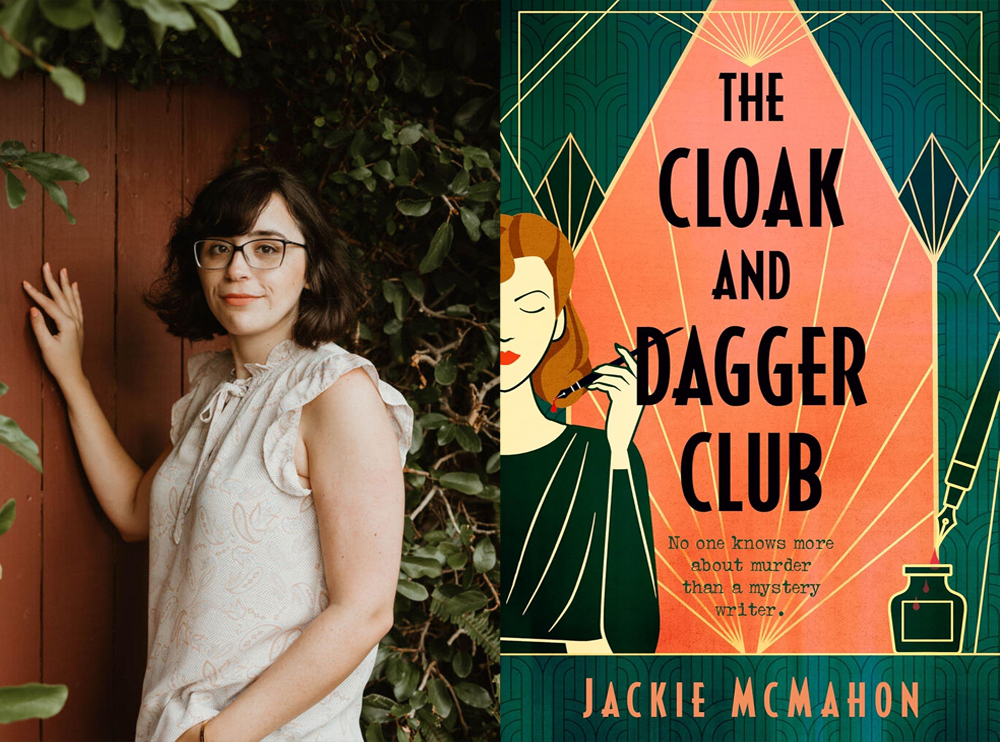
We chat with author Jackie McMahon about The Cloak and Dagger Club is inspired by Agatha Christie’s real-life Detection Club and sees a murder among a group of golden age mystery writers meets a second chance romance.
Hi, Jackie! Can you tell our readers a bit about yourself?
Hi, so glad to be here! The Cloak and Dagger Club is my debut, a fair-play mystery set in 1930s London surrounding a group of crime writers, where a real murder occurs. I’ve long loved mysteries, having read my first Agatha Christie in high school, and writing historical mysteries is perfect for me—I’ve been known to go down a Google rabbit hole from time to time, researching obscure historical questions.
When did you first discover your love for writing and stories?
I honestly don’t remember! It’s something that’s always been part of me. When I was two years old, and I didn’t know how to write, I would make up silly little stories and have my grandmother write them down for me. She’s the person I dedicated this novel to.
Quick lightning round! Tell us:
- The first book you ever remember reading: Disney’s Storybook Collection. My dad and I used to read it before bedtime.
- The one that made you want to become an author: My first attempt at a ‘novel’ was a mystery about a teen girl sleuth that I wrote in 3rd grade, a clear knock-off of the Nancy Drew series.
- The one that you can’t stop thinking about: Pride and Prejudice by Jane Austen is my all-time favorite novel. I could read it a million times and never tire of it.
Your debut novel, The Cloak and Dagger Club, is out now! If you could only describe it in five words, what would they be?
Murderous love letter to mysteries
What can readers expect?
The Cloak and Dagger Club is a fair play mystery in the Agatha Christie tradition, which gives readers all the clues they need to solve the crime. Since it’s a mystery novel about a group of mystery novelists, it has Easter Eggs and meta references to classic mysteries and mystery tropes. Mixed media elements include excerpts from the fictional books created by my fictional characters. Additionally, the book has a second chance romance between my main characters, Lucy and Frank, who broke up three years ago but have to work together to investigate a murder.
Where did the inspiration for The Cloak and Dagger Club come from?
The original idea came from a group called the Detection Club. Founded in 1930, it’s a club for crime writers that still exists today, and original members included Christie, Dorothy L. Sayers, and G.K. Chesterton. I loved the idea of all these famous crime novelists getting together and wondered: what would happen if a murder took place among a group like this? How would people who know so much about fictional murders solve a real one?
Were there any moments or characters you really enjoyed writing or exploring?
I love every character for different reasons. Lucy I relate to as an introverted book lover, and Frank is a character who I really understand psychologically. Even Horace—the club’s tyrannical president and the novel’s murder victim—was so fun to write because of how horrible and manipulative he is. He’s the complete opposite of everything I try to be in real life.
As for specific moments, my favorite line of the entire book is on page 278. I can’t tell you what it is, because that would be a spoiler, but if you pick up the book, you’ll hopefully know which one I mean!
Did you face any challenges whilst writing? How did you overcome them?
The hardest part of the writing process was finding my footing and getting started. I began my first draft of The Cloak and Dagger Club while trying (and failing) to get an agent for my first manuscript, a Regency mystery, and that made it hard to focus. But starting something new is the best thing an author can do when they’re waiting for news—both to keep yourself sane, and to ensure you’ll have something else ready to go.
This is your debut novel! What was the road to becoming a published author like for you?
The Cloak and Dagger Club was the second manuscript I ever completed. My first mystery didn’t get an agent, but when I saw Berkley was holding an open submission period for unagented authors, I decided to submit it. I was still polishing up The Cloak and Dagger Club, and figured, why not? I had nothing to lose.

Months went by, and in October 2024, I was almost ready to query The Cloak and Dagger Club when I got a positive response from a Berkley editor. I sent her the Regency manuscript, letting her know I was planning to query agents with another project in the next two weeks. For The Cloak and Dagger Club, everything happened extremely fast, which was not my experience the first time. My future agent was the second agent I submitted to.
December 2024, I got a positive response from Berkley, asking for a call. My agent told them about The Cloak and Dagger Club, and they loved that idea even more, so they asked to read it. January 2025, we signed a two-book deal. It was a wild journey. While my Regency mystery didn’t get an agent, it still helped me get where I wanted to go. I hope the lesson aspiring authors will take from this story is that no manuscript is ever a true failure.
What’s next for you?
I have a sequel to The Cloak and Dagger Club coming out next summer. I hope to write more books in the series after that, if it’s something readers and my publisher want. I’m also working on a draft for a new mystery, set in an entirely different time period, so that’s something I’m hoping to share with the world someday.
Lastly, what books are you looking forward to picking up? Any you’ve read so far this year that you’ve enjoyed?
One of my favorite reads of the year so far is another 2026 debut: The Oxford Guide to Scandal and Lies by Kate Westbury. It’s a delightful 1950s mystery set at Oxford, and it kept me guessing until the big reveal. Other books I’m looking forward to: A Killer for Christmas by Kim Harrington, Grace and Jo Have Never Solved a Murder by Jess Mey, and The Last Telegram of Mrs. Hudson by Mattea Orr.