

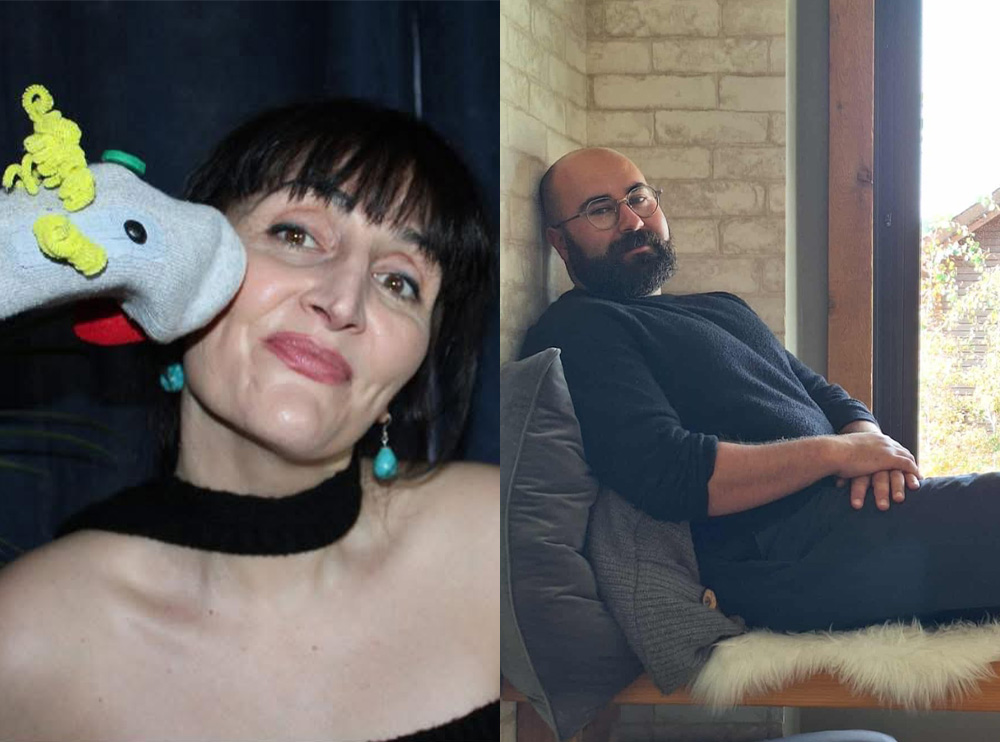


Acclaimed Calgary author Ben Berman Ghan joins Iranian-Canadian author Hollay Ghadery to talk about the speculative fiction renaissance in Canada and beyond, because what are borders anyway? And doesn’t speculative fiction so often blur and dismantle them? Most recently, Ben has authored The Library Cosmic (Wolsak & Wynn) , a fascinating collection of stories to follow up on Ghan’s debut novel The Years Shall Run Like Rabbits. From golems minding libraries that span millennia, to ghosts pursuing each other across deserts, to robots piecing together texts from lovers in a far future world, these are epic stories, sure to delight readers looking for magic, wonder, and compelling story telling.
Hollay’s fourth book and debut novel, The Unravelling of Ou (Palimpsest Press), tells the story of Minoo—a woman exiled from Iran to Canada after a teenage pregnancy. The story features first-person narration by the protagonist’s sock puppet. This approach provides a unique lens for the examination of female shame, neurodivergent experience, and the courage required to break free from internalized oppression.
Hollay realizes her initials spell HAG and as a middle age woman, is enthusiastically leaning into the dark whimsy they conjure—especially for this conversation on speculation fiction.
Hollay Ahktar Ghadery (HAG): I for one never start writing fiction thinking it’s going to be speculative. That’s something that happens because of how I want or need to approach an issue or perhaps there’s something about our world that doesn’t feel like it’s adequately equipped to explore how I experience life. For instance, with my novel, The Unravelling of Ou , I had no intention of having any speculative element to it, and perhaps some people would read the book as completely based in reality. But the fact of the matter remains that I see my sock puppet narrator as a separate entity, or at least as a distinct symbiotic entity. I needed to slip the confines of restrictive heteronormative, patriarchal, and Neurotypical, thinking to access what I felt was a lived reality for my character Minoo. Enter the sock puppet. Enter speculative fiction.
What about you? Is speculative fiction something you set out to write deliberately?
Ben Berman Ghan (BBG): I am enmeshed in genre, in the study of it, the reading of it, its culture and production and creation. So yes, I go into a new story already thinking about where it sits, what my work is playing into or subverting, what I am in conversation with. Most often, I get described as a science fiction writer. This makes sense to me, though there is very little science in my stories. Increasingly I have turned towards horror, and the gothic, and the weird. It isn’t everyone’s approach, I know, but I think of literature as a really, really slow conversation across the decades, and it matters to me to know what is being said in a conversation I yearn to contribute to. I wrote most of the stories in The Library Cosmic between 2021-2023, and then spent years editing. But the stories in this book were looking towards were speculative just as often as not. Arkady Martine’s A Memory Called Empire, and Jack Kirby’s Eternals, and Jeff VanderMeer’s Dead Astronauts are on my mind somewhere in these pages, but so is Maggie Nelson’s Bluets, and so is Kim Fu’s Lesser Known Monsters of the 21st Century. Genre has a wonderful capacity for metaphor, don’t you think? If a writer feels despairing, or lonely, their character may find themselves the only living person on a desolate, empty planet. If a writer is feeling hopeful, twinkling stars can appear in the sky, and magic can be real.
HAG: Absolutely! And speaking of metaphor, the way that you opened your novel, The Years Shall Run Like Rabbits, is indelibly imprinted on my brain; the image of an angel kneeling in a garden on the moon. It’s gorgeous and haunting. I was delighted to see you flex the same muscle in your short fiction collection, The Library Cosmic. Your work is airy but also intense and it’s a heady mixture. Tell me about the process of entering these worlds that you created and staying in them—especially staying in them because I found it exhilarating, but also consuming to stay in the world of my novel.
BBG: All-consuming seems like a good description! But I’m really only happy when I’m enmeshed in a story. The times between writing, the times between having a good idea to pursue and chew on, these are probably the times when I’m my most unpleasant, my most frustrating. I like being in these worlds. I usually just kind of fall into them. I don’t think about worldbuilding when I first start crafting a story, to be honest. Imagery and character and feeling come naturally, and then the world around it logically follows. The worlds in The Library Cosmic follow something of a stranger series of moods than the novel that came before, perhaps, caught between the extremes of hope and nihilism that I spent a lot of the pandemic in. Once I’ve fallen into the world of a story and I have the characters and the moods and the images, then I take lots of notes, I build things out and build things up. It is important that you, the writer, knows how everything works and how every little thing ends up where it is, even if you aren’t going to tell your readers, or at least, I think so. Really the biggest problem with my need to fall into a story, is that it is always the next story no satisfaction from the last thing done, no lingering intoxication. I am always chasing that next high, the act is the thing, I suppose. Is it like that for you?
HAG: Oh definitely. I always say I’m going to take a break after a book and then I never do. I need that next bump. I haven’t even quite finished a collection of essays I have due to publishers in the next few weeks, or the poetry collection I received a grant for after that, and I’m thinking about my next novel, which will definitely be speculative. But I never set out to write speculative fiction, unlike you. As this next story started developing in my brain, before I wrote anything down, I realized that if I wanted to investigate the themes I wanted to explore, the only way I could do that— the only way I could explode the systems and conventions and pick through the mechanism—would be to slip the (false) consensus of reality. I feel like it’s not just me who is increasingly drawn to speculative fiction, though. There is a speculative renaissance, and I’m noticing many Canadian writers have tapped into it. I’ve already circled why I think literary artists, like myself, might be drawn to this genre right now, but I’d love to hear your thoughts. And why do you think Canadian writers in particular seem increasingly drawn to spec fiction? If you agree with me at all about this part.
BBG: In terms of if/why more “literary” writers are drawn towards speculative fiction, I’m not sure how much I have to say about it. I was always drawn to this. I have always loved it. It is good more people have caught on, but I can’t say why, because I didn’t have the revelation with them! I don’t enjoy the term “literary” fiction to be honest, it is so restrictive, yet so vague. What makes something literary? There is artful and beautiful writing in literary spaces, there is terrible writing in literary spaces. There’s artful and beautiful writing in speculative lit scenes, and terrible writing in these scenes.
However, what I can say more about is I am encouraged by how much speculative fiction Canadian publishers have put out in recent years!! Just recently, Geoffrey D. Morrison’s The Coffin of Honey over at Coach House Books, Whitney French’s Syncopation: A Novel in Verse at Wolsak & Wynn, and A.D. Sui’s Our Infinite but Inevitable Ends which is forthcoming with ECW. All beautiful works, all very spec, very genre. It is good to see how much less closed off genre writing is from “literary” writing. I get very frustrated when people from one “camp” refuse to read the other and vice versa. Maybe that’s what feels different, really. Not the writers, but the readers. Readers seem far more open to finishing the new Sally Rooney or Rachel Cusk, and then picking up the new Jeff VanderMeer or Stephen Graham Jones or the new Isaac Fellman (look at me sneaking in my faves all throughout this answer hehehehe) from the same shelf, and not really thinking about how the genre lines may divide these books! If anything, I’m sure that has helped open up more writers to exploring different kinds of writing in their own work. I’m hesitant to say this is a uniquely Canadian affair either. It has happened here, it has happened all over. “Literary realism” as we think of it today, isn’t really that old or well defined a genre. “Literary” as fully separate and serious and altogether apart from the fantastic It is a microscopic blip in the history of art.
HAG: As someone who works in publishing, I’m definitely seeing speculative fiction more in Canadian books and I’m noticing—talking to other Canadian writers—that more writers are thinking about venturing into speculative realms more often, which perhaps has something to do with what you’ve touched on about genre lines being blurred and noticing readers aren’t fussy about genre divides.
Based on conversations I’ve had and I’m still having, I’m aware of writers who have always been drawn to speculative fiction, but who have stayed away from writing it because they felt there might not be taken seriously or there’s no serious market for it. These writers seem more ready to write it themselves, and I agree: it may be due to the heartening agility of readers. Of course, you are right that possibly it’s not just in Canada, but that’s where my career focus is and that’s where I’m noticing the change.
I feel like Canadians can sometimes have an inferiority complex—and this isn’t just related to art, but I’m most interested in how this plays out the way we talk about our culture. My interest is not born in any sense of nationalism either. Rather, I’m fascinated by the way people relate to and communicate about the spaces and places they are from. Speculative fiction is an infinitely exciting prism through which I can interrogate this preoccupation.
[To Ben: if you feel like I’m getting off topic here or straying too far, feel free to redirect and I’ll edit. I’m so jacked up on antihistamines right now. I’m not sure I’m even thinking straight.]
[To Hollay: This makes sense to me! I’m just gonna have to think about my answer. And oh no! I hope you feel better soon]

[[we should keep this exchange in the interview]]
[To Ben: Considering my new allergies I thought to be the result of human made climate change and this is a discussion about speculative fiction, it seems fitting to try to leave it in. I’m on my first day without Claritin, though my doctor assures me taking it every day even with my SSRI is perfectly safe, but these days nothing feels perfectly safe, you know?]
BBG: I’m not really interested in “CanLit” the way some people talk about it, as an ongoing project, as something nationalist and unique. I am interested in literatures in Canada, and what work people are contributing and what work is flourishing here. It is hard for me to think of speculative literature as something that adheres to a national writing scene. When I think of the magazine culture of spec, and the reading culture of spec, part of my hope and my delight is that Canadian speculative writing can find a place not in a “national” writing scene but in a writing scene without borders. One that, like speculative fiction itself, allows us to step into a bigger and more wondrous world. Something that’s been so interesting looking at our moment of Canadian speculative fiction is, like you said, the way writers are communicating with spaces and places. There’s something prickly and interesting seeing the specific way authors are transforming spaces like Toronto, or Montreal, or Vancouver, or Calgary through these works. I think the way I turn Montreal into a space for eco-cultists in Church of the Hot Pink Jesus, or the way that Andrew Sullivan can turn Toronto into a horrible sludgy hell in The Marigold, or the way Larissa Lai can transform Vancouver into the city of Tiger Flu, or the way Cherie Dimaline’s The Marrow Thieves rips through Ontario. That I think, is one of the big strengths of speculative fiction in Canada, in the capacity to consider place, and how our positionalities may be affected by place.
HAG: Love this answer. I think it’s a perfect way to wrap up this conversation, but first, want to shout out some speculative books we’ve loved? I’m going to keep mine to Canadian and Indigenous authors, but you can, of course, recommend anyone you’d like.
- As the Earth Dreams: Black Canadian Speculative Stories, edited by Terese Mason Pierre (House of Anansi).
- Call Me Stan & Stand On Guard by K.R. Wilson (Guernica Editions)
- Love After the End: An Anthology of Two-Spirit and Indigiqueer Speculative Fiction, edited by Joshua Whitehead (Arsenal Pulp Press)
- The Cross series (there are four of them!) by Peter Darbyshire (Wolsak & Wynn)
- The Monster in the Mirror by KJ Aiello (ECW Press)
- Countess by Suzan Palumbo (ECW Press)
- Gitwaałtk by Crystal AJ Smith (Gordon Hill Press / The Porcupine’s Quill)
- Breathing is How Some People Stay Alive by Alison Gadsby (Guernica Editions)
- The Haunting of Modesto O’Brien by Brit Griffin (Latitude 46 Publishing)
- The Years Shall Run Like Rabbits and The Library Cosmic by Ben Berman Ghan (Wolsak & Wynn)
- NMLCT (poems) by Paul Vermeersch (ECW Press)
BBG: Omg I think you’ve actually stolen a lot of the Canadian ones I wanted to say!! So I will just throw in a few more here both Canadian and otherwise. Boy, I do love books. Unfortunately, I’ve already mentioned a whole bunch throughout our interview, so apologies for some repeats here!
- The Marigold by Andrew Sullivan (ECW Press)
- The Coffin of Honey by Geoffrey D Morrison (Coach House Books)
- The Annual Migration of Clouds (and its two sequels!) by Premee Mohamed (ECW Press)
- Syncopation: A Novel in Verse by Whitney French (Wolsak & Wynn)
- Rakesfall by Vajra Chandrasekera (Tor Publishing)
- The Buffalo Hunter Hunter by Stephen Graham Jones (Simon & Schuster)
- The Practice, The Horizon, and the Chain by Sofia Samatar (Tor books)
Ben Berman Ghan is the author of The Library Cosmic (Buckrider books 2026), The Years Shall Run Like Rabbits (Buckrider Books 2024), and more. His work has appeared in Clarkesworld Magazine, Strange Horizons Magazine, and The Ancillary Review of Books. Ben is a PhD Candidate at the University of Calgary, and lives in Calgary with his partner and his cats, and is the co-editor in chief of Paper Bill Press. Find him at www.inkstainedwreck.ca
Hollay Ghadery is an Iranian-Canadian multi-genre writer living in Ontario on Anishinaabe land. Her acclaimed memoir Fuse (Guernica Editions 2021) won the 2023 Canadian Bookclub Award for Nonfiction/Memoir. She is the author of Rebellion Box (Radiant Press, 2023), and her short fiction collection Widow Fantasies (Gordon Hill Press, 2024) was a finalist for the Toronto Book Awards. She is a host on The New Books Network and HOWL on CIUT 89.5 FM, and serves as Poet Laureate of Scugog Township. Learn more about Hollay at www.hollayghadery.com