

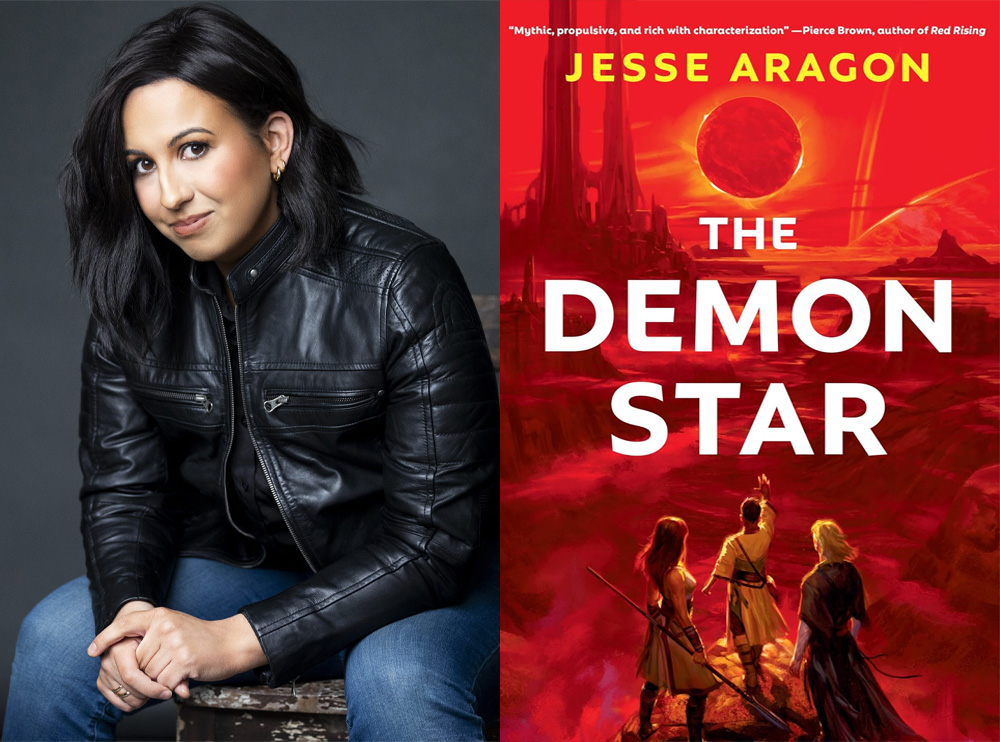
We chat with author Jesse Aragon about The Demon Star, which sees the otherworldly religious conflict of Dune, the cosmic strangeness of Gideon the Ninth, and the heart-pounding action of Red Rising converge in this horror-tinged epic science fantasy debut
The Demon Star is a multi-POV science fantasy about three humans seeking the power to overcome their tyrannical gods. Please tell us a little about your main characters?
The Demon Star has two main POVs, Jacen and Ysira. They’re both about 30, which is the age that I am. There’s a lot to explore in this life stage, where you’re a little more experienced and established, but that comes with this expectation to be a leader or a mentor. You might be in brand new territory just like when you were 20, but there’s more pressure because you’re expected to have more figured out, and more people rely on you. Odds are, you’re also somewhat disillusioned with how your life has turned out—or, as is the case for Jacen and Ysira, even downright embarrassed.
Women are subjected to a lot of messaging about how as we age we’re no longer as valuable—no longer ‘main character material’, so to speak. With TDS, I decided to lean into my frustration over this. I feel like mothers in particular are often sidelined or vilified in SFF books, so I tried to deconstruct that with Ysira. She’s a mother who never really planned on being one, and one of her defining traits is an overwhelming need for recognition and significance.
Neither Ysira nor Jacen would be the main character in a traditional fantasy story—that would be Ysira’s eleven-year-old son Neri. He’s the one who’s supposed to save the world, but it’s his parents and mentors who are pulling the strings. I wanted to explore how they feel about that power, how they use it, and how their own baggage affects how they relate to Neri. He never gets his own POV; you only ever see him through Jacen or Ysira’s eyes, and that was a very intentional choice.
How did your own life experiences and travels influence the world and themes of the novel?
My parents work overseas, so I was born in Brussels, Belgium. I had a lot of incredible experiences because of this multicultural upbringing, but it also made me a bit of an outsider. In the Belgian school system, I experienced a lot of bullying. When I started attending an American school on a base, I didn’t fit in there, either. I’m also of mixed ethnicity, which adds another layer of complication. I’ve spent a lot of my life trying to figure out where I belong, and whether I’m ‘enough’ of anything.
Both main characters of The Demon Star struggle with this, but especially Jacen. He’s been displaced in a pretty extreme sense, in that he’s had his childhood memories erased, and I did draw on personal experience to write him. I was exposed to a lot of military propaganda, and for a long time, to compensate for the sense of displacement I felt, I leaned into that fanatical brand of patriotism—a concept of identity that’s tied not to culture or place, but to ideology. This is reflected in Jacen’s character arc.
It’s incredible how much worldbuilding is packed into this standalone novel, and the demonic xenobiology inhabiting the planet is truly spine-tingling. How did you come up with it?
Growing up, I was obsessed with The X-Files, and my favorite episodes were always the ones with weird bugs or parasitic worms. I’m also a big fan of sci-fi horror creatures like in Aliens or Starship Troopers. In general, I just really like bugs. If you take me to a zoo, I’m going directly to the insectarium.
I also love horror movies about exorcisms, so I suppose it just made sense to me to combine demonic possession with parasitic worms and insect infestations. It all makes for great material to explore themes of bodily autonomy and free will.
Can you talk about the religious conflict facing the citizens of Zivora?
I drew on my Hispanic heritage in the US Southwest. Religion is a big part of this culture, and it’s marked by syncretism, blending Spanish Catholicism, indigenous religions, and Judaism. This came about not only through intermarriage and cultural exchange, but through forced assimilation, discrimination, and violence—which is also reflected in the region’s language, and its very people. I used that as a jumping off point for creating the world of the Scar, though more on a thematic level than anything, since it’s definitely not supposed to be a 1:1 equivalent.
I wanted to dig into the dissonance that’s inherent in a vibrant, beautiful culture that wouldn’t exist without a complicated, often ugly history. Zivora’s religion was not adopted by choice, but it’s woven its way into citizens’ lives and ways of thinking anyway. While this is often a very bad thing, it’s also given many people comfort, healing, and purpose. I wanted to make readers stew in this discomfort, of how you can love a thing that’s done you incredible harm, without providing easy answers. I tried to display a wide variety of perspectives on religion, none of which are objectively correct, and all of which respond differently to their world being upended over the course of the story.
Who are some of your genre influences?
My most obvious influences are old school space opera classics, notably Frank Herbert, Isaac Asimov, Gene Wolfe, and Dan Simmons—sci-fi that feels like epic fantasy. I actually take most of my cues from epic fantasy, so I’d be remiss not to mention George RR Martin. I read A Song of Ice and Fire when I was probably way too young for it, and it shaped the way I think about writing. It made me want to take big risks, explore consequences, and dig deep into the humanity of characters I would never want to meet in real life.

In a stylistic sense, I owe a lot to more modern writers—Kameron Hurley, NK Jemisin, James SA Corey, Pierce Brown, Brian Staveley, and Joe Abercrombie. These are all writers who can do fast-paced, twisty plots without sacrificing complexity or intricate worldbuilding. Their work is dark and high-stakes, full of impossible moral quandaries and very human characters who don’t always make the right choices.
Which identities or communities are reflected through your main and supporting characters?
Both POV characters are bisexual. There is a polyamorous relationship depicted in this book, though it’s not meant to be the healthiest example of one. The setting’s culture is largely made up, but most of the characters are described as people of color, loosely coded as Hispanic/Latino of varying racial backgrounds.
Jacen’s character in particular struggles with his mental health. It’s important to me to write unflinchingly about mental illness, never shying away from how messy and complicated it can get. That’s the sort of portrayal that’s always helped me process my own issues, especially having seen a lot of the uglier sides of humanity in my work as an EMT and RN. I want readers who need this kind of representation to feel seen.
Fascinating!
Ha! Nice. You’d love the insect wing at the American Museum of Natural History in NYC if you’re ever in town