


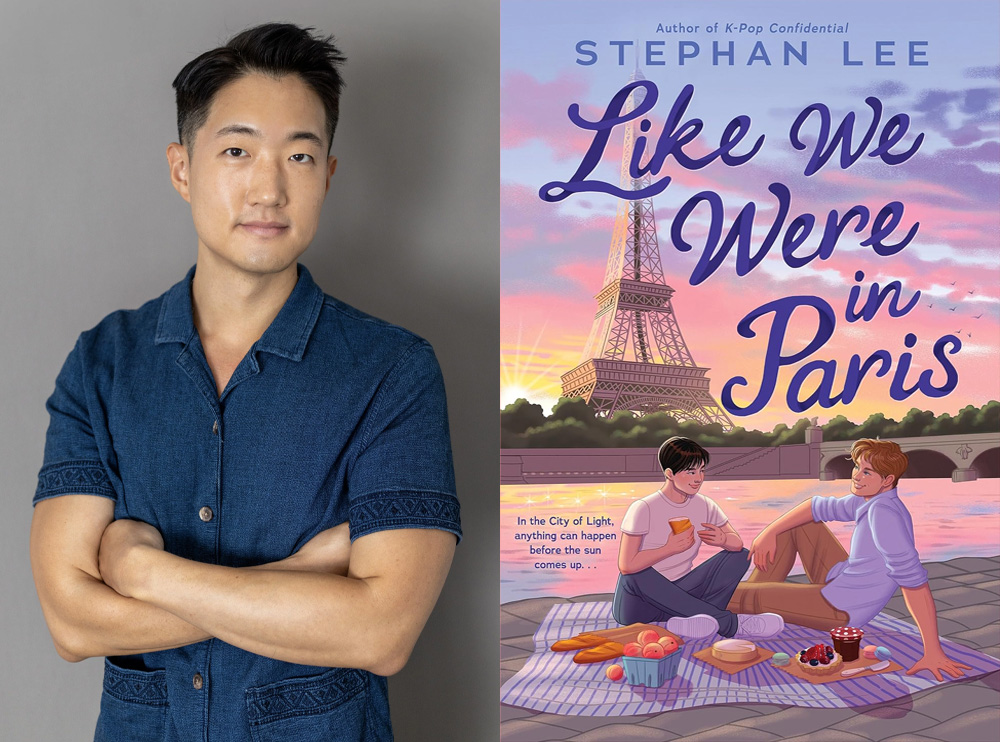
We chat with author Stephan Lee about Like We Were in Paris, which is an irresistible, swoony YA rom-com about two boys unexpectedly falling in love over the course of one night in Paris.
Hi, Stephan! For readers discovering Like We Were in Paris for the first time, how would you describe the book?
The original pitch was Before Sunrise meets the Paris storyline of Heartstopper, which remains an incredible pitch, if I do say so myself.
The book follows Ben Lim, a Korean American teenager on a school trip to Paris, who gets locked out of his hostel for one night. He ends up exploring the city with Tyler Travers, a boy from back home with whom he has a very complicated history. Over the course of those few hours, they have to confront everything they’ve never said to each other while also trying not to get lost or expelled or emotionally destroyed.
More than anything, I wanted to write something fun, funny, romantic, and truly transporting – something that’d take you on vacation even if you couldn’t physically go yourself. I wanted it to feel like a “song of the summer” in book form.
Why did you want the story to take place over a single night?
I loved the constraint of knowing Ben and Tyler only have this tiny window of time together. There’s something so romantic and terrifying about having only a few hours to change your life or say the thing you’ve always wanted to say.
The first image I had when I began writing was Ben realizing that the door to the hostel will not budge and that he is really, truly locked out. As a former “good kid,” that moment felt viscerally frightening and exhilarating to me. He has followed the rules his entire life, and suddenly following the rules is no longer an option.
At that point, he has a choice: he can spend the night panicking about how much trouble he’s in, or he can accept that he’s already broken one rule and might as well break a few more while having the best night of his life. That was the emotional engine of the book for me.
Paris has inspired countless love stories. How did you make your version of the city feel personal?
I wanted to embrace the fantasy of Paris without pretending that everyone experiences that fantasy in exactly the same way.
Ben absolutely arrives with all the cinematic expectations. He wants romance, beauty, glamour, pastries, dramatic walks along the Seine—the whole thing. But he is also a queer Korean American teenager who is very aware that people like him have not traditionally been placed at the center of these sweeping European love stories. Even within the queer community at his school, he’s definitely on the outside.
That tension interests me. What happens when you desperately want the fantasy, but you also understand all the reasons you may not be the person the fantasy was designed for?
I was also inspired by books about American writers and artists who went to Paris hoping to reinvent themselves. I read Proust and biographies of expat writers like Ernest Hemingway and Gertrude Stein while working on the book, which sounds hilariously grandiose when I’m also talking about The Lizzie McGuire Movie. But all of those influences belong together in my mind. They’re about people going somewhere beautiful and foreign and using it as permission to become someone new.
You’ve described The Lizzie McGuire Movie as an inspiration. What did you take from it?
I love any story where a school trip turns into a huge, glamorous, disastrous, life-changing adventure. That is one of my favorite fantasies.
There’s something wonderful about leaving your ordinary environment and suddenly believing anything could happen to you. Maybe you’ll perform at an Italian music awards show. Maybe you’ll fall in love in Paris. Maybe an adult chaperone will be revealed as super incompetent. These are the risks we take when traveling.
I wanted Like We Were in Paris to have that same feeling of a normal teenager unexpectedly becoming the main character in a movie. It also makes me genuinely happy that younger generations continue to discover the magic of Hilary Duff.
Ben is deeply sincere in a culture that often rewards detachment. Why was that important to you?
Ben’s superpower is that he understands his dreams and obsessions are worthy simply because they are his. He loves things openly–that’s something he learned from his father when he was alive. Ben has references. He wants too much. He is not very good at pretending not to care. In other words, he is cringe—and I mean that as the highest possible compliment.
We live in such a self-conscious culture. Everyone is terrified of being caught wanting the wrong thing, loving something too intensely, failing in public, or displaying too much sincerity. But almost everything worth doing is at least a little cringe, including falling in love or obsessively curating a dream trip where you’re the main character. Giving a sweet little book five stars on Goodreads is cringe. Hint, hint.
If you remove all possibility of embarrassment from your life, you also remove so pretty much all the joy and hope for the unexpected. I wanted Ben to understand that instinctively, even when the world around him tries to make him feel foolish for it.
The novel is romantic, but it also seems clear-eyed about who is most easily cast as the lead in a love story. How did you approach that balance?
Romance has always been difficult for me to write because I don’t want to create a fantasy that feels inherently dishonest.
I love swoons, tropes, yearning, misunderstandings, dramatic declarations—all of it. But I’m also a 40-year-old gay Asian American man who knows that not everyone can stumble their way into a love story. I have experienced the daily, constant, and agonizing pain of feeling invisible or automatically dismissed, especially in environments where people are making instantaneous decisions (or swipes) about who is desirable. It also makes it harder when you grew up thinking that being among queer people would be sort of like a cozy, small village and then discovering that hierarchies and prejudices are all there in full force, too.
Ben falls for Tyler, who is a very legibly attractive, privileged white boy. That is a familiar pairing in young adult fiction and romance, and I wanted to make sure the book never suggested Ben should simply feel lucky to receive Tyler’s attention. Their differences in privilege matter, and both of them know it.
But privilege is also complicated. Ben enters the night assuming Tyler has been protected from every form of pain, and he learns that isn’t true. Each boy’s hurt is connected to his identity, but it is also connected to being human in a difficult, wonderful, unfair world.
I wanted to hold two truths at once: the search for love is shaped by race, sexuality, gender norms, and power, yet love can still surprise you. Wonderful people really can enter your life on an ordinary day and disprove every cynical belief you’ve developed about who gets to be chosen. That isn’t naïve. It is literally something that happens every day.
Taylor Swift is part of the book’s DNA. What does her work bring to the story?
First of all, there are many deep-cut references for the people who will understand them. I shan’t apologize. But beyond the references and the title, I think Taylor Swift understands something essential about romance: an experience does not become meaningful only because it ends well.
Love can be cinematic and mythic because of the imagination and drama and attention you bring to it. A relationship can end. A person can disappoint you. You can eventually understand that what happened was more complicated than the story you initially told yourself. None of that means the feelings were fake or the memories were worthless.
Ben is someone who believes in giving experiences meaning. He doesn’t wait for the world to certify that something mattered before allowing himself to care about it. That feels very connected to the way Taylor writes about memory, longing, and the stories we build around the people we love.
The book sounds lighthearted, but you’ve said it was one of the hardest things you’ve written. Why?
Because lightness is hard!
I am a person with many dark and heavy emotions, so I love pop culture that is unapologetically fun. I’m always a little disappointed when it’s time for a “song of the summer” and all my favorite pop girlies release their deepest, most depressing albums. I love those albums too, but sometimes I need a song that makes me want to jump around the room.
I wanted Like We Were in Paris to feel breezy, funny, and effortless. Unfortunately, creating effortlessness required an enormous amount of effort.

The biggest challenge was making the romance believable within one night. I didn’t want Ben and Tyler to feel like two attractive characters being pushed through a machine that squeezes them through familiar tropes. They needed a real history. They needed to misunderstand each other in specific ways. They needed wounds and desires that existed before the first page.
I wanted readers to feel swept away, but I also wanted them to believe every step that carried them there.
What do you hope queer Asian American readers take from Ben’s story?
I hope they feel entitled to the fantasy.
Not entitled in the sense that life owes any of us one particular happy ending, but entitled to desire, hope, beauty, adventure, and romantic possibility.
I would never tell a queer Asian kid that the gay world will treat them fairly or most guys won’t completely overlook them as romantic potential. I’ve lived some life, and I don’t think false reassurance is useful.
But I would tell them that being overlooked by certain or even most people does not make them inherently overlookable (is that a word??). I would tell them that other people’s limited imaginations do not determine the size of the life available to them. I would tell them that the unexpected happens constantly, and that ridiculous hope, even beautiful delusion (how is that not a Taylor song title??) is sometimes simply an accurate understanding of how unpredictable life can be.
Ben does not need to become less Korean, less queer, less intense, or less himself to earn a great love story. He needs to stop assuming he has already been disqualified from one.
What do you hope all readers feel when they finish the book?
I hope they feel lighter. I hope they want to travel somewhere, text someone they miss, or do something a little embarrassing… it’s all for the story.
Mostly, I hope they feel more willing to want what they want without apologizing for it.
So much of adulthood involves learning how to protect yourself from disappointment, which is useful until it isn’t. Ben’s night in Paris does not teach him that nothing bad will happen if he takes a risk. It teaches him that something wonderful might happen too.
What’s next for you?
The sequel to Donutella Hamachi and the Library Avengers, the middle grade novel I co-wrote with drag icon and beauty superstar Kim Chi, is coming in 2027. I’m so excited for readers to see where that story goes next.
There are also some very exciting developments involving the film rights to K-Pop Confidential, my first novel, though I can’t say much more about that yet.
And I’m working on my adult literary debut, which I have been writing for much, much longer than any of my young adult or middle grade books. I am determined to finish it this year. Please send love and light! Although maybe discipline and threats would be more effective. 🙂