


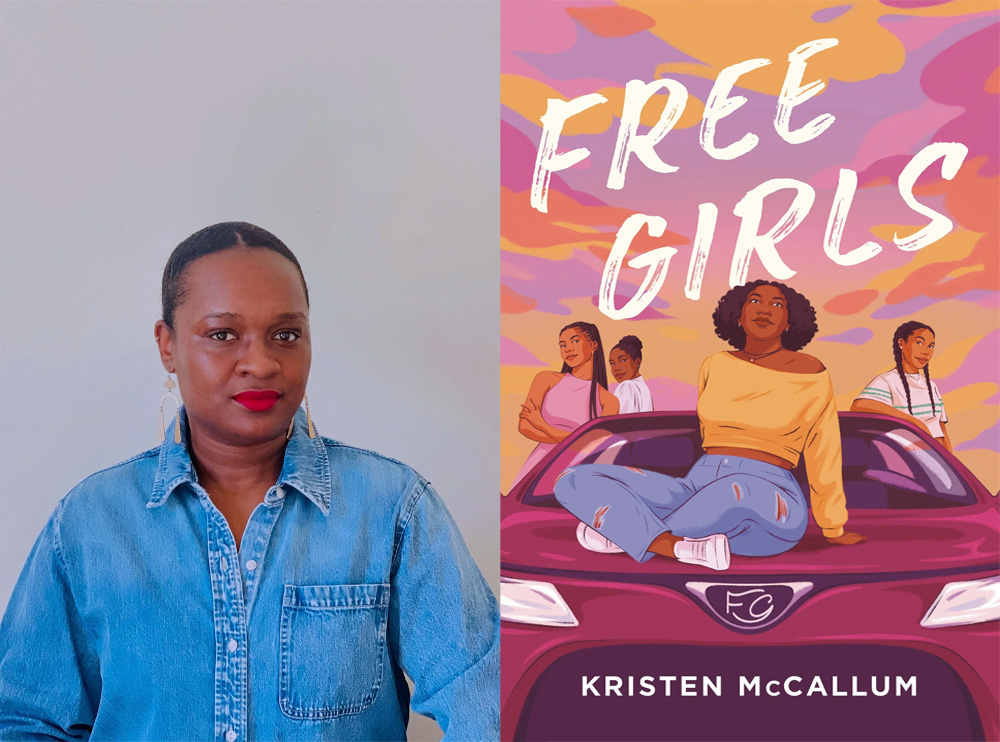
We chat with author Kristen McCallum about Free Girls, which is a heartfelt coming-of-age debut about a girl starting over while keeping secret that she’s spent the last year in juvenile detention.
Free Girls follows sixteen-year-old Jasmine Cooper in a journey of rediscovery through new familial dynamics, friendships, and romance after spending a year away in a juvenile detention center. Can you tell us a little bit about the book and what inspired you to write this story?
The book is about a teenage girl named Jasmine who’s trying to find her way through one thing after another, and it never really feels settled for her. I’ve always wanted to write a story like this, but the shape really became clear some years ago, after I gave a short talk at my former detention center. Being back there reminded me how much of that experience sticks with you, even after you leave, and how it shapes the way you see yourself. I wanted to explore that through Jasmine, especially what it looks like to come back and figure out who you are when everything feels different.
Free Girls is a heartfelt and thoughtful coming-of-age story that allows for Jas to figure out who she really is in the context of her new life. What are your favorite coming-of-age stories? What helped you in capturing Jas’ experience of adolescence and trying to fit in?
Ahhh… I have so many favorites but a few off the top of my head are Sula by Toni Morrison, The House on Mango Street by Sandra Cisneros, Their Eyes Were Watching God by Zora Neale Hurston, Clap When You Land by Elizabeth Acevedo, The Brief Wondrous Life of Oscar Wao by Junot Diaz, Promise Boys by Nick Brooks and Nothing Burns As Bright As You by Ashley Woodfolk!
It was a really interesting experience to work through Jas’s journey of fitting in, because it brought up so many questions about the chaos of my own adolescence. What did fitting in even mean to me? What did I think I had to do to get there, and did I ever actually get there? Once I started sitting with those questions, I wanted to ask Jasmine the same things and give her the space to figure that out for herself.
In the story, Jas is sent to the Guiding Hearts Home for Troubled Girls where she deals with the struggles of strict rules and punishments. What went into your depiction of life in the center? How would you describe Jas’ transition from when she first arrives at the center and when she is released?
First-hand knowledge! I was placed somewhere very similar to Jas when I was a teenager, so I was able to scaffold the world of Guiding Hearts with details from my own time there. Granted, she had a bit more freedom than I did, but I was glad to make use of such a specific experience.
I think Jas’s transition at the center was always going to be somewhat drastic, especially given the influences around her while she was there. Honestly, it could have gone either way, from good to bad or bad to good. An experience like that is bound to change you. You’re confronted with so many versions of yourself and so many mirrors of your behavior in the other girls, day in and day out. It’s a lot!
When Jas returns home a large part of her journey involves the transformation of her relationship with her mom. How would you describe their mother/daughter relationship from the beginning to the end of the novel?
Aww, this is one of my favorite relationship journeys in the novel because it is so transformative and really travels the entire length of the story. It feels like they start out with really deep misunderstandings of each other, and of the roles they play in each other’s lives, and then by the end they’re able to see each other more clearly, as people who care for each other while navigating shared challenges. The authority struggle that defines the beginning doesn’t really show up by the end. It feels like they’ve settled into a more honest understanding of each other, as full people, and are trying to appreciate each other in a different way. At least that’s what I hope comes through!
The blossoming feelings between Jas and Deanna is also a significant part of the narrative. Why was it important to you to include this romance? What role do you feel Deanna plays in Jas finding a place in her new life?
It’s funny because it didn’t feel super important for this romance to exist until it started to show up. I know it sounds cliché to say the romance decided it wanted to be there, but that’s honestly what it felt like. It came out of the characters connecting in a way that Jas deserved to explore, and it gave her another relationship to figure out how to exist in while carrying her secret. Deanna is one of the first reasons we see Jas start to question the value of the lie, which feels really important to how the story unfolds. She also becomes a kind of safer space for Jas, where she can see herself without shame, because Deanna doesn’t know anything she thinks she should be ashamed of. That felt really important too!
Throughout the novel we get to see how the relationships of Jas’ past at the center have impacted her. How do you feel that the friendships with the girls at Guiding Hearts like Amari has shaped Jas by the end of the story?
Amari, Amari, Amari… whew. I think the relationships at Guiding Hearts are what really prepared Jas to navigate the dynamics at Tinsley Day. If she hadn’t dealt with personalities like Amari and the other girls, or watched how they handled each other, I don’t know that she would have been ready to face Kayla and her friends. By the end of the story, she’s able to move through disappointment and a variety of emotions in a way she just couldn’t early on, and I think a lot of that growth comes from her time at Guiding Hearts.

Through depicting this experience of a teen navigating the juvenile justice system, what would you like for young readers to take away from reading Free Girls?
To me it feels less like a story about a teen navigating the juvenile justice system and more like the experience of a teen caught up in it. I really wanted to center what she’s carrying, what she’s reacting to, and honestly how messy the resolution is. I hope it feels more like it’s about navigating those ripple effects than the system itself! I also really hope it gives young readers permission to feel and express complicated things; to understand that figuring things out is a big part of the process.
Without giving away any spoilers, what was one of your favorite scenes in the book to write?
That’s such a hard question because there are so many moments. If I had to pick one, without giving anything away, it would be the fancy party and the events that follow. It feels like such a strange clue, but that’s the one!
What books are currently on your nightstand?
Last Chance Live! By Helena Haywoode Henry and Twenty-Four Seconds from Now by Jason Reynolds but my TBR pile is huge!
Lastly, we have to ask – what are you working on next? Without giving too much away, can you give readers any hints as to what they can expect from your next book?
Right now I’m working on some new stories that still ask similar emotional questions, but in different worlds with different pressures on the characters. I’m also exploring an adult novel alongside a YA follow-up, which has been really interesting creatively. I think readers can expect another character-driven story that’s messy in the way real life is! There will be relationships that shift and loyalties to question but with a lot more suspense…which has been really fun to lean into. But that could also change, you know how the writing process goes!