

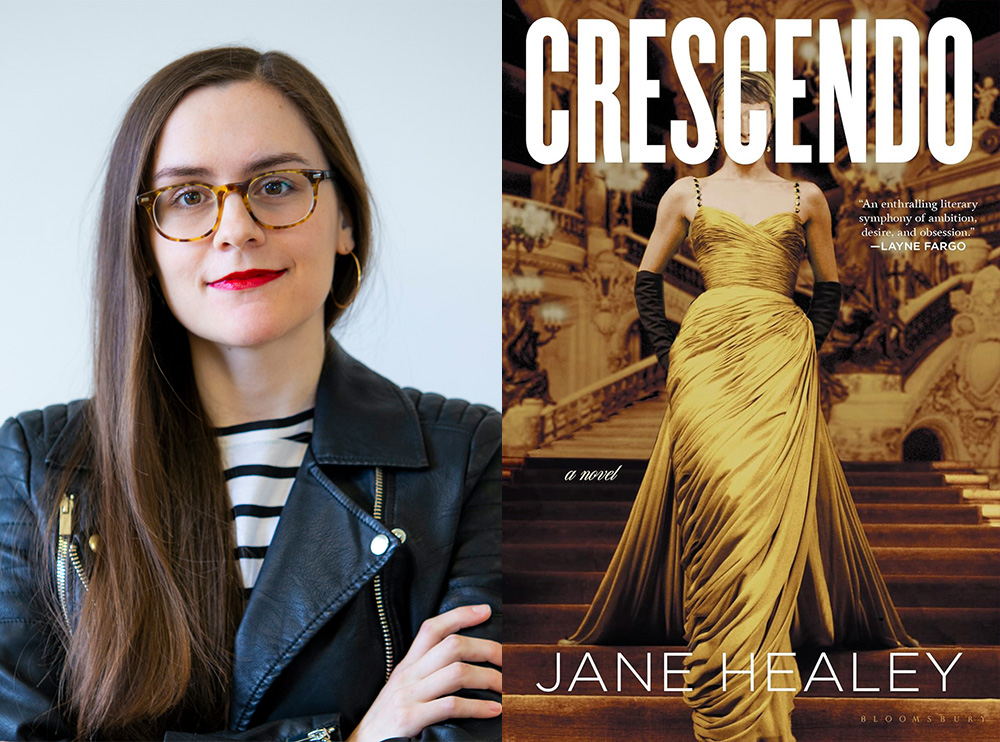
We chat with author Jane Healey about Crescendo, which follows a piano virtuoso and his twin sister who become rivals for a new spotlight-the adoration of a mysterious French patron-during the hot Parisian summer of 1957.
What was your initial inspiration for Crescendo?
During the early days of the pandemic, one of my neighbors across the street had a grand piano delivered. I watched as he nervously hovered around the delivery men on the street who then carried it up into his flat. He closed the curtains around the new piano, presumably to protect it from sun damage, so from then on all I could see was the keys and his hands on them. But he never opened his window, so I could never hear the music he played. Something about his presumed protection of and obsession with the piano, and my frustration at not being able to hear the sound, became my own obsession.
At the same time, I reread one of my favorite children’s novels, Apple Bough by Noel Streatfield (also author of Ballet Shoes), which was set in the 1950s and is about the sister of a child violinist who traveled the world following his tour along with her other musical siblings. It’s always struck me as an adult how the “stage children” in Streatfield’s books never came to any harm even though they were in pressurized adult environments with families relying on their incomes and an endless parade of strangers around them. Rereading that novel, I was interested in what the effects of a childhood like that would be, of the destabilizing force of childhood fame both on the performer and on a less-talented sibling.
What is it about live musical performance that drew you to explore it in a novel?
I’m not a musician myself, nor do I have extensive classical musical knowledge, but what I was really interested in exploring through Natasha and Max, and other characters around them like the ballet dancer Ruby and Max’s patron Henri, is the power and pain of performance, both for the performer and the people watching. What it costs for a performer to give themselves emotionally to an audience, to be vulnerable in front of a paying crowd night after night, and also what it feels like to be emotionally affected by watching someone else perform on stage. I am always fascinated by the electricity of live performance and the tension held in the room, the transformative qualities of performers and the particular power dynamic between those on stage and those in front of it (and behind). I also think part of this book was actually me working through how music can affect me so strongly, through the conduit of the character Natasha, who is often brought to tears by her brother’s playing.
The lush historical atmosphere is such an important part of this book—what kinds of research did that involve?
I’ve always loved the opulence of an old theatre with gilded plasterwork and red velvet seats, so I loved getting to set a novel in that space. I traveled to Paris twice and had after-hours tours of the Paris Opera, where the climactic scene of the novel is set.
I also researched quite a lot about a specific piano competition, the first International Tchaikovsky Competition in 1958, which was the first international musical competition held in the Soviet Union. Max in my novel is aiming to enter but doesn’t because of the tragic events of the novel’s conclusion. The actual winner of that competition, an American named Van Cliburn, was an inspiration for Max, especially in his skill at interpreting Russian composers like Rachmaninov and Tchaikovsky, and I listened to the recording of his prize-winning performance of Tchaikovsky’s Piano Concerto No.1 in B-Flat Minor, Op.23 on loop as I wrote.
Max is a child prodigy, arguably coming to terms with the end of childhood in the novel. How did you get into his mindset?
I researched the psychology of child prodigies through books and podcasts and did the same for concert pianists. One particular discussion between the pianists Gabriela Montero and Khatia Buniatishvili, who made their concert debuts at six and five, about what it felt like on stage as child performers—the pleasure and sense of abandonment, the feeling of something powerful which you control but at the same time controls you, and of the complicated desire to please the public—was key to Max’s psychology, as was their discussion about what happened when they reached their teenage years and gained more autonomy.
I also found Piano Notes: The Hidden World of the Pianist, by Charles Rosen, particularly inspiring for the mindset of Max when it came to the piano, especially this quote: “There has to be a genuine love simply of the mechanics and difficulties of playing, [an] almost fetishistic need for physical contact with the combination of metal, wood, and ivory.”
The rivalry between Max and Natasha might at times feel familiar to anyone with a sibling, albeit taken to an extreme. How do you think about the way their relationship develops throughout the novel—was tragedy inevitable?
I think of Max and Natasha’s story and relationship as a sort of dark fable. I knew there would have to be a rupture of some sort for them to grow up, that they could never stay as close and codependent as they were, and that the shape of that rupture would come in a relationship with someone else, with sex and romantic love. Enter Henri, a fictional French count, whose wealth undermines part of what ties Max and Natasha together—the money she earns as his manager—and whose home provided the perfect opulent claustrophobic setting for my story.

But it is the original love triangle of sorts at the heart of their story, that of Natasha, Max, and his obsession with the piano itself, that pushes their story to an extreme. After I had written the first line of the prologue: ‘The piano is a percussive instrument, there is a violence inherent in its playing’, I knew that tragedy was inevitable at the end of the novel, but I didn’t know yet exactly who would perform that violence upon whom. That was something I discovered in the writing of this novel, as I hope readers also enjoy discovering as they read.
Are there any other novels about rivalries—or complicated sibling relationships—you’ve particularly admired?
One book which I read whilst working on my second draft of Crescendo was The Turnout by Megan Abbott, about two sisters who jointly own a ballet studio and their psychosexual relationship with their mother’s former star pupil, Charlie. It’s a story of simmering rivalry and violence, of desire and obsession, with a feverish intensity of prose. I found the metaphorical way that Abbott describes dance and the body especially inspiring as I worked to draw connections in my own novel between the ivories of the piano and the bones of its player.
Another novel about romantic rivalry, although not one between siblings, that inspired me was the now out-of-print novella La Chamade by Françoise Sagan, about a love square between a rich older man, his younger mistress, and the younger gigolo of a rich older woman in late 1950s Paris. It’s a lush, woozy portrait of romance and of the distance between fantasy and reality, written with astounding psychological depth.