


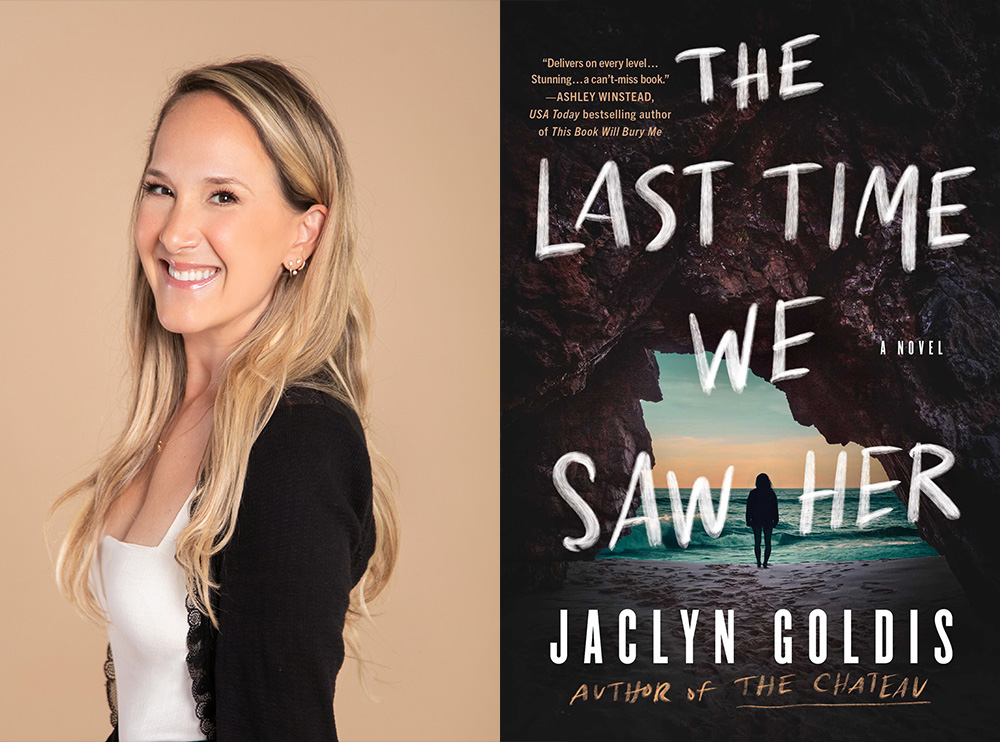
We chat with author Jaclyn Goldis about The Last Time We Saw Her, which sees a long-lost treasure and the decade-old disappearance of a teenage girl reemerge.
What appealed to you about an island setting for your latest thriller, The Last Time We Saw Her?
First off, I adore the water and have lived on or close to it for most of my life. And island settings are natural pressure cookers—finite space, no easy way to exit. For a group of people all keeping secrets from each other, the inability to simply leave is an explosive device. Plus, the isolated setting felt ripe for the missing person storyline at the heart of the novel. When I learned about the Azores—remote, volcanic Portuguese islands in the middle of the Atlantic, midway between the US and Portugal—I felt a seismic pull.
The reunion premise is such a potent one. What is it about people who share a formative trauma that makes them so combustible when they’re brought back together?
The reunion trope was a really fun one to play with. Shared trauma creates an undeniable bond. And unlike other bonds that perhaps break or soften with time, if anything, the trauma bond only calcifies. Plus, bringing people together who survived something as prior versions of themselves only reactivates those prior selves, yielding undeniable tension between the people they once were and the ones they’ve now fashioned themselves to be. Also, as people age, they often find they have so much more to lose. I am fascinated by the psychological implications of these dynamics. So many variables are ripe for marshalling to light a fuse—for instance, secrets forced into the light, and desperate or vengeful individuals who use what they know or saw to their advantage.
Summer camp elements suffuse this book. Did you attend sleepaway camp, and if so, how did it inspire you?
I did attend sleepaway camp—two separate camps as a camper and another as a counsellor. And I also spent one summer hiking throughout the western United States, sleeping in tents every night, and cooking all of our own food. Plus, I was a participant on various heritage trips to explore my Jewish identity. Those formative experiences all left a lasting imprint. Leaving your ordinary life, being thrown into a new environment with people you didn’t previously know, tackling new skills, and taking risks in a safe but foreign space are all experiences bound to stretch you as a person and also catalyze the intimacy required to cement real, lasting bonds. Summer camp has a magical quality that is both intoxicating to live and also intoxicating to read about. And to write about! I’ve known for a long time I wanted to write a camp-flavored book, and despite its dark aspects, it was an especially joyful book to write.
Endings are critical in thrillers. Do you know the ending before you begin, or do you discover it along the way?
This element varies book to book. As a book develops first in my head, I find there are certain aspects that I innately know belong to it, but for each project this looks drastically different. For this one, I knew the flavor of the ending, and that didn’t waver from the jump. But as I was writing and nearing the end, I realized that I wanted to tweak certain plot elements to make the closing land with a greater bang. I was fortunate to hop on a call then with my agent and editor—both phenomenal brainstorm partners—and nail down the right ending. It’s one of my favorites thus far.
What does your writing process look like? Are you a plotter, a pantser, or something harder to categorize?
I am a plotter who is also harder to categorize. I would say that I used to be more of a straight plotter, and this has relaxed a bit. I always enter the writing process knowing certain overarching story beats, but within that set framework, I more and more enjoy and surrender to the latitude that comes from letting a book flow and surprise me.
You practiced law for over seven years before writing full-time. Do you think that training made you a better thriller writer?
Without a doubt, yes. While legal writing is certainly less outwardly creative, I had fantastic mentors who tore up my documents with their red pens and taught me a masterclass in how to write concisely and precisely. Those years at the law firm indisputably improved me as a writer, in some ways more even than the literature and creative writing courses I took in college and otherwise. In addition, practicing law helped my thriller plotting skills in a way you might be surprised to discover. Plotting a complex thriller actually has a lot of parallels to legal reasoning. And when I am in the midst of plot development, I often joke that my head hurts with the complexities equally as much as when I was studying for the logic games section of the law school entrance exams.
You’ve set books on a chateau, an Orient Express train, a safari, and now a volcanic island. Is there a dream setting you’re saving—somewhere you haven’t gone yet but know is coming?
Japan. It’s number one on my bucket list at the moment, and I think a thriller set there would be both dreamy to write and dreamy to research.

Is there an author who intimidates you, whose sentences make you think I could never?
Growing up, my answer to this question would have been Pat Conroy. I remember reading Beach Music in high school and feeling unadulterated awe at the gloriousness of his writing and no shortage of envy, too. I definitely felt for a long time that I would never be able to live up to Pat Conroy, so why try? But now truthfully, and perhaps it’s funny to say, but I only try to live up to myself. I have moments of insecurity, sure, but in general I am more confident in myself and my writing at this stage so I try not to dwell too long in the space of intimidation. And instead to use incredible writing and authors succeeding greatly as inspiration and fuel.
What are you reading right now, and is it research, pleasure, or both?
I am re-reading My Cousin Rachel by Daphne du Maurier for research that is also patently pleasurable. I just finished The One Day You Were My Husband by Rosie Walsh (pleasure, loved), and have Annabel Monaghan’s newest romance queued up. I am obsessed with her books, so I’m excited to savor her latest.
How do you handle the space between finishing a book and starting a new one? Is it restful or does it make you anxious?
Both. It takes me significant time to develop a book; so much of the work for me lies in the research and development stage. But it is so much fun to stand on the precipice of a wide-open infinity of subjects, places, and characters I can write about, and to get to narrow down to the book that is really calling me to bring it into fruition. The last book I wrote took me on many unexpected detours. But now I am in that liminal space again, and who knows what this newest one will bring? It feels like the greatest gift to receive the space to birth a new book. My goal is always to stretch the bounds of what I did previously, to take risks and try new things, and to express myself through my fiction in often completely surprising, sideways ways.