


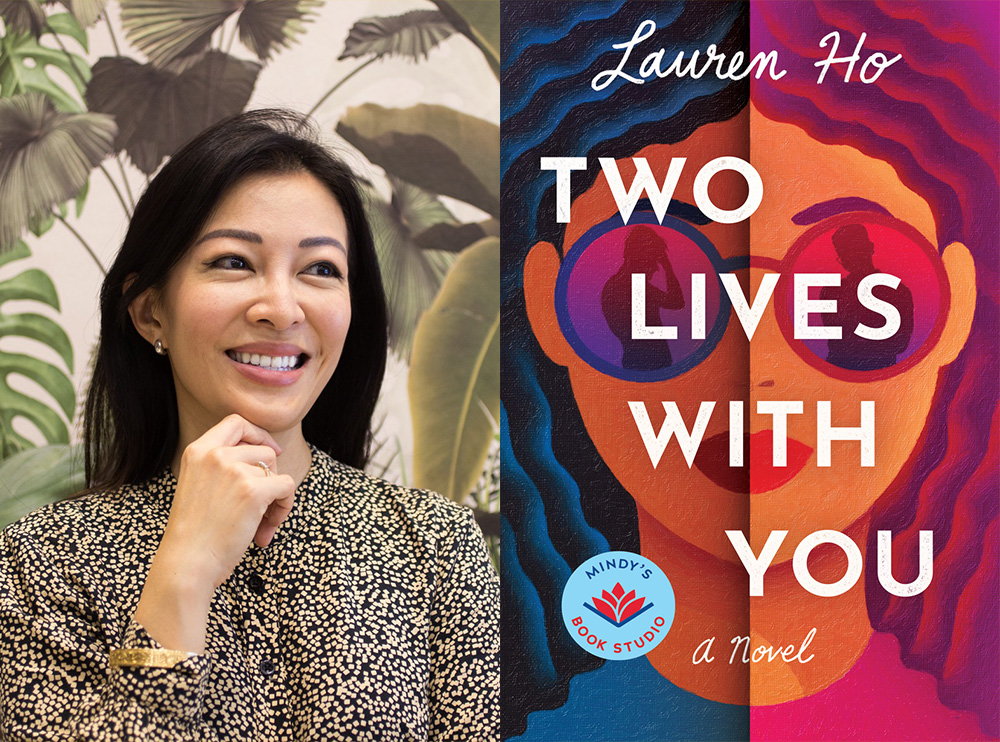
We chat with author Lauren Ho about Two Lives With You, which follows an overwhelmed husband and wife when that what-if wish comes true in an emotional and bittersweet novel about choices, sacrifice, and the love that they might lose forever.
PLUS you can read an excerpt at the end of the interview!
You have an impressive resume as a former legal counsel and philanthropy advisor How did you find the time to write? Have you always had a passion for creative writing?
I’ve always loved daydreaming and coming up with stories, and have been “competitively” short-story writing since I was a kid. Even when I grew up and got a job, I always made time for this passion of mine—if you love doing something, you’ll find a way to indulge.
It sounds as though your previous work in humanitarian diplomacy and conflict settings has been a sobering experience. What role has fiction played – both as a writer and reader – in helping you to find your way back to hope and love?
Fiction has always been how I process the world. Humanitarian work, especially in conflict settings, exposes you to fragility, power, and suffering in very stark ways, and that can be sobering. Fiction gives me a space to sit with those realities without the constraints of policy language. It allows me to explore the emotional truths beneath the geopolitical ones, which in itself is a kind of catharsis.
I believe fiction is inherently political in the sense that it decides whose interior lives matter. As a reader and writer from a minority background, I return to it because it restores dimensionality—where love, humour and contradiction can exist alongside injustice.
In featuring a frontline medical worker, I drew from anecdotes shared by family members and friends working in the US healthcare system, including one working in a Baltimore trauma hospital—the relentless emotional demands, the micro and macro aggressions, the mental, physical and emotional toll of constant crisis. Writing Dana was a way of exploring how someone carries that weight and still remains open to intimacy in their private lives. For me, fiction is an act of dehumanization—a way back to hope and love without denying reality.
In TWO LIVES WITH YOU, you expertly explore what happens after the happily-ever-after in the context of an ordinary millennial couple and capture the raw, unvarnished reality when the afterglow fades and the drudgery, the doubts, and the distance start to seep in, especially when life gets rough. What do you hope readers will take away from Dana and Nigel’s story?
In TWO LIVES, I wanted to explore the quiet, everyday struggles of contemporary (millennial) couples who’ve grown up ingesting a rose-tinted, IG-friendly ideal of romantic love—to showcase the unglamorous moments that don’t make it into fairy tales and social media posts. It was important to me to show that relationships don’t unravel only because of dramatic betrayals, but often through exhaustion, miscommunication, and life’s ordinary pressures. I hope readers see that going through difficult seasons doesn’t mean a relationship has failed. Sometimes it’s precisely in surviving those rough patches together that couples find a deeper, more resilient kind of love.
Dana is an overworked ER nurse who has never had the time to process the trauma she experienced during Covid. Tell us more about her and why you chose this career for her.
Dana was inspired by family members and friends working on the frontlines of the U.S. medical system, and former colleagues working to provide care in conflict settings. I’ve seen how burnout accumulates quietly—how trauma isn’t always processed in the moment, but carried home in small, invisible ways. I chose trauma medicine because it’s high-intensity, relentless, and emotionally demanding. I have deep sympathy for people who work in those environments and then try to show up fully in their personal lives. Dana embodies that tension between professional resilience and private vulnerability.
Her husband, Nigel, has been laid off from his job as a creative and is finding his way as a stay-at-home father. Tell us more about his situation and why he and Dana are butting heads.
Even as “woke” millennials, many of us grew up in societies or traditional households that quietly reinforced the idea that men must “bring home the bacon.” Being a product of such a background, Nigel may see himself as progressive, but those expectations still shape him. When he loses his job and can no longer provide financially, it shakes his sense of identity—especially because he’s always tied his self-worth to traditional markers of success. Those insecurities can unsettle even the most self-aware person. I wanted to heighten that tension by making Dana equally accomplished in a high-pressure career, so their conflict becomes not just about money, but about pride, purpose, and shifting roles.
What was it like to step out of your comfort zone to write a novel with an element of magical realism?
I’ve never seen myself as a novelist confined to one genre. To me, a story is a story—it just demands the form/genre it needs. I’ve written a murder mystery before and have a horror project in progress. Magical realism felt less like a departure and more like another tool to explore emotional truth in a slightly heightened way.
What were some things that surprised you while writing this book in terms of new plot twists or how the story developed while writing?
How hopeful it turned out to be. I’ve read this book countless times through revisions, and I still find myself emotional in the final act—in a cathartic way. The hope feels earned rather than sentimental.
Why is representation of AAPI stories so important to you, and how does your Malaysian heritage inform your work as an author?
It’s deeply important. I’ve lived much of my life abroad, including over a decade in Europe, and I grew up reading (English) books centered on people who looked nothing like me. Now my daughter reads children’s books with protagonists who share her cultural background, and I’m incredibly grateful for that shift. Writing contemporary novels set in Singapore and Malaysia, centering Asian voices, is both a responsibility and a point of pride for me.
How was the book’s title chosen, and what does it signify for you?
The title speaks to the idea that within one relationship, we can live multiple emotional lives. There’s the life we imagine, the life we actually live, and the life we build together after change, especially trauma. TWO LIVES WITH YOU reflects that duality: the version of love before hardship and struggle, and the version after, reshaped but still chosen.
What is the main message you hope readers will gain from this novel?
That while our circumstances may differ, our vulnerabilities are often the same. If we read widely and across cultures, we begin to see how much we share—in the way we love, fear, and in what we long for. Our common humanity binds us more than we realize.
Outside of writing, what do you enjoy doing with your free time? Do you have a secret talent readers would be surprised by?
I’m not sure you could call this a talent—I am a below-average singer with above-average confidence in a karaoke room. The same could be said for my enthusiasm for stand-up comedy.
Synopsis
Prologue
Our House
Dana Smiley didn’t believe in signs, and she certainly didn’t believe in fate. She believed in cold hard facts, and the cold hard facts were telling her that the house she and her husband were in was haunted.
Consider the listing: two-story colonial, four bedrooms, granite countertops, hardwood floors, big yard, good school district—all this, under market price?
There was no other explanation: It was a murder house.
“It’s not a murder house,” Nigel whispered as they climbed the stairs a few paces behind the smiling forty-something bottle-blond real estate agent in heels. Everyone was sweating—they were in the middle of a heat wave—but Nigel glistened. “Trust me, I checked. I also ducked out to speak to the neighbors while you guys were in the walk-in closet, and they were so friendly.”
“Everyone’s friendly to you,” Dana said, somewhat accusatorily.
He gave her a crooked, boyish grin. “That’s because I like people.”
She scoffed, wiping her sweating brow with a hand. “I like people too. May I remind you that I’m a nurse?”
“How could I forget my luck in marrying a medical professional?”
Nigel said, grabbing her sticky hand and giving it a lingering kiss. The real estate agent—Jessica—who’d stopped to allow them to catch up, cooed at the sight, and even Dana’s stone heart fluttered.
“How long have you lovebirds been together?” Jessica asked.
Dana and Nigel exchanged glances before chorusing, a tad guiltily, “Ten months.”
The “ah” that the agent responded with, coupled with the darting glance at Dana’s belly, told them everything. Ah, it’s that kind of relationship.
Only Dana knew it wasn’t. Sure, she got pregnant barely two months into dating the man she’d met in her ER, and now she was carrying his unbelievably big-boned progeny, but this was the real deal, and no, it had nothing to do with his accent or his crooked smile or his soulful brown eyes, those superficial nice-to-haves that reel you in at the beginning, and everything to do with the need-to-haves that keep you with someone: how he could lift her with his words after a long day at work, how he listened with his heart and mind, and how he was so, so blisteringly smart. He never failed to be kind to those who sometimes didn’t deserve it, people Dana would have told off (Dana dearly liked the act of telling people off when they were wrong). And he was patient, let’s not forget that—she’d been wading through pregnancy brain fog recently, and her temper was shorter than usual. She felt like Muncher in Ghostbusters, gassy and snarly and full of rolls. Yet he endured, yes dear-ing his way through the occasional tantrum, even when she didn’t deserve his patience or kindness (case in point: last weekend, when the pregnancy cravings hit and she sent him out for pickles and then forgot she had requested pickles and got upset because he brought home pickles and not the salted caramel ice cream she remembered requesting).
Dana shot Nigel a covert look of fondness. He was almost too good to be true.
The bowling ball inside her kicked her bladder, and she winced, brought back to earth. People like Dana weren’t built to daydream. That’s why it surprised her that she and Nigel—a dreamer of the first degree, someone whose career as an adman was entirely about inspiring others with words and images—seemed to be working out. She kept waiting for the other shoe to drop. When would he realize she was hopelessly dull?
“Are you OK? Do you want to sit down?” Nigel asked, catching her reaction to the bladder kick. Dana waved him away with a wan smile— he’d been hovering with a capital H for the last few months, a mixture of golden retriever–level exuberance and concern, which normally she found very attractive, but now she mostly wanted to be left alone to wilt in some fridge.
“I’m good,” she said. She glanced around the bright-pink kitchen, the one major flaw of the place. She directed her question to the real estate agent. “So tell me, what’s the catch?”
There it was, Dana in essence: the problem spotter. If Nigel was sunshine and positivity, Dana was pragmatic fatalism. That’s why they worked so well together.
Nigel turned and gave her a wink and a thumbs-up behind the agent’s back.
“There, um . . . there isn’t one,” Jessica said, the smallest twitch of one eyelid giving away her discomfort at Dana’s dead-eyed stare.
“The house has just been renovated with full Italian granite and hardwood floors. The walls are spotless, like no one’s been living in it,” Dana said, pacing around the kitchen, her No-Nonsense Nurse voice on. She stopped and pivoted slowly toward Jessica. “Someone died in it?”
Jessica’s smile grew fixed. “No. The owners renovated three years ago but then moved away soon after, when their daughter, who’s living in Indiana, got pregnant. And now they figured they should make the move permanent. That’s all.”
“But no one died in here?” Dana repeated, wanting to hear the actual words. You always had to hear the words; her lawyer friend—fine, somebody she saw on Law and Order—had taught her that.
“No,” Jessica said. She added, somewhat apologetically, “I mean, as far as I know.”
Dana and the agent eyed each other like gunslingers in a Western. Finally Dana’s demeanor relaxed and she nodded. “OK.”
“Dana, just forget the price and its possibly messed-up history for a second and tell me: Do you like this place?” Nigel asked.
“I do, it’s . . . it’s just . . . I don’t know,” Dana murmured. Her lips wobbled and her eyes prickled with tears—she wasn’t one to wear her emotions on her sleeve, but the hormones had destroyed her defenses and her poker face, honed through eight years of nursing. She felt all of them, every day: terror, overwhelming joy, anticipation, anxiety, anguish, and excitement, just to name a few. “The house is great, Nigel. I just—it’s all moving so fast.” Her voice cracked on the last word.
“I’ll give you both some space and wait on the patio,” Jessica said.
Nigel walked up to Dana and hugged her close. She sagged against him, feeling the tension ebb from her with every breath. “Don’t second-guess yourself, Dana. You like the place. I see you casing it like you’re already interior designing the space and planning trips to Pottery Barn and IKEA.”
“I am,” Dana admitted. “But even at this price, it’s at the high end of our budget. The very tippy top.”
“You let me worry about that,” Nigel said. He’d just gotten a job at a boutique ad agency in Baltimore—a step down from his career trajectory in New York, but an internal transfer had never been an option since his agency didn’t have offices outside of LA and New York. He pulled away and paced the kitchen. “Let’s run through the positives: It’s move-in ready, meaning we don’t have to spend a dime on unnecessary renovations; the community is diverse; the backyard is big enough for the four kids we’ll have—if you’re on board—and it’s in the neighborhood of a great public school. Your dad’s literally two miles away in the care facility and we can visit him every weekend. It’s perfect.”
She hated when he made sense. Especially in that warm, grinning, forever-boyish way that made her believe life could be one long adventure if you just leaned into it hard enough. She walked back into his arms again. “I don’t know if I’m up for visiting him every weekend,” she mumbled into his chest. “It breaks my heart seeing him like that, no matter what’s happened between us.” Her father, her sole living parent, had advanced Alzheimer’s—more often than not, he did not recognize her.
“The option’s there,” he said quietly. “That’s all.”
Sensible, reasonable, but imaginative. Add all those qualities to the secret sauce that made Nigel . . . Nigel. That made Dana sure this wasn’t just that kind of marriage—even if she was pregnant—because he was unlike anyone she’d ever been with, in that she couldn’t envisage a world, her life, without him.

“Well,” she said, brushing imaginary lint off her belly, “if the baby likes it, I guess we’re good.”
Nigel regarded her with those eyes. “And does the baby approve?”
The bowling ball stayed still—typical. Dana met his questioning gaze with a kiss. “She says she’s happy if I’m happy, and I am, so . . .” She exhaled shakily. “Yup, lucky house number twenty-three! I guess we’re getting a mortgage!”
“Great,” Nigel said, eyes shining (possibly with relief). He waved Jessica back in and told her the good news.
She clapped her hands together. “That’s wonderful news! Shall we go back to the car and sign the paperwork?”
As they walked down the flagstone path, Nigel waved at their soon-to-be neighbor from across the street, a white-haired woman with electric-blue eyeglasses and a toy poodle that might’ve just been stuffed, and Dana tucked her hand into the crook of Nigel’s arm.
“We’re definitely doing this, huh.” Dana tried to sound matter-of-fact when her heart was racing with anticipation and anxiety—her two most familiar states of mind these days. “Homeowners—and parents. All at once!” Maybe it was more anxiety than anticipation she was feeling.
No matter how far she’d come from her beginnings, Dana always felt like she was only a couple of steps ahead of disaster. She couldn’t explain why she was wired like this—maybe the financial stressors of her childhood and her parents’ constant bickering had something to do with it—but the fear was always there, lurking in the back of her mind. An imagined sword of Damocles hanging over her at all times.
When she first got together with Nigel, she kept telling herself, It’s a fluke, it’s a dream, he’ll leave me when he’s done having his fun. But then she got pregnant and Nigel kept staying, kept choosing her. She’d never had anything like that.
What’s the catch?
She shook her head. I really got to stop doing that.
He paused on the path, probably picking up on something she hadn’t meant to show. He turned to face her and put his hands on her arms, squeezed them, and told her, “I know this is moving really fast for you and you’re worried. I get it. It’s all new to me, and I’m scared too, Dana. This is a lot for anyone to take in all at once. But it’ll be all right, you’ll see. We’ll be all right.”
“How do you know?” Nobody knew. Anyone who claimed otherwise was setting themselves up for failure.
He patted his chest. “Because it’s normal to be afraid of changes, but my heart and my head are aligned on this, so I know this will pass.” He nodded in the direction of the house with its gently sloping front lawn. “In fact, I’m already imagining us eating toast in that sunroom while the baby throws mashed avocado at the cat we don’t own yet.”
“I’m a dog person,” she said, eyebrow raised.
Nigel smacked his forehead. “Oh, crap, how did we miss this discussion? That’s my deal-breaker.”
They laughed. “The backsplash is pink; so are the tiles in the guest bathroom,” she said, half laughing, half crying.
“So we’ll renovate. It’s just tiles, Dana.”
They reached the agent’s car—a spotless white Range Rover with enough bottled water to hydrate a football team—and slid into the back seat while Jessica cranked up the air-conditioning for Dana and pulled out the contracts.
Nigel didn’t even read any of it. He initialed and signed away his freedom without a second thought, using his usual messy, sprawling script; meanwhile, Dana’s handwriting was neat and almost apologetic, taking only just enough space as to be legible. And yes, she read the contract. Every last word. In their relationship, she was the one who dotted the i’s and crossed the t’s—which was a good thing, because Nigel was very much a big-picture guy.
“Congratulations.” Jessica beamed, handing them their copies when they were done. “You’re homeowners! Well, pending a few more niggling steps, of course. But you did it! Whoop whoop!”
Dana felt her last meal—or maybe it was the baby—somersault in her belly. “Oh my God.”
Nigel chuckled and laced his fingers through hers. “Breathe, Dana.The most difficult part is over: We’ve got each other. Things can only get better for us.”
“Famous last words,” Dana said as his lips met hers. But then the baby kicked, as if in agreement or in blessing, and for once Dana Smiley, chronic overthinker that she was, let herself be swept away by the moment. She could do this, she decided. This man was the beginning of a brand-new life, one they got to build together. She should be so lucky.