

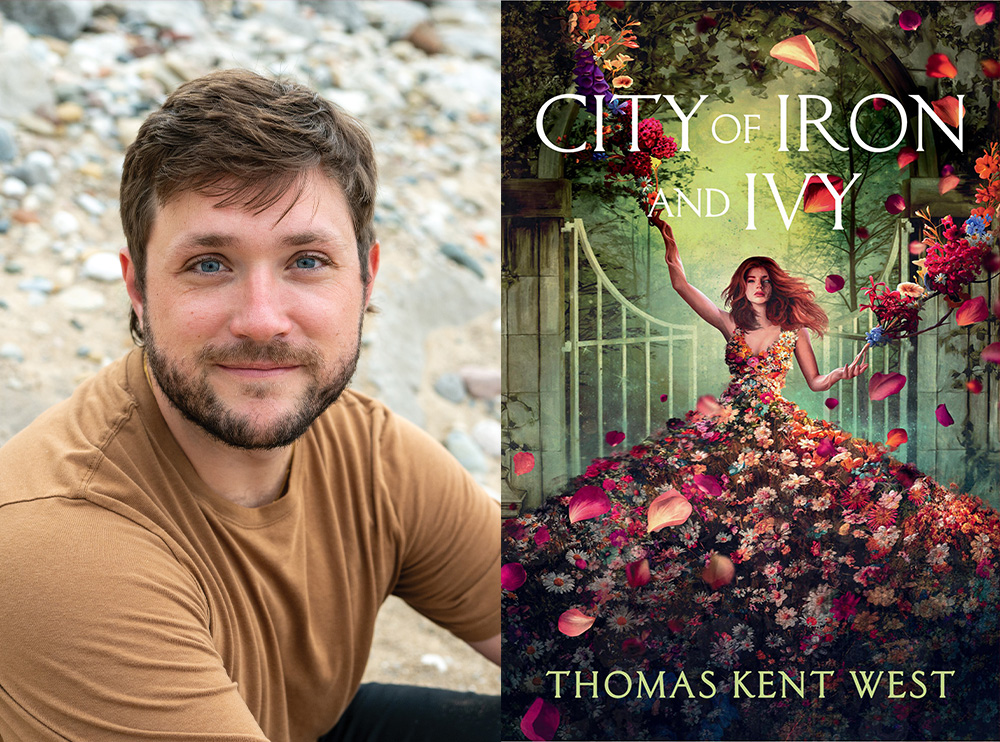
We chat with author Thomas Kent West about City of Iron and Ivy, which is a beguiling historical romantasy debut that blends dark academia with the glamour of Bridgerton, as a scholar of magic investigates her sister’s murder—perfect for fans of Heather Fawcett and H. G. Parry.
Hi, Thomas! Can you tell our readers a bit about yourself?
Certainly. I have always wanted to be a novelist, but like many creative people, I jumped around careers until I landed on my feet with writing. I studied Environmental Science in college, hoping to do something beneficial with my degree, but wound up taking the first job I could get, which was in a call center for an investment management firm. That was fairly miserable, and while working there I began volunteering in schools and quickly realized I wanted to be a teacher. So I quit and joined the Americorp teacher training program in Wyoming, focused on wilderness science and environmental education. From there I led backpacking trips, wildlife tours, and back-country science classes in Yellowstone and Grand Teton National parks and the surrounding national forests. Covid hit, and I moved back in with my parents and started to write again, which is when I wrote the first (very rough) chapters of City of Iron and Ivy, which was inspired, in part, by the botany I had learned as a wilderness guide. I took a few jobs in schools after that—at a nature-based charter middle school and an elite sports boarding school—but the whole time I was writing. I found that I had a hard time showing up my students because I felt so called to this other profession, and teaching is something that really requires your whole soul to do. Covid and the end of a long-term relationship had put the fear of death in me, and so I decided that I would quit and try to make an old dream come trueI was lucky to have worked in schools where my room and board had been paid for, and so I had a nice cushion that gave me the courage to pursue writing for a year. I moved into a small house in south Minneapolis with an old friend and wrote novels in the basement, working as hard as I could to make something happen, and during that year I signed with my agent and sold my first novel, which is City of Iron and Ivy.
When did you first discover your love for writing and stories?
It’s always been sort of innate. As far back as I can remember I wanted to write books, and there are several very sweet home videos of me as an elementary schooler reading my “novels” aloud. I can’t really say where it came from but I have it on good authority (my mother) that I have always taken a lot of joy from language and stories. It wasn’t always novels—in elementary and middle school I did a lot of comics—but by high school I was set that I wanted to become a novelist. I went into college expecting to study English, but was slowly dissuaded by the persuasive cultural belief at the time that English majors wound up unemployed (which was not true then, nor is it now). Why I thought Environmental Science was a surer route to employment is beyond me. But I have always written and always been drawn to the near-totemic power of books themselves, which drew me to novels rather than, say, screenwriting or stage theatre or other forms of storytelling.
Quick lightning round! Tell us:
- The first book you ever remember reading: One of the first books I remember reading on my own and really loving, which I think is different from the experience of being read to by an adult, were the original stories of the voyages of Doctor Doolittle. I also enjoyed the Magic Treehouse Books and the Secrets of Droon.
- The one that made you want to become an author: To Kill a Mockingbird and One Hundred Years of Solitude moved something in me that made me want to write.
- The one that you can’t stop thinking about: I’ve been reading The Sibyl by Pär Lagerkvist. I picked it up as a vintage paperback at a thrift store on a whim. I think it’s a really fantastic novel, and I rarely see it discussed. Reading it has this feeling of almost elemental power to it, like a deep, human resonance achieved through universal symbols and simple language. Also, I think about Chuck Tingle a lot.
Your debut novel, City of Iron and Ivy, is out now! If you could only describe it in five words, what would they be?
Botanical. Victorian. Gothic. Debutante. Murder.
What can readers expect?
A genre hybrid with plenty of mystery, magic, and mayhem that is equal parts glittering high-society drama and gritty murder mystery with threads of slow-burn romance and botanical horror.
Where did the inspiration for City of Iron and Ivy come from?
City of Iron and Ivy came to me in two parts. The first was the magic system, which as I said earlier, was inspired by my time as a science teacher and wilderness guide in the national park system. Years later, I started learning about Victorian botany and that society’s fascination with plants and the setting clicked into place.
Were there any moments or characters you really enjoyed writing or exploring?
I personally love Mrs. Rose. She is Elswyth’s etiquette tutor and her polar opposite in many ways, and their interactions are always entertaining. She seems to light up the scene whenever she arrives, and I liked discovering things about her as I wrote. As far as moments go, I won’t spoil anything, but the finale of the book is a big set-piece that I loved imagining every second of. Also, anything where Elswyth wears any sort of elaborate gown.
Did you face any challenges whilst writing? How did you overcome them?
I do suffer from a lack of organization. I’m not very good at sticking to a schedule. When I write, I write obsessively; I lock myself away and I live in another world for weeks at a time while I pound out a draft or a set of revisions. I tend to neglect human needs in favor of the imaginary world, and that never goes well. Sure, I can write a lot of words in a short amount of time, but it’s not very sustainable. So I try to remember Stephen King’s advice that art should be a support system for life and not the other way around.

This is your debut novel! What was the road to becoming a published author like for you?
I’ve always known that I wanted to be a novelist, for the most part, and I think my path was fairly traditional. Like many authors, I wrote several books before publishing. I love to write, but I’ve never been very inclined to share my writing, and that was a skill I needed to develop. One way I cut my teeth was through sharing my writing online—I wrote fanfiction and posted original stories online, and especially on Reddit. That—and getting lots of rejections from lit mags—was the way that I started building the writer’s armor that allowed me to survive querying. When I had written City of Iron and Ivy and realized it might be publishable, I queried about 200 agents and was rejected by the vast majority, but wound up with a few offers of representation as well. I think the thing that I would impart on people who are looking to publish is that it is possible. People do it every day. There’s a lot of luck and timing involved, but all kinds of books get picked up every day, and it could be yours.
What’s next for you?
I can’t officially say anything yet, but I can confirm that two more books are on the way, set in different universes from City of Iron and Ivy. The second will be a queer cozy fantasy. I am not sure what the third will be yet, but there is a YA fantasy and a gothic fairytale retelling that are in the pipeline. I will say that all of these books are very different from one another, as I tend to be genre agnostic. But readers can expect more of something soon.
Lastly, what books are you looking forward to picking up this year?
My most anticipated read of the year was Vigil by George Saunders, and, as expected, I loved it, because I love all of his work. I’m also very interested in Amal El-Mohtar’s Seasons of Glass and Iron, as I devoured This is How You Lose the Time War. I’d also like to read Veronica Roth’s latest, Seek the Traitor’s Son, and I’ve just received a lovely copy of Blood Bound by Ellis Hunter, so I’ll be reading that soon.