

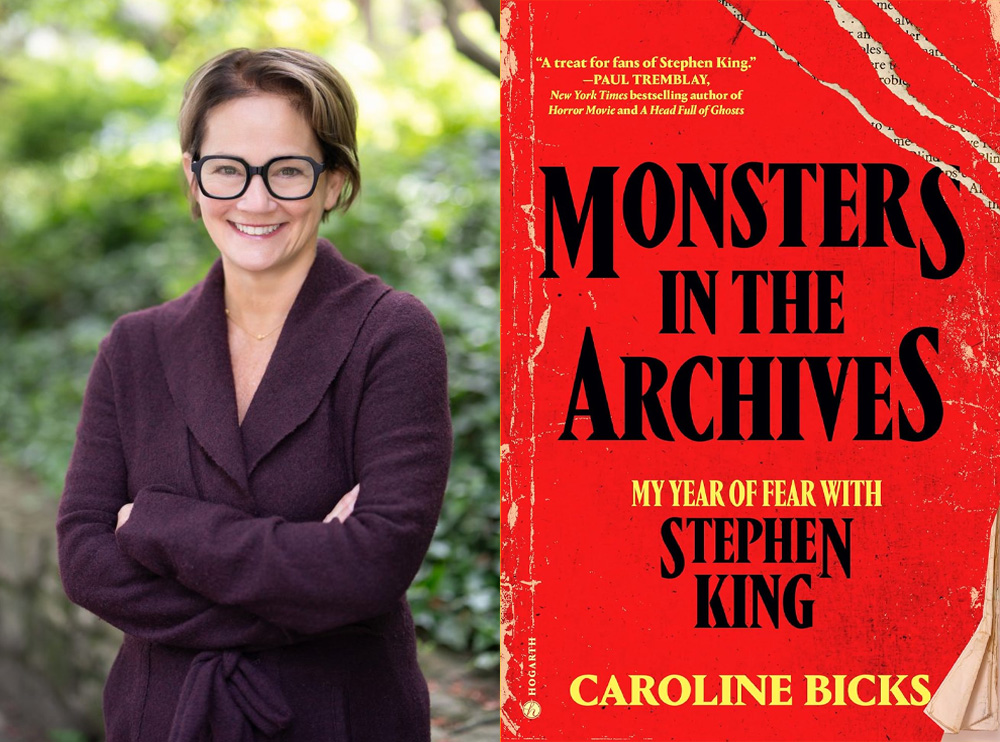
Caroline Bicks has done what avid horror readers can only dream of—She spent a year digging through Stephen King’s personal archives. Thankfully, she compiled everything she learned into her new book Monsters in the Archives: My Year of Fear with Stephen King, so we can all come along for the ride.
This is a book King fans definitely don’t want to miss, sharing never-before-seen drafts and changes across five of his most famous works: Pet Sematary, The Shining, Night Shift, ’Salem’s Lot, and Carrie. Read on to learn more about how Bicks was granted permission to the archives, how she chose which books to research, and which classic (with a tie to King’s work!) made her first fall in love with reading.
Hi Caroline and thank you so much for taking time to chat with The Nerd Daily! To start, tell our readers a bit about yourself.
I’m a Shakespeare professor, but I love reading and writing about stories that cut across all genres and time periods. My husband and I moved from Boston in 2017 when I became the inaugural Stephen E. King Chair in Literature at King’s alma mater, the University of Maine. We have two adult-ish aged kids and one sweet, tough old rescue dog, Chuck.
Your new book, Monsters in the Archives, takes Stephen King fans where we’ve never been before—deep into his private archives, digging into original drafts of his most popular work. How did this opportunity come about and why do you think King allowed you to be the first scholar with this level of access to his private collection?
When I took the King Chair position, I was told not to expect any contact with the Master of Horror. Four years later, I got a call at home: “Caroline, it’s Steve King.” I invited him to speak to my students, and he offered to come two days in a row. He was so generous and kind that I felt comfortable asking him if I could spend my sabbatical year reading through early drafts of his works that he’d just collected and attached to his home in Bangor. I think he trusted me because he got to know me, first, as a teacher who cares about the craft of writing as much as he does.
In the book, you share that you wanted to recreate your original experiences with King’s work. You did this by seeking out the same editions you read as a child to revisit alongside your research. (I must admit you inspired me to add an old Signet paperback copy of Night Shift, complete with creepy eyes staring out from a gauze-covered hand, to my own collection!) Can you share a bit about your calling to this project and the connections it has to your own childhood and personal life?
I love that you found that old Night Shift edition! It’s the one that got me hooked on King’s stories when I was twelve. I still can’t sleep next to an open closet because of “The Boogeyman.” A whole posse of monsters followed after that one: the woman in Room 217 (The Shining), Danny Glick scratching at the window (’Salem’s Lot), little undead Gage Creed (Pet Sematary), Carrie in her blood-soaked prom dress. I still remember specific sentences and scenes from all five of those books. I started this project because I wanted to understand how King had crafted the horrifying words and images that had stuck in my head for forty years (and counting).
Toward the beginning of Monsters in the Archives, you describe being uncertain of where to start your research, even the night before your first trip to the archives. (This is absolutely understandable, considering King’s massive body of work!) Ultimately you felt drawn to begin with Pet Sematary. How did the process of selecting which books to focus on evolve from there?
I knew before I began that I’d be focusing on just those five books that had scared me the most when I was a teenager. Beyond that, I didn’t have an organized plan; I let my instincts guide me. After I finished The Shining, for example, I felt really drained by the dark journey those manuscripts had taken me on. So I took a step back and decided to explore King’s undergraduate writing (which included his newspaper columns and some of the stories that eventually made it into Night Shift). By the end of it all, I realized that I’d been moving back in time with each chapter, starting with his most recent work and ending with Carrie, his first published novel. I didn’t plan it that way, but, as a result, I was able to perceive the relationship of the works to one another —not in terms of a chronological story about artistic improvement, but as part of a recursive, organic writing process for King.
King is famous for saying “kill your darlings” in reference to how writers must mercilessly pare down their work. It must have been incredibly difficult to distill everything you learned down to just 40-50 pages per novel. How did you approach killing your own darlings, so to speak, when writing Monsters in the Archives?
The hardest part was finding the unique human story I wanted to tell in each chapter about the revisions I was seeing King make to a particular book. After that, the chapters took shape pretty seamlessly because I knew which of the changes spoke to that story. If there was a darling that didn’t fit in, I didn’t have to kill it—I could tuck it into the blind notes for safe keeping.

What did your communication look like with King throughout this year of research? Has he shared his thoughts on the finished product?
I’d usually email him. Sometimes I had a question about a margin comment I’d found, or a plot point he’d changed; sometimes I asked him about a literary reference, or an event he’d experienced, like his move to Durham, Maine, when he was eleven, or the anti-war protests he’d taken part in as an undergrad. He always wrote me back within an hour with a detailed response. (I don’t know when the man ever sleeps!) If he had time for a more extended conversation, we’d talk. At no point did he say “That’s wrong,” or “You can’t say that.” He recently posted on social media that this is the best book he’s ever read about his writing process, which is surreal to me. I’m so grateful that I had the opportunity to bring forward a story about his writing that hasn’t been told and that resonates with him as authentic.
Were there other books you researched in the archives and considered including? What are one or two other King novels you love that aren’t featured in Monsters in the Archives?
I considered researching The Stand (which had a huge impact on me as well at that time), but decided it was just too huge to include. Maybe next time!
Let’s Get Nerdy: Behind the Writer with 5 Quick Questions
- The book that made you fall in love with reading: The Wizard of Oz. I write about how, as a little kid, I’d read it to my mom after school as a way to manage my fears of being away from home and from her.
- A movie you know by heart: Raiders of the Lost Ark. I was so in love with Harrison Ford in 1980. I bought an LP (that’s how old I am) of the script and listened to it on repeat.
- A song that makes you want to get up and dance: Flashdance. What can I say? I’m a product of the ’80s. I have the cut-up sweatshirts to prove it.
- Introvert or extrovert: Extrovert
- Coffee, tea, or something else: Dark roast. (And, if it’s after 5:00pm, a gin gimlet.)