


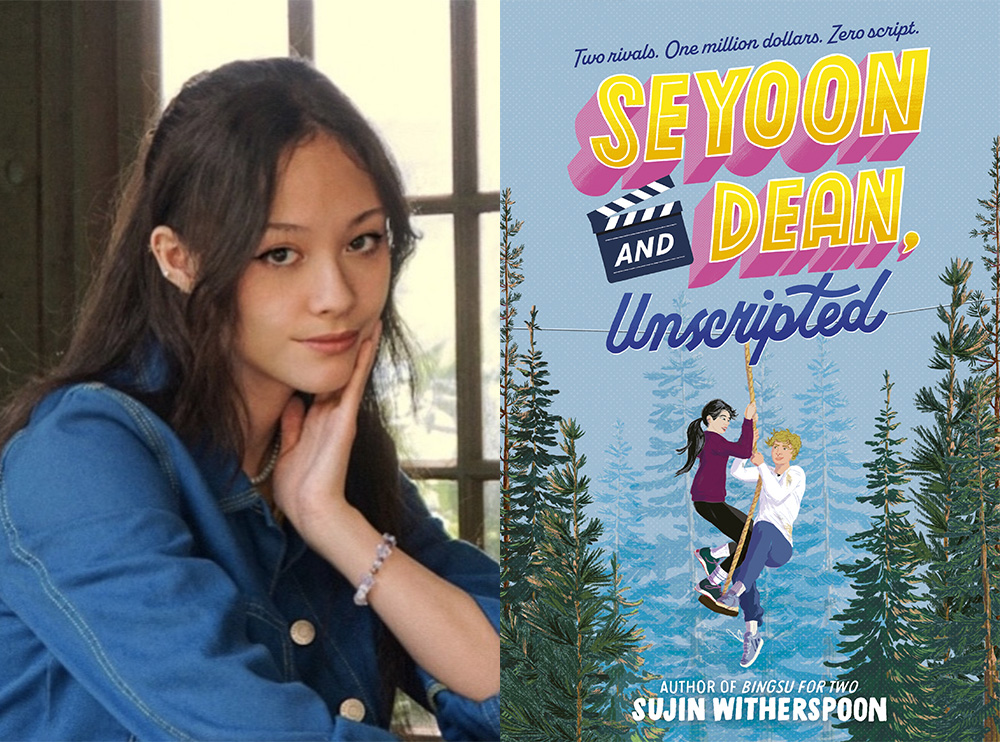
Guest post by Seyoon and Dean, Unscripted and Bingsu for Two author Sujin Witherspoon
Sujin Witherspoon is a Korean-American author, artist and lover of words she can’t pronounce. She gravitates towards stories that will either plague her nightmares or make her stomach hurt from laughter – no in between. Having earned her degree in English from the University of Washington, she spends her time writing, thinking about writing, or thinking about how she should be writing.
About Seyoon and Dean, Unscripted: Two teens compete to win a reality show in the woods of the Pacific Northwest, but the producers frame them as rivals-to-lovers, in this hilarious YA romance—perfect for fans of Lynn Painter and Emma Lord. Releases April 23rd in the UK and April 7th in the US.
There’s a reason publicity teams send their celebrities to perform in off-the-wall skits on Saturday Night Live. And no, it’s not for exposure therapy or a humiliation ritual, but good guess. It’s because we fall in love with the people who make us laugh.
Seeing Harry Styles spoof HBO’s The Pitt or Sabrina Carpenter star in a Blumhouse parody endears them to viewers (and ideally makes us care about the album they’re promoting). Charm and suave is one thing, but what really makes someone swoon is a great sense of humor.
It’s why rom-coms work so well. From 10 Things I Hate About You to anything written by Talia Hibbert or Emily Henry. Witty leads and snarky banter balanced delicately with tender moments are the perfect recipe for a swoon-worthy romance. You don’t necessarily need humor to make a romance sparkle–see, quite fittingly, Twilight–but it certainly doesn’t hurt. I think we fall in love faster when we’re laughing.
Maybe this is a hot take, but I wouldn’t consider romance novels a rom-com just on the basis of it having a few jokes or quippy one liners, or if the author’s narration is particularly funny. Rom-coms are a distinctive category in their own right, that work intentionally to walk the fine line of balance between both genres.
One way rom-coms do this is by the intentional use (and subversion) of tropes. I know some people view trope as a dirty word synonymous with cliche and unoriginal, but I climbed this hill a long time ago in fandom spaces, have planted my little flag, and am willing to die here over this: tropes are good. They become tropes because people love them so much.
I sometimes hear writers say they worry about their story being minimized to its inclusion of tropes, say the ‘coworkers to lovers’ element or the ‘second chance romance’ aspect. They’re concerned readers have already seen too much of this, they’re sick of it. To that, I might point them to this cute comic. No two writers are ever going to approach the same trope, the same premise, the same idea in identical ways. It’s one of the beauties of storytelling. And it’s why certain tropes remain so beloved; it’s wish fulfillment. Something readers are already seeking in romance literature.
I say that loud and proud, by the way, as both a romance author and reader. I am here to fulfil my wishes! I do want to read about characters accidentally booking a hotel room with only one bed! I, and others, come to romance seeking certain things, and the genre conventions promise to satisfy my craving for it.

Comedy, on the other hand, is all about the unexpected. This is where subverting time-old tropes and using the readers’ expectations against them can come into play. When you catch them off guard, you can make them laugh. A great rom-com sets out to do both: feed into your expectations, and then unseat them.
One trope I love using in my own rom-coms is the opposites-attract dynamic. In Seyoon and Dean, Unscripted, both titular characters are competing against each other for the grand prize in the wilderness game show they’re on. This rivalry puts them at odds and adds tension between them that helps build simmering chemistry. But when the producers see this spark and play them up as lovers for the viewers at home, it forces these rivals to change the way they play their game, and flips the trope on its head.
There’s a particular flavor to second-hand embarrassment that I personally relish in. Reading about romantic interests shoved into awkward, absurd situations with each other not only makes me laugh (and relieved that it’s not happening to me), but it also adds a layer of vulnerability that lends itself well for rooting for these characters to grow close and fall in love.
In rom-coms, these lighthearted moments provide important contrast for the more sincere and heartfelt scenes that are necessary for the love story to flourish. We laugh until we’re sore, and then when there is a break, the romance now has the breathing room to shine and–well, take our breaths away.