


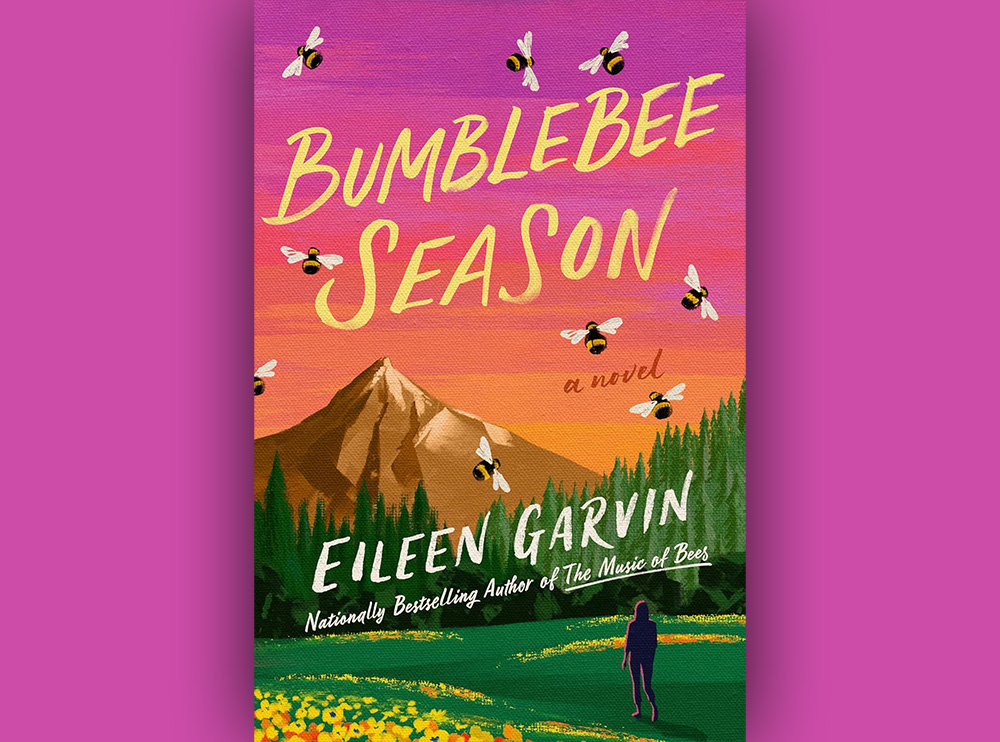
From Eileen Garvin, nationally bestselling author of The Music of Bees and Crow Talk, a heartwarming new story that returns to the vibrant world of beekeeping in a small Oregon town.
Intrigued? Read on to discover the synopsis and an excerpt from Bumblebee Season by Eileen Garvin, which releases on April 21st 2026.
Beekeeper Jake Stevenson should be celebrating. His fledgling honey farm has been inundated with orders. Instead, Jake is worried. He can’t seem to hire anyone—with local teens more interested in jobs at Hood River’s hip waterfront—and there’s no way he can handle the approaching harvest all by himself, no matter how adept he’s become at maneuvering among the beehives in his wheelchair.
Meanwhile Flaco López, a young migrant from Mexico, is lost on Mount Hood when he stumbles upon Jake’s beehives in a high alpine meadow. As Flaco takes refuge on Jake’s farm, they begin to form a tentative friendship. And the two soon cross paths with Abigail Plue, a scientist more interested in insects than people, who’s on Mount Hood studying a threatened native bumblebee.
Then a local rabble rouser begins to rally support to build a commercial hunting camp that would destroy Mount Hood’s pristine wilderness—the home of Jake’s honeybees and Abigail’s beloved bumblebees. And Jake, Abigail, and Flaco must come together to protect everything they hold dear. Full of warmth, big-hearted characters, and a celebration of nature in all its complexity, Bumblebee Season reminds us that human connection might just be the most powerful force there is.
EXCERPT
Abigail Plue surprised people, though she didn’t understand exactly why. It seemed as if, upon meeting her, they’d been expecting someone else. At least after Abigail had spoken. That was the only way she could explain it. People seemed to harbor some expectation of what she’d say or how she might say it, and when her words came out they were never quite right. No one ever said that exactly, but she could tell it was what they thought.
Before she opened her mouth there was a neutral space, a two-dimensional field that she could exist on, suspended, in orientation to other people. She felt like a stick figure on a flashcard, fulfilling the correct requirements. Human. Woman. Person. But something changed in the air after she spoke. Her voice induced an invisible but tangible shift, a breaking apart of particles. Sometimes she imagined a pungent scent, like the smell of petrichor right after it rained. And then she was Other, Different, Strange. Was it what she said or how she said it? She didn’t know. It all seemed terribly unfair to Abigail. How could people have expectations of a person they’d never even met?
When she was alone, though, Abigail didn’t feel troubled by how others might perceive her. She simply felt like herself. She enjoyed her own company and found the workings of her brain interesting. Instead of that cramped two‑dimensional plane she balanced on so precariously with others, her solitary world was vast—a boundless expanse to observe and explore, to turn over rocks and look under logs, both literally and figuratively. As a girl, Abigail had spent considerable time on her hands and knees observing what was happening on the ground. In fact, it was in this exploratory setting that Abigail first understood she was odd. People also called her strange, weird, and wacky. But “odd” was the first moniker, and one she didn’t mind. Odd. Pronounced by Miss Mary Ricketts, Abigail’s neighbor, the day they met, when Abigail was seven years old, and already eraptured with the kingdom underfoot.
Abigail’s father didn’t get home from work until five thirty, so Abigail spent hours alone. Another girl might have felt lonesome. Another girl might have passed the time watching TV or sneaking cookies her father had hidden above the refrigerator where he thought she wouldn’t find them. But Abigail liked solitude, was bored by television, did not overindulge in sugary treats, and preferred to be outside.
…
Feeling unwelcome was no longer surprising to Abigail. She felt out of place in school, at work, and in social situations. But at the age of twenty‑three she’d finally found a spot that fit. Her teaching assistantship in the entomology department at Oregon State University had felt like a safe haven, at last. Until this unfortunate meeting with her adviser, Dr. Thomas, when the familiar feeling descended. Unwelcome.
…
It didn’t take long to clean off her desk—a few print publications, a photo with her dad at the Grand Canyon, and a fish fossil that Miss Ricketts had brought back from a cruise to Greece when Abigail was in high school. Her office mates, Linda and Diane, were in the kitchen with everyone else for the end‑of‑year TA potluck. Since she was no longer a TA, Abigail decided it would be inappropriate for her to attend. She passed the open door to the kitchen without pausing to say goodbye and carried her things down to the south wing of the building, where the research group was housed.
The overhead lights buzzed, and her footfalls echoed in the empty corridor. The acrid smell of fresh paint hit the back of her throat. Every step forward was a step away from what she knew and toward the unknown. Away from teaching her classes, which she did not particularly like but knew how to do. Away from her fellow teaching assistants, none of whom were her friends, really. But they were familiar, especially her office mates—Linda, who sniffled in a maddening, rhythmic manner while grading student work but was generally congenial, and Diane, who never remembered to shut the door when she left, which Abigail and Linda both preferred. Diane made up for this shortcoming by bringing in freshly baked cookies on a regular basis. Linda would probably take her desk by the window with the view of the maple trees and sidewalk. Linda would get to watch the clouds descend in fall and the rain come down in sheets all winter. Lucky, lucky Linda.
Sunshine streamed through a bank of south‑facing windows at the entrance to the research wing. “Welcome to the Honeybee Lab!” was painted on one wall. Undulating golden honeycombs created a border around a series of figures illustrating the life cycle of Apis mellifera: egg, larva, pupa, callow bee, and adult worker. The bodies of a petite worker and big‑eyed drone flanked a queen, distinguished by her long, tapered abdomen and short wings.
Abigail glanced at the sticky note from Dr. Thomas. He’d scribbled, “Stellar Hall South, Dr. Mora, Room 208 and Lab 4.”
The entomology research department included agricultural research as well as the Oregon Master Beekeeper Program but was universally known as the Honeybee Lab.
“Oh, I Heart Honeybees!” people would exclaim, if Abigail chanced to mention her area of study, naming the podcast produced by the Honeybee Lab graduate students. Everyone on campus had listened to at least one episode, it seemed.
Abigail was not a fan of the Master Beekeeper Program. As a requirement of her graduate work, she’d been obliged to spend a week helping teach community beekeepers. She found their enthusiasm tiresome and the other graduate students unbearably arrogant. The way they carried on you’d think honeybees were the only pollinators. What about native bees, bats, birds, and small mammals that were also key to pollination? Even beetles? What about the humble stink bug? But Abigail never had a chance to bring up the stink bug or anything else, what with the backyard beekeepers’ endless repetitive questions and worries. And the graduate students with their smug answers and quaint stories: Bees could count! Bees could recognize their keepers! Bees could play! Their enthusiasm was exhausting. She was glad when the week finished and never thought she’d find herself back in the Honeybee Lab.
No one was at the reception desk. Out in the sunny apiary, several people in white canvas jackets stood over an open beehive. Honeybees buzzed around their heads as one person lifted a frame free of the hive and held it up. The others leaned in to observe. The person holding the frame said something that made the others laugh.
Abigail turned away. She wanted to find her new desk, unpack her box, and go home to her familiar, quiet apartment and draw the shades. She would lie on the floor and think about things and reorder them in her mind. She would envision her new office and the view outside the window, if there was one. She would think about how to introduce herself to her office mates and explain about how important it was to shut the door when coming and going. And to leave the overhead fluorescent lights off. She would compose a script in her head, and she’d say it over and over so it would come out sounding natural. Then she’d probably feel well enough to get up off the floor and review the materials she had on Apis mellifera. She’d read up on the latest research the Honeybee Lab was doing and by Monday she would feel Calm. Or less Depressed, anyway.
She continued down the hall and located office number 208.
“Dr. Nicolette Mora, Professor, Graduate Adviser,” the placard read. Adjacent, a cartoon figure of a honeybee danced on two legs, holding daisies in each of its other four feet. “I’m a Bee‑liever!” the bee proclaimed.

Abigail sighed.
“Hello, Dr. Mora. My name is Abigail Plue. Dr. Thomas sends his regards. Can you please direct me to my new office?” she muttered to herself.
She’d written this on the back of the sticky note Dr. Thomas had given her so she wouldn’t say the wrong thing, or A Wrong Thing.
No one answered her knock. Abigail continued down the hall to the laboratory area and found Lab 4. The door was closed and the light was off. She heard a loud thump and a muffled exclamation.
“Hello?” Abigail said, knocking. She heard another thump. She put her hand on the knob, and it turned in her grasp. She pushed the door open. Someone crouched near the floor in the dimness. The light from the hallway behind Abigail illuminated a slice of the far wall. As Abigail stared at it, the wall appeared to move. She heard a rising buzz and realized the wall was covered with a velvety mass of pulsing, undulating insect bodies.
She stared, dumbstruck.
A voice, sharp and urgent, came from the figure huddled on the floor.
“Get in and shut the door! Quick!” the figure said.
Abigail stepped into the room and pulled the door shut. Everything went dark.