
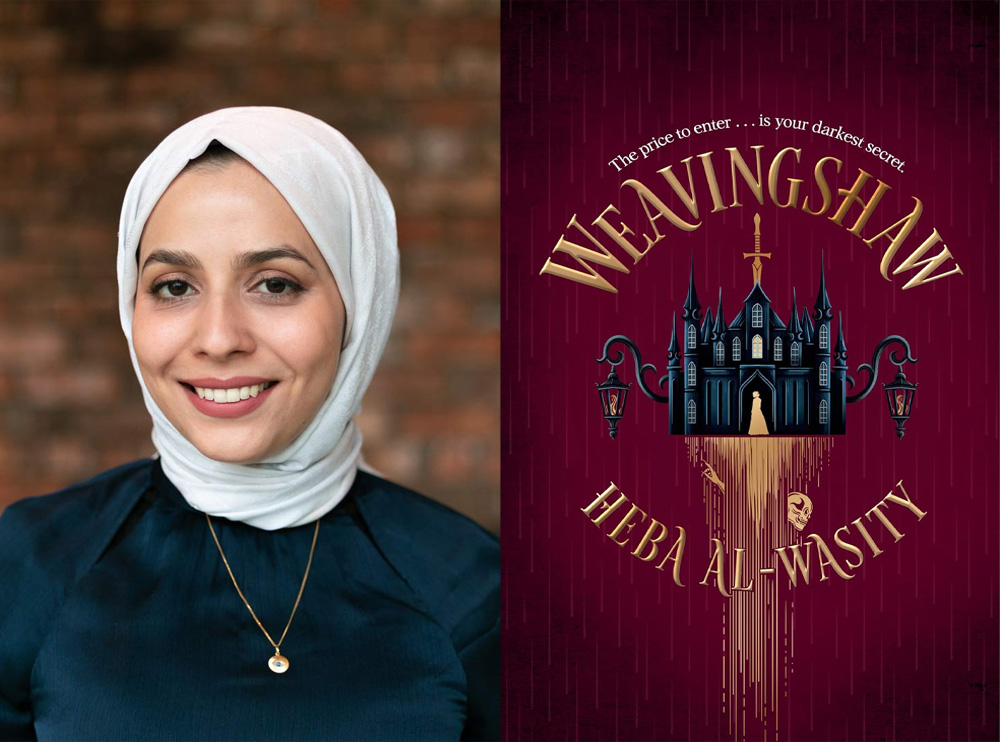
We chat with author Heba Al-Wasity about Weavingshaw, which is a debut gothic fantasy and follows a young woman who can see the dead and strikes a deal with the magnetic and dangerous Saint of Silence, a purveyor of dark secrets, to save her brother’s life.
Hi, Heba! Can you tell our readers a bit about yourself?
Hellooo, I’m Heba. Although I am Iraqi, I grew up in Canada due to my family’s displacement from the war. I moved to the UK when I was freshly eighteen to start medical school, and I have been here ever since. While I love the rain, I do miss the heavy snow days of my childhood. I have just finished my training (yay!) and I am now working as a GP while rushing to find time to write. I also have a million and one other hobbies, and I am mediocre in each.
When did you first discover your love for writing and stories?
I am dyslexic, so I learned to read at a later age. In early elementary school, I was the kid who was always pulled out of class for extra help. Still, no matter what, I just couldn’t grasp my letters.
Despite this, I was obsessed with stories. To me, it felt like a kind of magic that black-and-white letters on a page could turn into tales of knights and dragons, warlocks and witches.
I used to constantly ask my mum, What does it feel like to read? I remember this question always confused her—reading has no feeling.
But now that I’m a little older (although not much wiser), I think I was right all along. Reading is a kind of magic.
Quick lightning round! Tell us:
- The first book you ever remember reading: The Balloon Tree by Phoebe Gilman (I’ve bought a copy for my nieces and it is wonderfully nostalgic to read it to them)
- The one that made you want to become an author: On the Jellico Road by Melina Marchetta
- The one that you can’t stop thinking about: Heat’s Blood by Juliet Marillier
Your debut novel, Weavingshaw, is out February 24th! If you could only describe it in five words, what would they be?
Yearning. Dark. Gothic. Secrets. Ghosts
What can readers expect?
I wanted Weavingshaw to be a loving ode to all the gothic stories of the past: Rebecca, Wuthering Heights, Jane Eyre. While at the same time, I wanted it to shed light at real life issues that I encounter every day as a doctor: the struggles of class; racism; wealth disparities; war and displacement. I also wanted it to feel like a true slow-burn romance, full of yearning and quiet intensity.
Where did the inspiration for Weavingshaw come from?
I am the youngest of three. A few years ago, my oldest sister (inspired by Lord Byron and Mary Shelley) gave us a challenge: create a story about a building that is alive. At that moment, the idea for Weavingshaw was born, although it would be some time before I began writing.
It is a idea I constantly returned to again and again, but I did not set pen to paper until insomnia hit me while I worked as a doctor during Covid. Only then, did Weavingshaw truly come alive for me.
Were there any moments or characters you really enjoyed writing or exploring?
I loved the challenge of writing Weavingshaw, the grand and haunted house on the moors, as a living, breathing creature. I truly reflected on all the different emotions that Weavingshaw evoked in each character: whether its love, hatred, fear. It was one of the few elements of the book that came easily for me even from that awful first draft
Did you face any challenges whilst writing? How did you overcome them?
I had to learn first how to write a novel! I shudder at the horrors of my first draft, and feel even worse for my poor sister who had to drudge through it. Honestly, I am surprised it had not permanently severed our relationship!
This is your debut novel! What was the road to becoming a published author like for you?
I honestly never even considered the possibility until my sister suggested it. I wrote as a way to channel my emotions, to release old ghosts. But once it was planted, I put my heart into researching the process (and boy what a process!). Honestly, if I had known how badly the odds were stacked against querying writers, I probably would’ve talked myself out of it. Who was I to think I could be a writer? It really goes to show the ways that fear can influence you.
What’s next for you?
If the book world will continue to have me, I would love to keep publishing. If not, I will likely continue scribbling on old receipts and discarded train tickets.
Lastly, what books are you looking forward to picking up this year?
Ooooh, there are so many!

I’ve really enjoyed In the Country I Love by Alaa Al-Barkawi, Deathbringer by Sonia Tagliarni, and Blood Bound by Ellis Hunter.
I cannot wait to start Dawn of the Firebird by Sarah Mughal Rana, Love at First Fright by Nadia El-Fassi, and The Poet Empress by Shen Tao