

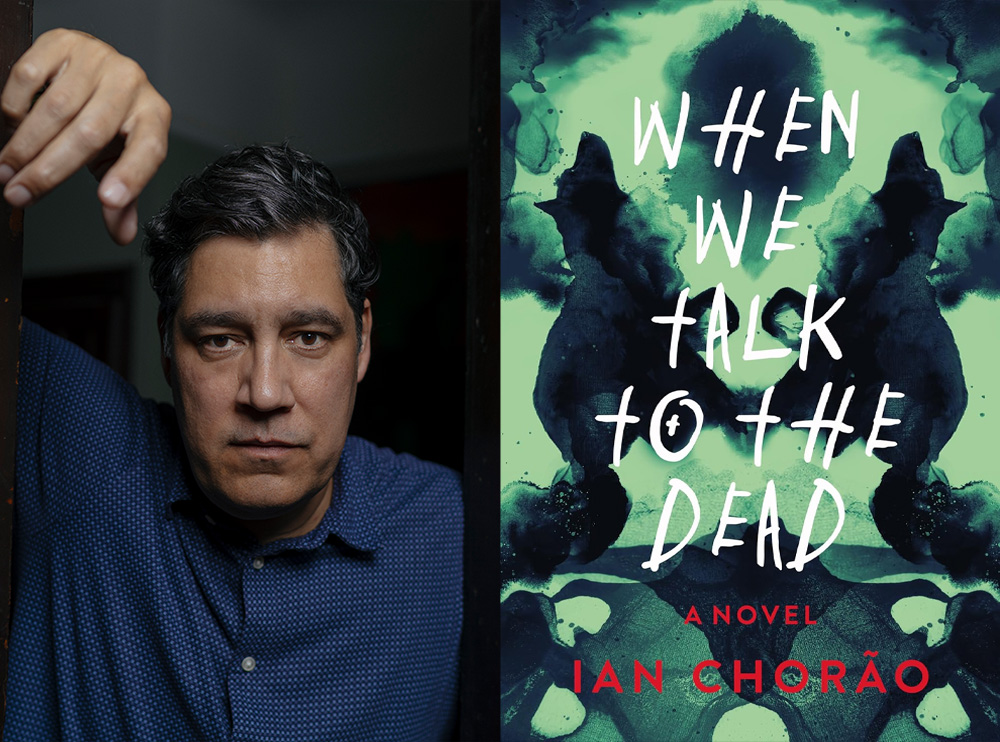
We chat with author Ian Chorão about When We Talk to the Dead, which is a slow-burning horror novel will sweep you out, and like a churning ocean, before you realize, it will pull you under its turbulent spell. PLUS we have an excerpt to share with you at the end of the interview!
Hi, Ian! Can you tell our readers a bit about yourself?
Hello! I’m a native New Yorker who lived in LA for some years but missed the seasons and the stoops and moved back. I now live in Brooklyn with my wife; we have two kids. I’m a psychotherapist in private practice. There is a distinct difference between my writer self and my therapist self, but both are anchored in a similar space in my brain.
When did you first discover your love for writing and stories?
Like a lot of writers, it’s something I always did. When I was young, school mostly was a drag so I would spend a lot of time staring off, spacing out to little stories in my head—a lot more fun than long division. But then I learned: stories that appeared in my head, when written down, could take on a new life. It was fourth grade; we had to read aloud stories we’d done. I remember the pride and amazement I felt looking up after I was done and seeing the impact it had on the other kids, the teacher. I was hooked. Writing let me vent, express, explore whatever I wanted. I felt the magic of words becoming alive, and the connection and conversation it made with those who read it.
Quick lightning round! Tell us:
- The first book you ever remember reading: In the Night Kitchen, Maurice Sendak; both terrified me and made me feel seen; it captured how it truly felt to be a child.
- The one that made you want to become an author: This is a terrible question: there are so many! The earliest I can remember is Edgar Allen Poe. When I read Tell-Tale Heart in elementary school, something in me changed. It wasn’t just the disturbing nature of the story, but the way it was written, like a fever dream. I’d never experienced anything like it. I wrote so many stories inspired by it, cheap knockoffs of a 10-year-old. I’m sorry, but I’m cheating: another early inspiration, The Outsiders by S.E. Hinton floored when in my tweens; I attempted my first novel then, another cheap knock off. In many ways, the DNA of these boyhood inspirations are all over my book When We Talk to the Dead.
- The one that you can’t stop thinking about: The last paragraph of The Dead from James Joyce’s collection Dubliners. I have read that ending so many times. It’s like a song, it’s like atmosphere: I feel entranced by it. It feels less like words and more like being transported. It is melancholy, lyrical, beautiful, timeless, painful, filled with longing and love and loss. In my mind, no greater collection of words exists than the end of that story.
Your latest novel, When We Talk to the Dead, is out now! If you could only describe it in five words, what would they be?
Emotional, raw, unnerving, exhilarating, devastating
What can readers expect?
When We Talk to the Dead is a psychological, gothic horror story. So, expect to feel like you are inside the mind and body of the main character, Sally da Gama. She is a young woman whose early life is marked by an intense trauma. She and her family lived on a remote, desolate island off the coast of northern Maine where tragedy stuck. Her twin sister was swept out, drowned in the violent Atlantic when they were 6. The event left Sally’s remaining family shattered long after they fled the island. Yet Sally has no memory of her life from them, or the events that have haunted her life ever since. And she is that: haunted; deeply, chronically, and with increasing intensity when her mother (mute and institutionalized since the tragedy) suddenly dies. So, expect the sensation of a building apprehension that gets under your skin, as you enter Sally’s deepest fears. Expect to yell at the book when Sally and her friends visit to the island, long deserted, telling them to not go. And on the island, as Sally’s memories slowly return, and as the group is stalked by the malevolence that exists on the island, expect to feel the only thing worse than not knowing: the horror of learning the truth.
Where did the inspiration for When We Talk to the Dead come from?
In addition to being a writer, I’m a psychotherapist. Psychology and writing have always existed side by side for me. As a therapist, I work with a lot of traumas, anxiety, dissociation, depression, memory loss. But, honestly, my first psychology books were novels. Fiction lets us experience the many corners of our humanity is such an expansive way; sometimes we read characters who feel familiar, sometimes we get to enter lives that feel very different, but always, when the writing is good, we get to access something deeply personal. Though I didn’t experience the specific traumas of my character, she and I have many similarities, and I was able to use her as a vessel to explore, in fictional form, fears, troubling events from my own life. What I love about horror is how big it is; with the plotting, with the intense expressions of fear and rage, we get to explore intimate and vulnerable feelings in an exciting way.
Were there any moments or characters you really enjoyed writing or exploring?
The daydreamer I was as a kid is school fed into my main character Sally, who has a very vivid imagination. She’s the kind of person who makes frightening faces in the mirror until she has herself freaked out, convinced that the person in the reflection is a monster. I loved writing those scenes where reality and imagination melt and create a new realty: one that is a fabrication but says something truer than the facts. Also, Sally makes little films to express things she can’t understand, which I relate to—and I loved coming up with her films, seeing them in my head. Writing the malevolent presence on the island was disturbing and upsetting because even the worst things have complexity, rage covers wounds. And lastly, I love the ocean, I love a moody landscape, so it was a joy to have the island be another character, letting it talk through its elements, the wind, the trees, the sea, the soil.

Did you face any challenges whilst writing? How did you overcome them?
The greatest challenge is being a Gen X man writing a Gen Z woman. Capturing an authentic character who’s different than oneself can be challenging and should be taken seriously. That is the wonder of writing: crawling into the skin of another person. It demands a lot of respect and empathy, curiosity and open imagination. Of course there is something universal we all share as humans, so that is always my first doorway into a character. The second personal doorway was really returning my own lived experience being the age and temperament of my main character. But, so much of writing, especially when writing a person who is different than oneself, is to spend time with people who are different. To shut up and listen, to see life from their point of view. That’s what I have always loved about writing, but also, my job as a therapist is very much dependent on trying to quiet my perspective and assumptions to understanding the life of the person I’m working with. For me, it’s important to reflect the real world in my writing, which means having characters who are diverse in terms of race, ethnicity, gender, gender-expression, socioeconomics, culture. I also had a lot of readers, specifically those who align with the characters in the book, to keep me honest.
What’s next for you?
I’m currently working on my next book, which is primarily a ghost story, with some cult elements, mystery elements, and, of course, family drama (gotta have it!). I have been asked about a sequel to When We Talk to the Dead, which I’m mulling over. I also had a different novel completed, one that is very different—more straightforward literary fiction that should maybe find a home.
Lastly, what books have you enjoyed reading this year? Are there any you’re looking forward to picking up?
Some highlights of recent amazing reads: The Exorcist by Blatty, Incidents Around the House by Malerman, The Unfolding by Homes, Don’t Be a Stanger by Minot, John & Paul: A Love Story in Songs, by Leslie. Some books I have on my shelf I’m looking forward to: Hamnet by O’Farrell, The Little Stranger by Waters, Mary: An Awakening of Terror and When a Wolf Comes Home, both by Cassidy, The Lamb by Lucy Rose
 Loading…

 Reload document
  Open in new tab