

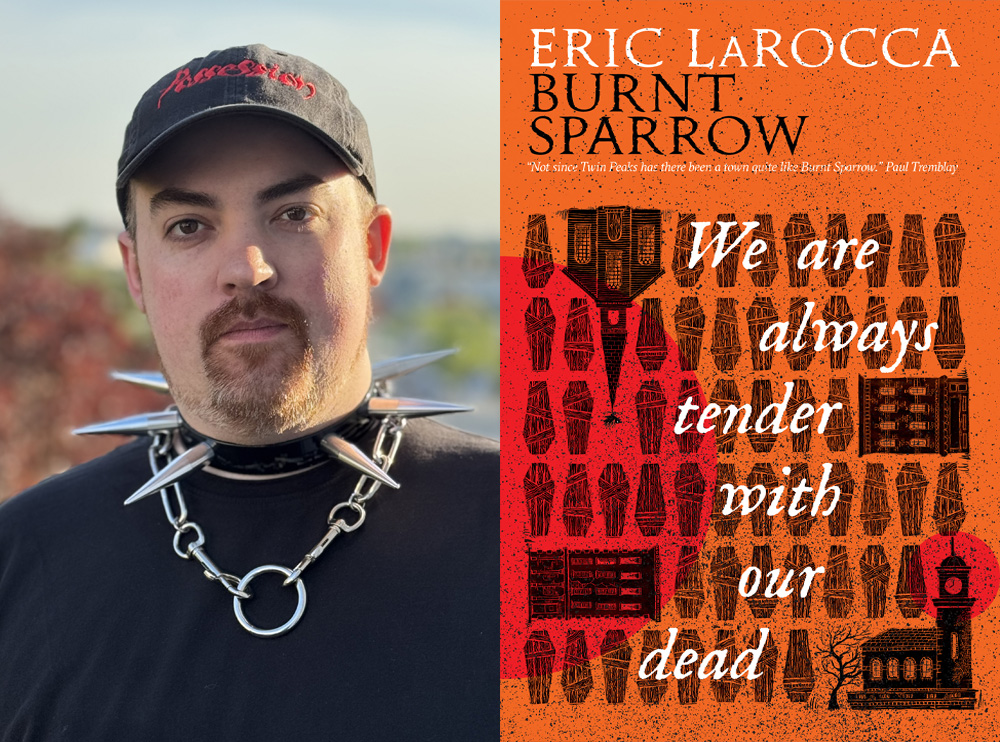
Guest post written by Burnt Sparrow author Eric LaRocca
Eric LaRocca (he/they) is a 3x Bram Stoker Award® finalist and Splatterpunk Award winner. He was named by Esquire as one of the “Writers Shaping Horror’s Next Golden Age” and praised by Locus as “one of the strongest and most unique voices in contemporary horror fiction.” LaRocca’s notable works include Things Have Gotten Worse Since We Last Spoke, Everything the Darkness Eats, and At Dark, I Become Loathsome. He currently resides in Boston, Massachusetts, with his partner.
About Burnt Sparrow: Engrossing, atmospheric, and unsettling, this is a devastating story of a small New England community rocked by an unforgivable act of violence. Writing with visceral intensity and profound eloquence, LaRocca journeys deep into the dark heart of Burnt Sparrow, leaving you chilled to the bone and wanting more. Out September 9th 2025.
Growing up in a rural, isolated community nestled in the hills of Northwestern Connecticut, I often felt painfully aware of my differences from my peers. Children are gifted with a special sense of who stands out amongst their group. It’s in their very nature to pick apart and ruthlessly dissect the noticeable dissimilarities of others. I often felt ostracized, ignored, even excluded by my classmates (and adults!) because of my inherently flamboyant nature, because of my obvious queerness even at such a young, vulnerable age. Although coming of age in a small, isolated community was beneficial to my growth as an author simply because it afforded me the privilege of time to seek out and read as many brilliant authors as I could find at our local library, it also showcased and magnified the very worst traits of humanity and effectively illustrated the intrinsic cruelty of others when trapped inside the petri dish of a small town.
I was asked in an interview recently if my upbringing greatly influenced my work in horror fiction. While I hadn’t truly considered the influence before, it seems quite obvious now that I have ruminated on the question further. When looking at my body of work so far, you’ll notice an emphasis on queer characters subjected to relentless suffering while struggling to navigate the complexities and detriments of dwelling in small, rural communities. My previously released novels (Everything the Darkness Eats and At Dark, I Become Loathsome) both explore the suffering, the misfortune, of those who are obviously different and marginalized while attempting to coexist with others in the peaceful, idyllic community of Henley’s Edge. I’m afraid my new release, We Are Always Tender with Our Dead, exemplifies the very same characteristics with queer characters struggling to come to terms with their sexuality while existing in a harsh, unforgiving isolated community known as Burnt Sparrow.
Because of my upbringing, I find myself inherently drawn to the concept of marginalized folks struggling and suffering in smaller neighborhoods. I wonder if I’m so drawn to this not only because of the trauma I endured in my childhood, but also because I saw a distinct lack of “small town queer stories” in the publishing landscape. For instance, I think of so many of the seminal works of queer horror fiction I encountered when I was younger—the texts that would eventually shape the structure of my own imagination, my own voice as a fledgling author. I think of brilliant novels like Exquisite Corpse by Poppy Z. Brite, Skin by Kathe Koja, Frisk by Dennis Cooper. If you’ve read any of these books, you’ll know that each of these novels takes place in an urban setting. In each of these books, we follow queer characters through a labyrinthine cityscape while they navigate the perils and misfortunes of their queer identities. Although I was enthralled by the work of Brite, Koja, and Cooper, I sometimes felt detached from their urban-dwelling characters and found myself longing for stories set in smaller, more rural locations with openly queer characters.

Although I primarily write fiction now, I initially began my literary journey as a playwright. I voraciously read the work of iconic writers for theatre like Edward Albee, Arthur Miller, and Tennessee Williams. Although I don’t write plays as much as I used to, I’ve found that I’ve adopted many of the instincts I felt as a playwright to my work in horror fiction. One of my professors at college once told me that “a great play needs to have a profound sense of trouble, a foreboding threat of danger.” I try to employ that at all times in my work and I find it especially true when writing about marginalized folks surviving in smaller communities simply because, to me, there is nothing more dangerous than being queer in a small town. While it’s unsafe to make grotesque generalizations, I do believe so much of small-town life is about upholding a proper image and maintaining a sense of societal harmony. Queerness is an inherent disruption to the convenient, the proper, the polite. We, as queer people, are disruptive to the heteronormativity you commonly find in these smaller, more remote communities. Therefore, because of our differences, we are a threat and are consequently punished or persecuted. That’s exactly how I felt as a young child growing up in Connecticut. I often felt like I was a nuisance, a hideous disturbance to the comfortable and the respectful.
To me, writing about queer characters facing unending persecution in small towns is intensely cathartic. It helps me reconcile some of the gratuitous cruelty and despair I faced growing up. Of course, there were many kindhearted folks I met while I was a child—people who embraced my differences, who championed my non-conformity, my uniqueness. However, the town where I grew up left an indelible mark upon me because it’s where I truly learned about human viciousness and the very palpable need for adults to inflict pain on others no matter their age. The fictional town of Burnt Sparrow, New Hampshire, has served as a therapy session for me in many ways—a place where I can be as flawed, as deeply problematic as I can possibly be while successfully exorcising some of my more argumentative demons.