


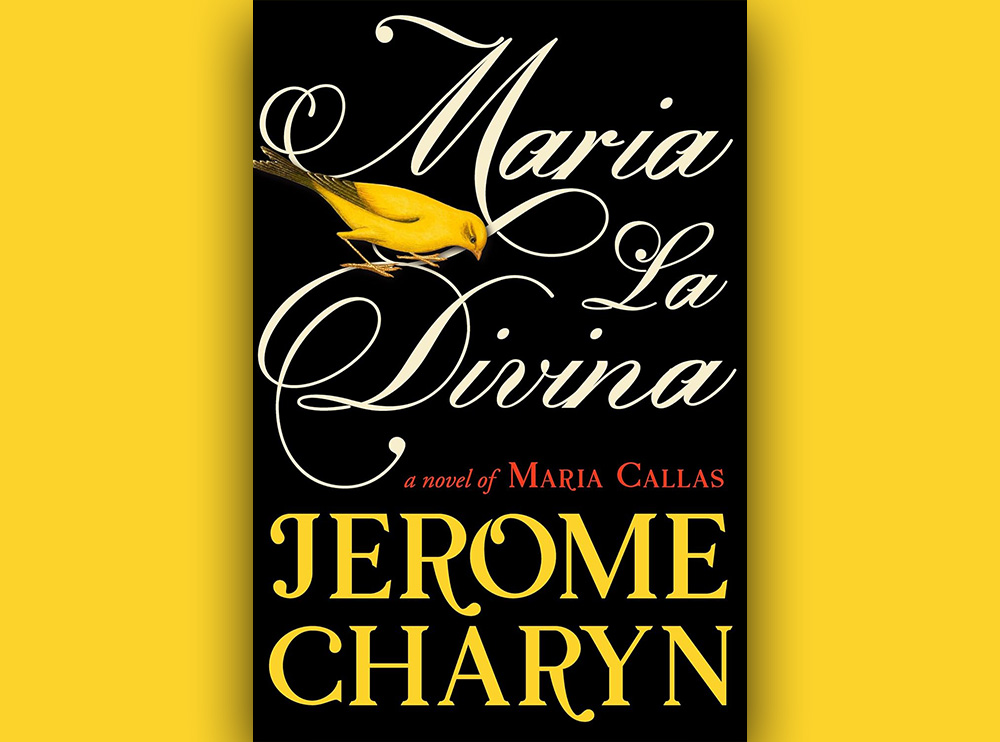
In Charyn’s inimitable style, Maria La Divina humanizes the celebrated diva, revealing the mythical artist as a woman who survived hunger, war, and loneliness to reach the heights of acclaim.
Intrigued? Well read on to discover the synopsis and an excerpt from Jerome Charyn’s Maria La Divina, which is out September 16th 2025.
Maria Callas, called La Divina, is widely recognized as the greatest diva who ever lived. Jerome Charyn’s Callas springs to life as the headstrong, mercurial, and charismatic artist who captivated generations of fans, thrilling audiences with her brilliant performances and defiant personality.
Callas was one of the first divas to come from an impoverished background. As an outsider, she was shunned by the Italian opera houses, but through sheer force of will and the power and range of her voice, she broke through the invisible wall to sing at La Scala and headline at the Metropolitan Opera, forging an unforgettable career. Adored by celebrities and statesmen, the notable and notorious alike, her every movement was shadowed by both music critics and gossip columnists—until, having lost her voice, she died alone in an opulent, mausoleum-like Paris apartment.
“Profesora, Profesora, Profesora!”
Elvira de Hidalgo was bored to death. It was stifling in the audition room; the porter had forgotten to close the shutters, and the room was flooded with bitter, blinding sunlight and hot wind from the mountains. Elvira had to remove the summer cape she’d once worn in Il barbiere di Siviglia. This stranded diva, who had sung with Chaliapin and Caruso, was stuck at the Athens Conservatory, a teacher of students without a crisp of talent. The intruders sat on a long bench with their mothers and aunts, jabbering and calling out to her like a flock of sick canaries, “Profesora, Profesora!”
She cursed under her breath and then assumed her stage mask. “Please,” she said. “A little patience. I do not have a dozen ears. I can only deal with one student at a time.” And the canaries stopped their horrid chirp. Elvira was practically fluent in Greek. She’d arrived in Athens several years ago, with a traveling troupe from Bilbao, but the troupe disbanded within weeks. And this veteran of La Scala, a coloratura soprano, who began losing the upper registers of her voice by the time she was thirty, decided to remain right where she was.
Elvira stood next to the accompanist’s piano and noticed a stout girl sitting all by herself on the bench, removed from the other applicants, as if she wanted to hide. The girl had no discernible shape other than a pair of slouching shoulders, and she wore thick glasses and battered sandals. She had a long nose, a large mouth, and a barrage of pimples that seemed to scar her face. It was laughable, ridiculous, that this pasty, half-blind girl in an ill-fitting smock should waste Elvira’s precious time with the fantasy of becoming a fledgling soprano. The girl kept biting her nails as she sat there, revealing a glimpse of her swollen ankles.
Elvira went through the canaries, one by one, dismissing them all and sending them home with their mothers and aunts, who kissed her hand, curtsied, and said, “Thank you, Profesora” in a very musical Greek. And then Elvira came to the stout girl in the corner, who took off her thick glasses and wiped the sweat from her forehead with a handkerchief that had as many furrows as the Greek flag. She had the deepest eyes Elvira had ever seen—dark and dead—while her mother had flaring blue eyes and bleached blond hair. These poor, listless girls always seemed to have mothers with the manic energy of a firecracker.
“Child,” Elvira said, “stop biting your nails. . . . What is your name?”
“Maria,” her mother said, “Maria Kalogeropoulos.”
Elvira looked at the girl’s application form. She was born in America, had come to Athens at the age of thirteen, and had studied these past two years at the National Conservatory with Madame Trivella—an amateur, with her precious prodigies. Madame Trivella had never sung at La Scala, had never sung anywhere. And yet she taught the half-forgotten art of bel canto—the art of embellishment coupled with the finest phrasing—to these prodigies who graduated from Madame Trivella’s séances, got married within a month, and practiced arpeggios while they shopped at Plaka Market. That was the beginning and end of their careers.
“Child,” Elvira said in the slightly mannered English she had picked up while performing at Covent Garden, “did Trivella invite you here?”
“No,” Maria said without looking at Elvira. “She cannot teach me bel canto, and I cannot master it on my own.”
Elvira smiled beneath her stage mask. “Bel canto was lost a long time ago. But why did you ever leave New York? You could have had some of the best teachers in the world.”
“Profesora,” the girl’s mother said, wiping her brow with the back of her hand, “my Maria wanted to study with you.”
Elvira ignored this blue-eyed pest. “Madame, I cannot audition her with people in the room.”
The haughty blonde rebelled. “But you did not banish the other mothers, Profesora.”
“Still, you will distract your daughter, throw her off-key. You must go.”
Elvira had the porter escort Maria’s mother out of the audition room, while Maria rose off the bench with a furtive look as she handed the accompanist the aria she intended to sing from Oberon, an opera about a mischievous company of elves and the bedlam they bring to Baghdad. Now Elvira smiled with a bit of malice. She knew the girl would fall flat. The aria was too complex for a fifteen-year-old girl. It is sung by Rezia, the luscious daughter of the caliph of Baghdad, and this duckling from the “Bronx” could hardly inherit a princess’s voice or aristocratic manner. She stood there in her sandals and swayed like some molten creature.
Maria’s eyes widened as she broke into song, while the soprano from Bilbao suddenly started to shiver at the melody this strange girl could summon from the very first notes. The voice was rich, deep with emotion that a fifteen-year-old shouldn’t have been able to capture. Elvira was shaken, enthralled. She lost control, started to cry. This duckling with the bad eyes and botched skin moved her arms like a princess, and her once vacant eyes flashed with fury. The bitten nails meant nothing. Elvira saw a startling, beautiful girl.
She wouldn’t let Maria finish the aria. She could not bear the rough enchantment of her roulades, the way Maria could stretch and magnify a note.
“Stop, please. I beg you.”
Now it was Maria who started to cry. “Profesora, did I disappoint you?”
“Child, you’ll ruin your voice with such roulades. You’re much too young.”
Fifteen or not, she accepted Maria on a full scholarship. “Classes start in a week, and please don’t have your mother pester me.”
“But Profesora,” Maria said in that “Bronx” accent—an accent that utterly vanished when she sang. Maria understood with the clarity of a witch what syllables to emphasize and what syllables to drop in each musical phrase. “It was my mother who sent me to your conservatory. I wouldn’t have had the courage without her.”

“But she is not my pupil, child. You are. You will be here every morning at ten when the term starts. And you are not to practice roulades until I tell you.”
Elvira couldn’t say why, but she kissed this magnificent brute of a child on the cheek as she would have kissed a comrade of hers, another soprano at La Scala, when she, Elvira, still had a voice and was adored; she would promenade in the tunnels under La Scala after her final aria as the rich young beauty Rosina in Il barbiere; she’d enter a private door of Biffi Scala with her painted cheeks and sit at the center table of La Scala’s own bistro as opera buffs knelt at her table and asked her to sign their autograph books. . . .
Maria looked down and kneaded her fine, expressive hands, alive with sweat. “Profesora, my mother will want to come with me to every class.”
“No,” the diva said. “I cannot teach under such conditions. You will have to tell her, child. Mothers are forbidden.” They were the wreckers of a girl’s career, ruinous and willful.
Maria bit her nails. “She will not believe me, Profesora. She will insist.”
“Then I will have the rector write her a letter with the conservatory’s seal. . . . And I told you. Stop biting your nails.”
The girl hesitated for a moment. Elvira began to notice little things. Maria had a feistiness under her mulish look. “Mother will convince the rector. She knows how to seduce.”
Elvira removed her stage mask. “Child, she will not win. Now go home. And don’t practice your roulades without me.”
Maria left, like a hulking ghost. Elvira could not console her. She would train this girl, teach her how to dance, how to move, how to sing. Elvira’s sojourn in Athens began to make sense. She’d arrived like a fugitive, a member of a company that unraveled so fast, it could have been a figment of her imagination. She found a maid’s room in a firetrap not far from Constitution Square. She had to grovel for a living, with a student here, a student there, until the rector at the Athens Conservatory realized that Elvira de Hidalgo had almost plummeted into his lap. He’d seen her at La Scala, had been one of her admirers, had left a bouquet of roses outside her dressing room, and now he invited her to join the faculty.
She moved into a stone building near the Royal Garden and the Little Royal Palace, where George II, the puppet king, lived in his own internal exile. King George was always coming into power and was always being forced out. He’d lived in London for many years at Brown’s Hotel in Mayfair. And he now lived in the shadow of General Metaxas, the prime minister who declared himself military dictator. Greece had a parliament that never met. Metaxas prowled the Old Royal Palace with all his colonels in purple riding boots. Elvira had stayed at Brown’s whenever she sang at Covent Garden. It was famous for its cucumber sandwiches. She never missed an afternoon tea at Brown’s. But that was before King George’s time in London, and she never had the pleasure of introducing herself to the deposed king. Now she often saw him on the ramparts of the Little Royal Palace, wearing his medals and military cap, and she would wave to him. The king waved back, a prisoner inside his palace.
George’s plight softened her own exile. Elvira could see the Parthenon and the Acropolis from her balcony. And on the days she didn’t teach, Elvira would often climb the Acropolis and stand within the ruins of the Parthenon—it was here that all human measurement began. And opera itself had emerged from the Greek chorus on this hill. The birth of song began here, long before Carmen and Il barbiere de Seviglia. She giggled like a schoolgirl. She wouldn’t have been surprised if bel canto had been discovered by the Greeks.
Excerpt from Maria La Divina. Copyright © 2025 by Jerome Charyn. Published by Bellevue Literary Press: www.blpress.org. Reprinted by permission of the publisher. All rights reserved.