


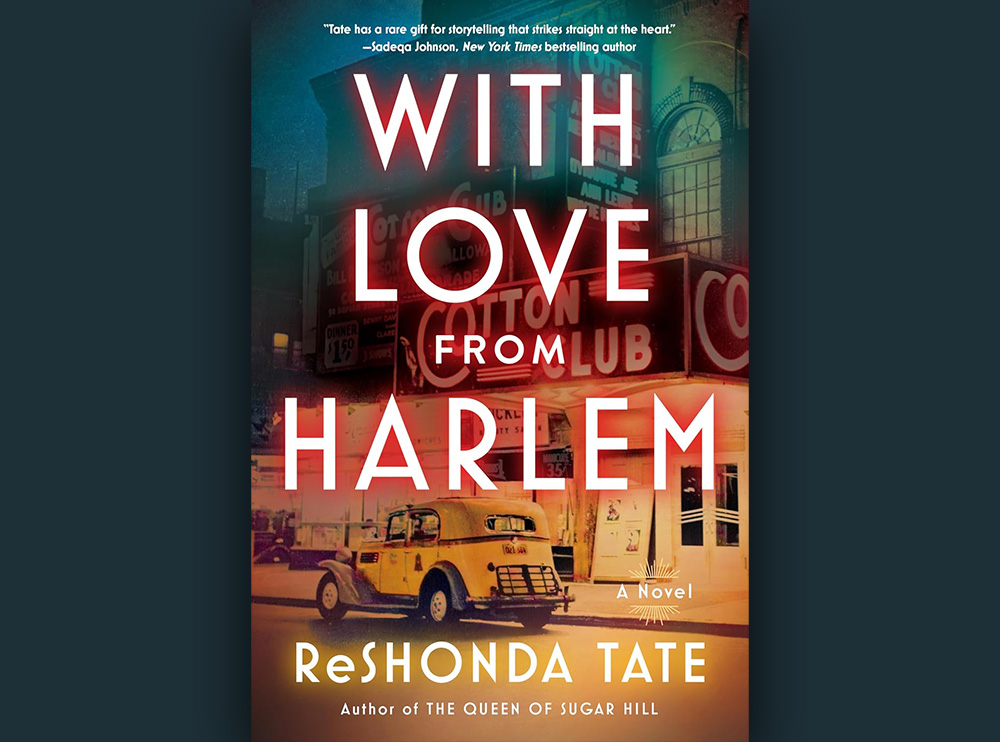
From The Queen of Sugar Hill author ReShonda Tate—a new novel inspired by beloved Harlem jazz performer Hazel Scott and the equal parts exhilarating and tumultuous relationship that changed the course of her life.
Intrigued? Read on to discover the synopsis and an excerpt from With Love From Harlem by ReShonda Tate, which releases on January 27th 2026.
Harlem, 1943. At just twenty-three, Hazel Scott is a woman on fire. A jazz prodigy, a glamorous film star, and a fierce advocate for civil rights, she’s breaking barriers and refusing to play by the rules. Then Adam Clayton Powell Jr. walks into her life. Harlem’s most electrifying preacher-turned-politician, Adam is as bold and unyielding as Hazel—charismatic, powerful…and married.
This kicks off a decades-long relationship that propels them into the center of a political and cultural revolution. As Hazel’s star rises, Adam takes the national stage in Congress and the couple becomes the toast of the country. But when their affair turns into a marriage, behind the glamorous façade is a battlefield of ego, ambition, and sacrifice. Forced to choose between her music and her family, Hazel must decide what she’s willing to lose—and what she refuses to give up.
Set against the pulsing backdrop of twentieth-century Harlem and featuring icons like Billie Holiday, Langston Hughes, and James Baldwin, With Love from Harlem is a sweeping, emotionally charged romantic drama, rich with historical detail. ReShonda Tate delivers a powerful portrait of love, art, and the price of being unforgettable.
EXCERPT
She’d played to packed houses all over the country, but only New York knew how to love her like this.
The “Hazel Scott Returns to Cafe Society” sign pulsed in sync with the energetic crowd. As Hazel peeked out from behind the velvet partition, a surge of electricity coursed through her and danced along the edges of her nerves.
She’d expected a full house—every one of the fifty tables in the club was crammed with patrons, and at least two dozen more spectators lined the walls. Jewel-toned swing dresses, wide-legged trousers, and checkered zoot suits were on full display.
Hazel inhaled the anticipation. These people were ready for a show. And she was ready to give them one.
The announcer’s voice cut through the chatter like a brass horn.
“. . . She’s back from making history as the first Negro woman to have her own show in Las Vegas, from touring all over the world, and capturing our hearts in movies. Here for one night only before she heads back out to change the world with music. Ladies, gents, and drunks, put your hands together for America’s biggest jazz star, the incomparable Hazel Scott!”
The applause exploded as Hazel slipped from behind the partition. The spotlight beamed on her shimmering off-the-shoulder gold floor-length gown, the fabric cascading like liquid light against her golden-brown skin as she glided into the center of the room. Each step felt like a homecoming, a return to the place where her heart and soul had always belonged.
“Welcome home, Hazel. We love you!” a voice rang out from the back of the room.
Hazel pressed her hands together in gratitude, relishing the familiar faces and adoration that filled the U-shaped space around her. Cafe Society was as she remembered—elegant, intimate, decadent. The art deco murals shimmered under the soft chandelier light. Cigarette smoke curled lazily in the air. A beautiful tapestry of faces, white and colored, sat side by side, drawn together by the one thing that transcended the world: music.
“New York, how is everyone doing tonight?” Hazel purred into the microphone.
As the crowd roared in response, her attention landed on a table directly in front of her where a handsome man sat wearing a pin-striped suit that made him look like he had just stepped out of a Langston Hughes poem—smooth, confident, and full of purpose. Hazel recognized him as the Harlem representative for the New York City Council, Adam Clayton Powell Jr. A petite, fair-skinned woman with soft curls pinned neatly in place sat next to him, dressed conservatively in a navy knee-length dress and a single strand of pearls. She eased her hand on Adam’s arm when he didn’t take his eyes off Hazel.
“We missed you!” someone shouted.
“I missed you, too.” Hazel extended her arms to the crowd. “All of you.”
She glanced at Adam again. He stared at her with an intensity that made her shiver.
Hazel took a breath and turned her attention back to the enthusiastic crowd. “You ready for a show?” she asked before making her way to the grand piano in the center of the room.
“Yeah!”
“For sure!”

A chorus of enthusiastic replies filled the room as she took her seat. For many artists, facing this crowd of ritzy, integrated folks might be intimidating, but not for Hazel. From the moment she first stepped in front of the Cafe Society crowd, Hazel had felt an inexplicable connection with this place and its patrons.
Hazel’s fingers hovered over the keys, and as the first note escaped the piano, it was like oxygen to her soul. Now, she was alone . . . just her and the music.
“Swing those classics, Hazel!” someone shouted, and she obliged, beginning with Chopin before seamlessly transitioning into a jazz improvisation. Her hands obeyed no script, turning centuries of classical precision into something raw and unique. This was her signature, what had made her a star. Hazel let herself indulge in the sight of the men swaying along, the women snapping their fingers, and everyone tapping their feet. But then, her eyes, like magnets, were pulled back to Adam.
He took a long, slow drag of his cigar, the red ember glowing, then fading. The music surrounded him, but he didn’t move, didn’t crack a smile. It was as though he were dissecting her with his gaze, peeling back the layers of her performance to see what lay underneath.
“That’s how you do it, baby!” another voice called from the back, and Hazel answered with a cascade of faster, wilder notes. She wasn’t the first to jazz up the classics, but she was the first to do it like this—to blend them so seamlessly that you couldn’t tell where the classical ended and the jazz began.
Just as the crowd seemed to settle, two men rolled out another piano to the right of Hazel. Confused chatter rippled through the room as Hazel continued playing Fletcher Henderson’s “Sugar Foot Stomp” with her right hand, while her left hand launched into Beethoven’s Moonlight Sonata on the new piano. The simultaneous melodies set the crowd on fire.
“That’s the cat’s meow!” someone yelled.
Hazel performed a few more pieces, each song a story, each note a word, weaving tales of love, loss, and the indomitable spirit of New York. As she played her final refrain, a hush settled over the room before thunderous applause broke out. Hazel rose from the bench, stepped forward, soaked in the moment, then took a deep bow. As she straightened, her gaze locked on to Adam.
He was still sitting, still watching her, yet his posture had softened. His lips curved into a smile, and Hazel felt something electric and unsettling shift deep in her spine. Despite the woman by his side, whose lips were pressed in a tight, irritated line, Adam’s eyes never wavered from Hazel. And for a brief moment, her pulse quickened, as though they were the only people in the room.
From With Love From Harlem by ReShonda Tate. Copyright © 2026 by ReShonda Tate. Reprinted by permission of William Morrow, an imprint of HarperCollins Publishers.