

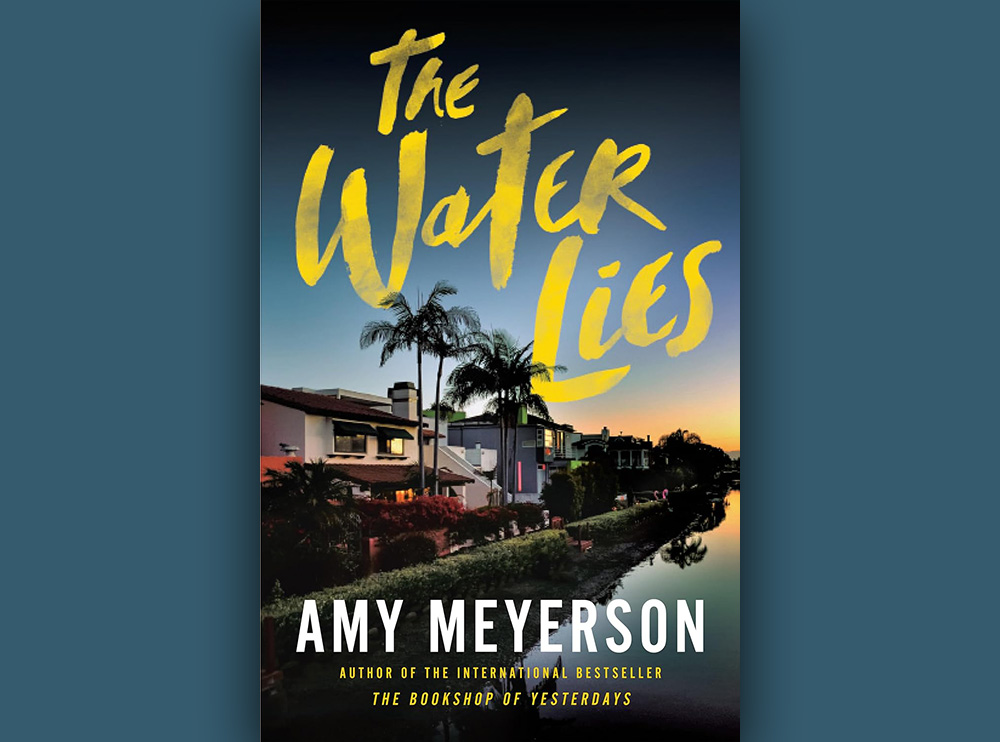
Internationally bestselling author Amy Meyerson takes readers on a harrowing journey where two mothers―one of a woman who drowned and the other of a toddler who might know what happened to her―are the only ones searching for the truth.
Intrigued? Well read on to discover the synopsis and an excerpt from Amy Meyerson’s The Water Lies, which releases on January 1st 2026.
Heavily pregnant with her second child, Tessa Irons has enough on her mind without her toddler throwing tantrums at the local coffee shop. The boy is inconsolable, shouting “Gigi!” to a woman Tessa’s never seen before―and never will again. The next morning, the woman’s body is dredged up from the canal outside the Ironses’ posh Venice Beach home, and Tessa’s gut tells her it’s no coincidence.
Barb Geller refuses to believe that her daughter’s death was just some drunken accident. She heads to California for answers, where she crosses paths with Tessa. Together they hunt for the truth, certain they’ll find a connection between their children.
But the police don’t believe them. Tessa’s husband dismisses her worries as pregnancy jitters, and even though people are always watching along the canals, no one saw a thing. Tessa and Barb only have each other, their intuition, and the creeping sense of danger that grows with every shocking revelation.
CHAPTER ONE
TESSA
We’re waiting at Café Collage when he spots her in line. It’s hot in the coffee shop, and stuffy, despite its proximity to the Venice Beach Boardwalk and the Pacific Ocean beyond. Or maybe that’s the pregnancy talking. Either way, I’m sweaty and breathless as the other customers side-eye me and my round belly, the pregnant woman waiting for her caffeine fix with her son who is practically still a baby himself. Yes, I’ll have two under two in one short month. Yes, I’m pregnant and drink coffee. The French do it all the time. I squat to wipe the crumbs from Jasper’s sugar cookie off his face, hoping my drink arrives soon. Yes, I buy my eighteen-month-old son cookies to entertain him while I wait for the coffee everyone thinks I shouldn’t be drinking.
The café isn’t particularly crowded. Three other people wait for their coffees; two more stand in line to order. A few twentysomethings are spread across the tables, their skateboards blocking the paths between metal chairs. My latte should be ready by now, but the barista froths milk like he is kneading bread, in long luxurious strokes.
From his stroller, Jasper’s legs begin to kick. He leans forward, then thrusts his torso back, a seesawing that means he’s excited. His red-sugar-stained finger points as he shouts, “Gigi!”
I follow the line of his finger to the woman ordering at the counter. She’s about my height. Narrow like I used to be, with tattoos down her arms and scraggly blond hair dipped blue at the ends and pulled away from her face by sparkly butterfly barrettes. She must be one of the nannies he sees at Linnie Canal Park, although I don’t recognize her. I don’t remember anyone named Gigi, but children have their own language at this age. They splice and weave names into a shorthand only they can understand. Lindsay into Zeze, Sarah into Sasa. This woman’s name into Gigi.
The woman taps her phone to pay, then makes her way to an empty table by the door. Jasper’s eyes trail her every move, but she hasn’t noticed him. He flails his legs as he watches her settle into a metal chair and remove a small sketch pad from her leather satchel. Prada, which I wouldn’t have expected from her ripped jeans, the steel poking through both toes of her leather boots.
“Gigi,” Jasper repeats. She’s consumed by her drawing, unaware my son is beckoning her until he shouts “Gigi!” so loudly everyone in the café turns.
The woman looks up, scans the room until her attention lands on Jasper. He giggles when she spots him. She flashes him a polite, anonymous smile, then returns to her drawing. So not one of the nannies from the park. Not anyone we know.
Jasper continues to call “Gigi” to her, his excitement morphing into frustration when she won’t engage with him further. From the way she furiously sketches, I can tell he’s making her uncomfortable. I squat down again to unbuckle Jasper and hoist him onto my side.
“Hey, buddy,” I say as I walk away from the woman’s table. “Do you like your cookie?”
I brush his sticky blond curls from his forehead. My husband’s hair is straight and dark. Mine is light, and this close to the ocean has a wave to it, a trait previously unknown on the East Coast. Still, it’s never been curly, not like Jasper’s, not even when I was his age.
I thrust my hip out as a seat for Jasper to reduce some of his weight in my arms. With my growing belly, it’s getting harder to hold him like this, but I want him to know that he will always have a place against my body, even when it hurts my lower back and flattened feet. That’s the sacrifice I’ll make as his mother. While I’ll love the child inside me as fiercely as I love Jasper, she’ll never replace him. He stares at me like he can hear my thoughts, can sense my guilt, all the ways I fear I’m betraying him by giving him a sister. I don’t need your judgment, coffee addicts. I have enough of my own.
“Cookie, yum.” Jasper offers me a bite. It’s covered in drool, the red granules of sugar melting off it like makeup off the face of a sad clown.
The barista calls a name. Not mine. Not the woman’s either. She remains at the table, focused entirely on her drawing. Jasper notices her again.
“Gigi.” He points, staring at her with the uninhibited intensity only small children display. She glances up, no longer smiling.
“Bud, let’s give the nice lady her space.” I peer over at her, expecting her to respond that it’s fine, to wave or coo or tell me how adorable Jasper is. Instead, she ignores us, and I’m starting to get offended. Gabe teases me that not everyone wants to marvel at other people’s children. But Jasper is impossibly cute. Strangers comment on it all the time. As I silently chide this woman for not acknowledging my son’s unparalleled cuteness, I realize that I’ve become one of those mothers.
Except his relentlessness isn’t cute now; it’s embarrassing. Over and over, he calls to her—“Gigi, Gigi, Gigi”—demanding a response she can’t provide. Why won’t he stop? A vertical line appears down the woman’s forehead from concentrating on ignoring him.
“Come on, bud.” I start to put him into his stroller. He wrenches and screams incoherently, arching his back and refusing to be strapped in. Everyone’s attention is on me again, even hers, even the skateboarders’, their ears cocooned in oversize headphones. I lock eyes with the woman. Her expression is indecipherable yet intense, like she’s only now realizing that Jasper is accompanied by an adult.
We hold each other’s gaze until the barista finally calls my name. I collect my coffee and push Jasper’s stroller toward the door as he continues to shout “Gigi!” only more desperately, so it comes out “Geeee-Geeee.” People step out of our way, shunning me, like if I were a better mother, I’d be able to control my son.
“Sorry,” I mutter to the woman as we pass her table and Jasper tries one last time to get her to acknowledge him. She stays focused on her drawing. It’s a sketch of the barista with dreadlocks snaking down his back.
“You have nothing to apologize for,” a woman a little older than me says as she holds the door open for us. It’s a small gesture, kind enough to make my eyes sting. “We’ve all been there.”
We haven’t all been there. This Gigi hasn’t been there, the other patrons in the coffee shop. I can tell from their chiding manner that they’ve never had to negotiate a tantrum with a toddler.
I push Jasper’s stroller down Pacific Avenue toward the canals where we live, stopping outside Hotel Erwin to throw my latte in the trash and sit down to cry. Jasper stares at me from his stroller, sucking his thumb. His legs kick, only now it’s a happy tapping, sugar fueled. Once again, he’s the sweet child I love. Sometimes, I wonder if he has the memory of a goldfish, his moods vacillate so quickly.
“What happened in there?” I ask him, knowing he can’t answer me. And that’s the problem. He can tell me when he wants food or water or a kiss. Simple words that convey his basic desires. Young as he is, Jasper isn’t simple. His needs are nuanced, multifaceted. His language is not. That disconnect is the source of all his tantrums. As much as I want to know, as much as he wants to tell me, he can’t explain why he exploded in the café, why he called Gigi to a woman we don’t know.
By the time I push Jasper’s stroller down the ramp into the canals, he’s forgotten about the incident at the coffee shop. It lingers in my nostrils like the stench of the waterways where we live, pungent and ripe. The Venice Canals were Gabe’s dream. I’d never heard of them before moving to LA, even though they date back to the early twentieth century, when Abbot Kinney hoped to bring a slice of Venice, Italy, to the shores of Southern California. Most of the canals have long since been paved over, and our neighborhood is all that’s left: two hundred houses across four canals, bounded by Eastern Canal to the east and Grand Canal to the west.
Despite the city’s best efforts, the canals often smell. Although they’re flushed out regularly according to the tides, with fresh salt water from Ballona Lagoon, they’re never able to drain completely. Even when they’re emptied, one and a half feet of sludgy water lies trapped in the basins, clotted with debris and algae blooms that flourish in the rot. We’re entering the high tourist season, so the city leaves them empty during the week and hires workmen to clean them before they’re refilled for the weekend, when the tourists descend upon the crystalline waters, none the wiser. Today, there’s no water, only that muck, a reminder of the effort it takes to maintain our picture-perfect neighborhood.
I lug Jasper’s stroller to the side of the pathway so a man with full leg tattoos and two Yorkies can scramble by. The sidewalks around the canals are barely wide enough for a stroller and make passing anyone, especially someone with two dogs, into a game of chicken. Like most of our neighbors, this man looks familiar, but I don’t know if he lives on the canals or nearby, only that he walks here each day.
As we continue down Linnie to our house, I think back to the first time Gabe brought me here, the surprise of the now-familiar colorful houses hidden along a modest grid of waterways. We held hands as we got lost in the canals’ maze, imagining what our life would be like in the wind-battered Cape Cod, the craftsman bungalow, the modern glass house. We were new to the city, freed from the containment of New York’s skyscrapers to the open spaces of Southern California, ready to fall in love with LA as much as we were with each other.
The canals were a dream then, something we could covet but never afford. Gabe had just started his practice, the reason we’d moved to LA. Between student loans and the overhead of his fledgling career, it was all we could do to pay rent on our one-bedroom apartment in West LA. No one ever expected us to live off my jewelry career. Like everything with Gabe, he knew how to plan, how to save, how to churn fantasy into reality. When we were ready to buy, the canals were the only place we considered.
I wanted an old house, something with history. Few of the original homes from the ’20s are still standing, though—all tiny bungalows. We settled on a four-bedroom Spanish revival built in the ’90s when the canals were refurbished. As a jeweler, I specialize in antique styles, everything from Byzantine to art deco. Although I’ve acquiesced to CAD and 3D printing, I do all the fabrication and stone setting myself. I like the traditional ways of crafting and incorporate as much of it into my work as possible. Our home is like my jewelry, new disguised as old. Just like that, we became one of the couples we used to watch, an assertion that it was attainable—the love, the life, the house along the canals.
Everything shifted when I got pregnant with Jasper. I felt self-conscious in my swollen body, exposed in my home. Suddenly, the tourists who paced the canals were no longer aspirational observers but voyeurs. The constant sirens that blared were no longer white noise I could ignore, the lights of the police helicopters that circled no longer fireflies pocking the sky, the private security cars that patrolled each night no longer a means of protection. I tried closing the blinds, something almost no one does along the canals, but I could still see strangers’ shadows as they walked by, could still hear the ambulance sirens. It felt like I was retreating, hiding from my own life.
Three months before Jasper was born, I asked Gabe if he thought we should move. Together we laid out the pros and cons of uprooting our life in my third trimester. The idea alone felt overwhelming. We agreed to table it for six months until we had a handle on parenthood. Now that this is Jasper’s home, the idea of moving is inconceivable. He loves spotting ducks when they land on the water, waving to tourists, knowing that a left out of our gate means a trip to the playground and a right means Café Collage. The sirens still keep me up at night. The tourists who stare at our house for too long make me uneasy. But Gabe reassures me that they’re an asset, not a threat. Potential witnesses, not perpetrators.
I open the gate to our garden and let Jasper into the yard. He bolts toward the door as I fold his stroller and haul it to the house. We can’t leave it on the patio, because despite the near-constant crowds, our neighborhood is a target for petty thievery.
Although it’s almost five, the June Gloom only burned off an hour ago, and the sky is still brightening with the last hours of day. A few tourists loiter along the canals. Two young women in floral maxi dresses stop outside our garden to snap a selfie. Jasper hardly registers them as he plays in the gated area in our living room while I monitor him from the stove in the kitchen space of our open floor plan, browning chicken for dinner. I’m a little over thirty-six weeks pregnant, and despite how uncomfortable I may look, I feel great. Sure, my tailbone throbs and my ankles have ballooned, but I still have energy and am eager to use it, particularly since I’m not working. I can’t be around the chemicals necessary for fabricating and don’t trust anyone else to make my pieces. The custom projects that constitute the bulk of my work have dried up. Engagements wait for no jeweler. Birthdays and anniversaries don’t either. Sketches for earrings and necklaces I may someday craft have piled up, tempering any impulse to design more consistently. This leaves me idle. I’m not good at being idle—it’s why I work with my hands—so I focus my energies on cooking dinner each night.
I don’t realize Gabe’s home until he slips his arm around my waist.
“Is that coq au vin?” he whispers into my ear.
I spin to kiss him more urgently than the moment calls for. For the first seventeen weeks of this pregnancy, I was too nauseated to believe I’d ever, in my entire life, want to have sex again. Recently, I find myself wanting it, wanting him. I can sense him wanting me too. Then the baby will roll or kick or hiccup, causing us both to giggle and diffusing the momentary lust. Our connection has already shifted with Jasper, less about us as a couple and more about us as a family. As we make room for this girl, I worry we’ll lose even more of the space we’ve reserved for us as lovers. Neither of us has a template of how to do this, the committed relationship or the involved parenthood, let alone both at once.
Gabe kisses me back, his mouth half open, the tip of his tongue probing mine. Suddenly, Jasper laughs. My eyes flit sideways to find our son standing at the gate, eager to be let out.
“Hey, buddy.” Gabe pecks me on the nose before scooting around to release our son. Outside, the sky is darkening, and a man walking a bike with an orange child seat fastened to the front glances into our living room before scuttling by. The near-constant construction has quieted. It’s just the ducks and the sirens greeting the night.
“How was your day?” I ask Gabe once we’re seated at the table and Jasper’s momentarily invested in his dinner. Gabe never divulges much about his work. His patients are famous or wealthy enough to seem famous, or otherwise private people. Mine are, too, though no one makes you sign an NDA to design an engagement ring. Instead, they flaunt it, which attracts me more clients. In fertility, everything is shrouded in secrecy. There’s nothing shameful about fertility problems. I had my own challenges with Jasper. Yet we’re taught to view it as a personal failure when we can’t get pregnant or can’t stay pregnant, a shortcoming that creates more silence. More shame. This stigma frustrates Gabe, but he honors his clients’ choices.
“Best part of my day’s just starting.” He reaches for my hand and brings it to his lips.
Gabe’s phone vibrates on the kitchen peninsula. He glances at it without moving to answer.

Since Gabe can’t tell me about his patients, he offers granular details on the soap opera unfolding with his staff. Cynthia, his head nurse, is constantly having problems with Stacey and Michelle, the receptionists: disorganized records, rotten food in the communal fridge, longer breaks than sanctioned. When he decided to open his own clinic, Gabe didn’t anticipate having to manage a team. This has always struck me as naive, part of why I’m a one-woman shop. Gabe gets tunnel vision when he sets his mind on a goal.
As he begins today’s installment of the Cynthia show, his phone continues to buzz.
“Maybe you should get that,” I suggest.
Gabe cuts a bite of chicken. “Whoever it is can wait.”
It’s sweet that Gabe tries to preserve this time. We both know, though, if someone’s calling so insistently, it can’t wait.
His phone buzzes again, and I nod to him to get it. He mouths “Sorry” and trots upstairs to answer the call.
“Aram, slow down.” Above us, the door to our office taps shut.
Aram is Gabe’s embryologist. The qualities that make him unparalleled at his job—diligence, fastidiousness, attention to detail—make him a headache to work with. One-person shop. It’s really the only way to go, although it’s impossible in Gabe’s world. You need multiple people to harvest and implant eggs, which means multiple headaches, too many nighttime calls. I play peekaboo with Jasper as we wait for Gabe to return, hiding my face behind my linen napkin, then fanning it away. He guffaws over a mouthful of broccoli before waving exaggeratedly at one of the guys who lives next door to us in the prayer-flag-adorned compound, walking with his surfboard tucked under his arm. The neighbor nods back. I smile even though we’ll never engage with him beyond these small moments. Still, we’re bonded in this strange life.
“Sorry,” Gabe says as he slips back into his chair.
“Everything all right?” I don’t expect an answer.
“Aram’s still on edge about the break-in.” Gabe digs into his food, immune to his embryologist’s nerves. “He’s overreacting.”
The break-in happened last week, when a drill to the dead bolt burst open the front door to his clinic. While that was the first time his office had been broken into, it’s been vandalized before, with anti-IVF messages graffitied across the door. This time, Gabe thinks it was paparazzi, not pro-lifers, seeking dirt on one of his clients. They didn’t find what they were searching for before the police arrived. For Gabe, it’s comforting to know how quickly the security system worked.
“Tell me about your day,” Gabe says instead.
“Let’s see, we stopped at Busy Bee for a class with Claire and Summer. Jasper’s really mastered his beep-beep-beep rendition in ‘Wheels on the Bus.’”
“Beep, beep, beep,” Jasper shouts. Gabe laughs. It’s genuine if overgenerous.
As I continue to chronicle our day, I realize how vapid it sounds. And indulgent. It’s not that I don’t like mommy-and-me classes or the way Jasper responds to any and all music. I’ll simply never get used to dropping forty dollars for a single session, then another sixty for breakfast with our neighbor Claire and her daughter, Summer, at Great White. Even though we can afford it, when you’ve spent your life counting every dollar, frugality is instilled in you like a sixth sense.
Gabe eats greedily, waiting for me to detail more about our unremarkable day. Jasper’s outburst at the coffee shop and the mysterious Gigi are the most noteworthy things that happened, but Gabe doesn’t need to hear about Jasper’s lowest moment. Before Jasper, Gabe hadn’t spent much time with children. Ironic, given he works in fertility. Although we’re in our thirties—me, mid; him, late—most of our friends are childless. While his sister has three kids, they live in the Bay Area, and we haven’t seen them since we first moved to California, before we had Jasper. We don’t have anyone to ask for advice, anyone to tell us that explosive tantrums are cognitively appropriate for toddlers. Gabe reads too much into Jasper’s mood swings, searching for signs of oversensitivity or behavioral issues, as though an eighteen-month-old should be in control of his emotions. I don’t want Gabe to fret, and in retrospect, today’s episode barely measures on the scale of tantrums. Plus, I’m embarrassed by my response, how quickly I’m prone to tears these days too. I don’t want Gabe to have to worry about me either.
Jasper’s naughty cackle saves me from having to continue the tale of our banal day. A few chunks of chicken litter the floor beside his high chair. He’s got another piece in his outstretched hand, daring us to react.
“All right, you,” I say when it slips from his fingers. I lug myself from the chair, my uterus thudding against my pelvis as I stand. Gabe bounds up to help me and carries Jasper upstairs for a bath. I follow, watching from the doorway as Gabe starts the water, strips Jasper, and places him in a sea of bubbles and toys. After that, it’s all hands on deck to get our son dried, slathered with lotion, into pj’s and off to bed. Once we’ve cleaned the kitchen, Gabe shoveling the rest of his dinner into his mouth as he loads the dishwasher, I’m too tired for even a thirty-minute show. That’s the deal with my energy these days. It’s potent and then totally depleted. A battery drained.
Gabe tucks me into bed like he did Jasper. He lies beside me and spreads his fingers across my stomach, prompting our daughter’s in utero dance. She’s most active when I’m least. I lace my fingers through his, feeling the vigor of our child.
“I love you,” he says, curling into me.
“I love you too,” I tell him, pulling him closer. As we snuggle, the day’s tedium drains away, Jasper’s tantrum, the lingering unease of it all. I drift to sleep, the incident at the coffee shop, Gigi, long forgotten.
Copyright © 2025 by Amy Meyerson. From The Water Lies by Amy Meyerson. Reprinted by permission of Thomas&Mercer, a division of Amazon Publishing.