


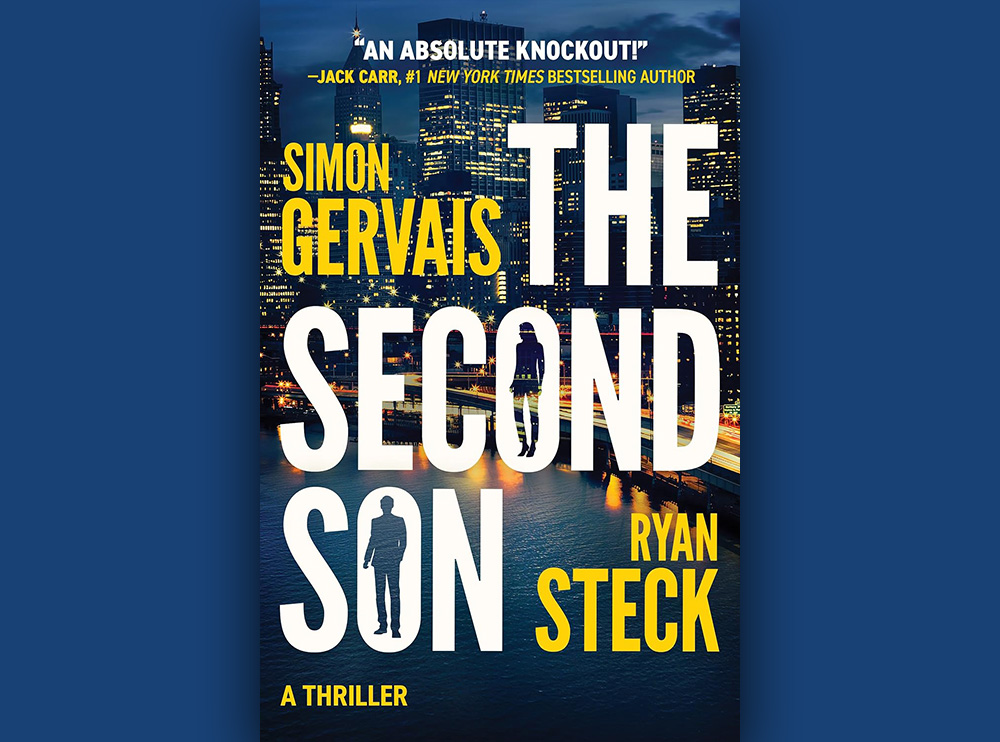
A pulse-pounding yet soulful espionage thriller for fans of Brad Thor, Jack Carr, and Mark Greaney, delivering plot twists so explosive, it took two top suspense writers to pull it off.
Intrigued? Well read on to discover the synopsis and an excerpt from Simon Gervais and Ryan Steck’s The Second Son, which releases on December 1st 2025.
Soldier-turned-sommelier Chase Burke may have traded his rifle for bottles of wine, but violence and conspiracy aren’t through with him yet. First, his intelligence analyst brother is killed in a covert op gone wrong and branded a traitor. Then a brutal ambush at the restaurant where Chase works leaves the woman he is romantically involved with―a congresswoman―clinging to life.
Scrambling to clear the family name and protect his secret love, Chase teams up with NYPD Detective Alice Doyle, a single mother fighting battles of her own. Together they uncover a powerful criminal syndicate whose unscrupulous influence sweeps the globe―and strikes painfully close to home.
As elite mercenaries close in, Chase is dragged back into the dangerous world he thought he’d escaped. Facing a mother losing her memory and a past that never forgets, he fights to win a zero-sum game where trust can be lethal. But when all seems lost, an unlikely ally could help turn the tide…
CHAPTER ONE
New York
Chase Burke carefully drew the cork from the neck of the jet-black wine bottle and brought it close to his eyes, inspecting the wood for any signs of crumbling, rot, or mold. Finding none, he set it aside and poured a small amount of the bottle’s contents into a large-bowled wineglass.
Chase set the bottle on the counter and picked up the glass, tilting it to a forty-five-degree angle against the plain white of a paper napkin. He assessed the wine’s color intensity by looking at how far the color extended from the core of the glass—where the stem is attached the bowl—to where there was only the shallowest depth of wine left.
Intensely pigmented. Almost to the rim.
The wine, which Chase knew had been fermented from a blend of merlot, cabernet franc, and cabernet sauvignon grapes—with a small quantity of petit verdot added in for its spiciness—and aged in French oak barrels, was a deep ruby color.
He swirled the contents gently, noting the streaks that formed on the sides of the glass as the wine slid back down into the bowl. These legs, also sometimes called tears, were a good indicator of viscosity and, consequently, alcohol content, which in this instance was substantial.
But of course, in wine, as in all things, looks could be deceiving.
He swirled the wine again, this time to release the aromas into the glass, then placed his nose over the rim and took a long sniff.
If asked to describe this wine’s aroma—and as the head sommelier of Chrysalis, a Michelin-starred restaurant, he often was—he would have compared it to the smell of fleshy red and black fruits and dry violets, with a hint of black pepper. Also present—the secondary aromas—were subtle notes of vanilla and charred wood from the oak barrels in which the wine had been aged.
It was, he would tell his customers, a complex experience. One to be savored.
An image of his old master gunnery sergeant, Enzo Bartoletti, staring at him like he had two heads popped into his mind. The thought of trying to explain his new career to the grizzled senior noncommissioned officer—or really, to any of the men he’d served with—made him want to laugh out loud.
You do what for a living? Smell wine?
But the smile faded quickly as that train of thought pulled into the inevitable station, reminding him, as it always did, of how his years of service had ended.
Ten long months at the Midwest Joint Regional Correctional Facility in Leavenworth, Kansas. Loss of rank. A bad conduct discharge, and with it the loss of any benefits to which he might have been entitled as a veteran.
There was a saying in the Army. Once a soldier, always a soldier.
But did it apply to men like him who had earned themselves a disciplinary discharge? Chase didn’t think it did. He was an ex-soldier. A scandalous designation.
Yep. That’s what I am. An ex-soldier.
And a former boxer.
And let’s not forget: a family disappointment.
But at least I’m a decent sommelier. I think.
Chase shook his head. Hell of a résumé, he thought.
A far cry from his big brother’s CV. Whereas Chase’s life had been a complex experience, Michael, on the other hand, had always been the golden boy. And that was fine with Chase. There was no bad blood between the two, and in fact, he was proud of Michael and the honorable life he led.
Or had led.
The realization that he would now have to talk about Michael in the past tense had hit him hard, and he wasn’t ready for it.
Shit.
He brought the wineglass to his lips and took a small sip. He swished the liquid around his mouth to evaluate its acidity and tannin levels, then, holding the wine on his tongue, Chase breathed in over the wine, using his mouth as a mini decanter.
The first thing you’ll notice, he might tell restaurant patrons, are the tannins. Firm but well integrated, providing a solid backbone. Now, let the flavor explode in your mouth. Dark cherries, black plums, cassis burst forth, and a touch of blueberry. Cinnamon, clove, and a dash of black pepper . . . Powerful, but elegant with a strong, lingering finish.
Trying to put the experience into words was an essential part of his job, but to his way of thinking, words could not adequately convey smell or flavor. You had to experience it for yourself.
The wine, a 2019 Mission Hill Oculus from the Mission Hill vineyard in the Okanagan Valley of British Columbia, was somewhat expensive, especially when compared to other good wines made in North America. Owing to its limited supply, how hard it was to find, the award-winning wine was special to Chase for reasons that had nothing to do with its perceived value and only indirectly to its attributes.
The Oculus had always been Michael’s favorite wine.
Satisfied with his tasting, Chase poured the content of the bottle into a crystal decanter. The Oculus was best enjoyed after being allowed to breathe for at least forty-five minutes, which was more than enough time for him to whip up a chimichurri with the rib eye he planned to grill for his dinner. Wine was best enjoyed when paired with the right food. It was also best enjoyed in the company of loved ones, but that wasn’t going to happen. Tonight, he would drink the Oculus to honor the man who wasn’t there . . . who would never be there, ever again.
The shock of the news from Colombia had yet to fully sink in, but he knew the worst of his emotions was yet to come. At first, the initial reports had been just ambiguous enough to allow for hope that Michael might be found alive, but the latest word from Michael’s boss and friend of the family, Secretary of State Connor Williams, had left no room for hope.
Michael was gone. Forever. And Chase Burke had never felt more alone.
As he toasted his lost brother, his voice quivered.
“I love you, bro,” he whispered to nobody.
***
Earlier that day, Chase had gone to Hartford to visit his mother at the private medical facility where she had been staying for the last two years.
Chase’s relationship with Henrietta Enfield Burke had always been difficult.
Not bad. Just . . . difficult.
As the second son, his accomplishments were always held up against those of Michael, four years his senior. Growing up, Michael had been the star athlete, captain of every team, with a shelf full of trophies to attest to his prowess. Chase, while athletic, had only ever wanted to be a boxer, and the only way for him to pursue his passion was through an underfunded after-school program at the YMCA. He was good at it, but somehow, his matches never garnered the same degree of favorable attention as Michael’s football and basketball games, and his victories failed to impress their mother. Their father, a former investment banker turned diplomat, privately applauded his younger son’s ambitions, but between his career—which often kept him away from home—and his desire to maintain a level of domestic tranquility, he was never open with praise or support.
Michael always cheered me on, though.
Despite their obvious differences, both in age and temperament, the two boys remained close. As close as brothers four years apart could be, anyway.
And now he’s gone . . .
Both Chase and Michael had been outstanding students, but somehow, Chase always fell short in Henrietta’s estimation. No matter what he did, Michael had always done it first and done it better.
When are you gonna live up to your potential? Henrietta would often ask, usually following some form of troublemaking antics. A fight at school. A bar fight. There was usually fighting—because when you boil everything down, that’s what Chase was.
A fighter.
Not that Chase had made any real effort to please his mother, or father, for that matter. Michael tried to, and it worked. Chase had a different take on the world and accepted his role early on. When he had first read Robert Frost’s poem “The Road Not Taken” in freshman English, the closing line had resonated with him.
I took the one less traveled by, and that has made all the difference.
Things had come to a head when, upon earning his master of science in business analytics from MIT—an accomplishment that had everyone in his family believing he’d finally lived up to his potential—he’d promptly rejected a job offer from a top Wall Street investment firm and instead announced his intention to enlist in the Army.
You have a master’s degree from one of the most prestigious universities on earth, and you want to be a soldier? Henrietta had raged. What’s wrong with you? With your degree, you could be earning six figures this year. Do you know how much a soldier makes?
It’s not about the money, he had told her.
Of course you would say that. You’ve never had to work for anything in your life.
This is what I want to do.
Why can’t you do something useful for once? Join the FBI like your brother did, for fuck’s sake!
Michael’s decision to pursue a career in law enforcement hadn’t exactly pleased Henrietta, either, but she’d quickly found a way to turn it into something to brag about at cocktail parties. My son, the FBI agent, says . . .
Chase had thought about trying to explain the career path he was going to follow. With his degree, he was a shoo-in to join a psychological operations—PSYOPS—unit, using his intuitive skills to influence both allies and adversaries in the name of national security, but ultimately knew that no matter what he said, she would disapprove.
This is what I want to do, Mother, he had repeated.
You’re not actually lowering yourself to a common soldier, are you? At the very least, get a commission and save some shred of dignity.
His recruiter had urged him to take that track. With his degree, he could go directly to Officer Candidate School. But Chase had no interest in being an officer. PSYOPS didn’t need officers; they needed skilled NCOs who would stay with the unit.
He knew better than to expect his mother to take pride in any of his accomplishments. Still, her next outburst had driven a wedge between them. You’re even dumber and lazier than I thought, Chase. What a shame. You had so much potential.
It was nothing she hadn’t told him before, in one form or another, but that day, he’d decided he’d had enough. He walked out the door, went back to the recruiter he’d been consulting with, signed on the dotted line, and chose the road less traveled.
You’re even dumber and lazier than I thought.
He never would have believed those words would be the last coherent thing he would hear his mother say.
The guard at the main gate greeted him like an old friend—not surprising since he’d been making this trip every Monday for the last two years—and thumbed the button that rolled the wrought iron security gate out of the way to permit his entry.
Havenwood Retreat was no ordinary assisted living home. Billed as “an oasis of tranquility where residents can relive their cherished moments, even as the tides of memory ebb and flow,” it catered exclusively to a wealthy clientele, and while ostensibly dedicated to preserving the dignity of once-influential men and women dying the slow death of dementia, its real function was to ease the consciences of their clients’ family members, who now had to deal with the social stigma of having a relative who was no longer in their right mind.
Henrietta had first begun to exhibit signs of dementia two and a half years earlier. Chase had been in the Loire Valley at the time, well on the way to his advanced sommelier certification—another life choice that would doubtless have earned his mother’s scorn had they been on speaking terms—and by the time he returned stateside, her symptoms had already worsened to the point where his father had made the decision to move her to Havenwood Retreat.
Realizing that his window of opportunity to reconcile with his mother was fast closing, Chase had begun making regular visits, taking the train from New York to Hartford three times a week at first, in hopes of finding her in one of her increasingly rare lucid moments so that he could . . . what, exactly? Forgive her?
Like that would go over well.

But he felt it was his duty to at least try because once she was gone . . . really gone, it would be too late.
Ultimately, it didn’t matter because every time he came to visit, she looked at him like he was a stranger. Her nurse would introduce him always just as Chase, never “your son,” because telling her that might have unpredictable consequences. Better, he’d been told, to simply sit with her and see if his mere presence could bring her back to herself.
It didn’t.
He began to think that maybe she was just pretending not to recognize him, but he was assured that was not the case. Her lucid moments were few and far between. After several months, and on the recommendation of Curtis McGraw, the facility’s managing director, Chase had scaled back to just one visit a week. Counterintuitively, McGraw told him, the frequency of his visits might be inhibiting the recovery of her memories of him. Chase had rationalized limiting his visits because his father and brother were also regularly checking in on her. Then, six months earlier, shortly after being confirmed as the next American ambassador to Czechia, Robert Burke, an experienced pilot, had perished, along with three other souls, when the Piper Cherokee Six he’d been piloting flew into the side of a mountain. The National Transportation Safety Board’s thirteen-page preliminary report stated “The pilot’s inattention to the plane’s altitude and speed, combined with the pilot’s inability to adequately respond to his airplane’s entry into an aerodynamic stall by executing multiple abrupt control inputs, resulted in the plane impacting terrain.”
Executing multiple abrupt control inputs?
That makes no sense.
His dad, an experienced pilot who had racked up more than 1,200 hours of flight time on that plane, always paid attention to his surroundings.
Especially when he was flying.
Chase was looking forward to reading the NTSB final report. He was confident the federal investigators would find a fault with the airplane. They had to. A mechanical failure was the only thing that made any sense to him.
And now, as if his family hadn’t suffered enough, Michael was gone too.
Chase shook his head. Even in his wildest dreams, he never would have believed their family would be reduced to just him and his mother.
He pulled into the porte cochere, leaving his car, a Mercedes S-Class, running, and got out, allowing the valet to drive it away. The vehicle had belonged to his father, but Chase had been borrowing it for the trips to Hartford for so long that it sort of felt like his. He supposed it actually was, now. His father’s will had divided the assets between Michael and him, along with establishing a trust to pay for Henrietta’s care, but Michael, who had been named executor, had still been in the process of determining how the property should be apportioned. Now that he was dead, too, that role would fall to Chase, along with the bulk of the estate.
But he didn’t want to think about that right now.
He didn’t want the family money. And thanks to a few smart investments that were paying off handsomely, he didn’t need it.
As for the car, owning one was more of a liability than an asset for him, living as he did on Manhattan’s Upper East Side. It was easier and quicker to take the train out to the family home in Long Island and then drive to Connecticut than it was to ride the train to Hartford and then catch an Uber out to Havenwood.
Curtis McGraw was waiting for him just inside. “Mr. Burke, so good to see you today,” the managing director said.
McGraw, a British national who’d lived in the United States for over eight years, had lost none of his East End accent. His speech pattern reminded Chase of the actor Michael Caine. “Your mother is in the Memory Garden. I can take you there if you’re ready.”
“Thanks, Curtis.”
McGraw, Chase had learned, had been a detective inspector with the Metropolitan Police in London for many years before emigrating. While managing a high-end care facility like Havenwood was no doubt far more lucrative than working in law enforcement, Chase had more than once wondered how McGraw had found his way into the job.
The Memory Garden was one of Havenwood’s therapeutic spaces—a sprawling garden with native flowers, shade trees, and a meandering path with several benches where residents could peacefully while away the hours, but always under the watchful eye of the nursing staff. As he followed McGraw outside and onto the path, Chase easily spotted his mother sitting at one of those benches.
Chase had gotten his dark hair, olive complexion, and startlingly green eyes from her. Alzheimer’s might have taken her mind, but even in her late fifties, she remained strikingly beautiful. Chase, however, was more interested in the pretty blond woman in dark blue scrubs sitting beside her.
“Who’s that with her?”
“That’s Lucy Noonan,” said McGraw. “She’s a recent addition to our family, but she and your mother get along famously.”
“Where’s Shana?” Shana had been his mother’s primary nurse for as long as Chase had been coming to visit her.
McGraw seemed taken aback. “Oh my. You haven’t heard. Well, of course, how would you? Shana was in an accident while on holiday in Mexico.”
“Is she okay?”
McGraw shook his head in a gentle, discreet way that said it all.
“Damn,” muttered Chase. “Shana? That’s awful. How did it happen?”
“A parasailing accident. We’re all just gutted.”
Chase hadn’t known Shana all that well, but the mere fact that someone else within his family’s sphere of influence had met with misfortune left him rattled.
“How’s Mother taking it?”
Henrietta had always been “Mother” to him. Not “Mom,” “Mama,” “Mommy,” or anything remotely affectionate.
McGraw smiled. “You know how she is.”
That bad, huh?
Chase did know. A moment later, when he approached the bench, Henrietta Burke looked up at him, smiled, and in that impeccable mid-Atlantic accent that sounded like Katharine Hepburn in her prime, said, “My, aren’t you a handsome young man. How do you do? I’m Henrietta.”
Copyright © 2025 by Simon Gervais and Ryan Steck. From The Second Son by Simon Gervais and Ryan Steck. Reprinted by permission of Thomas&Mercer, a division of Amazon Publishing.