


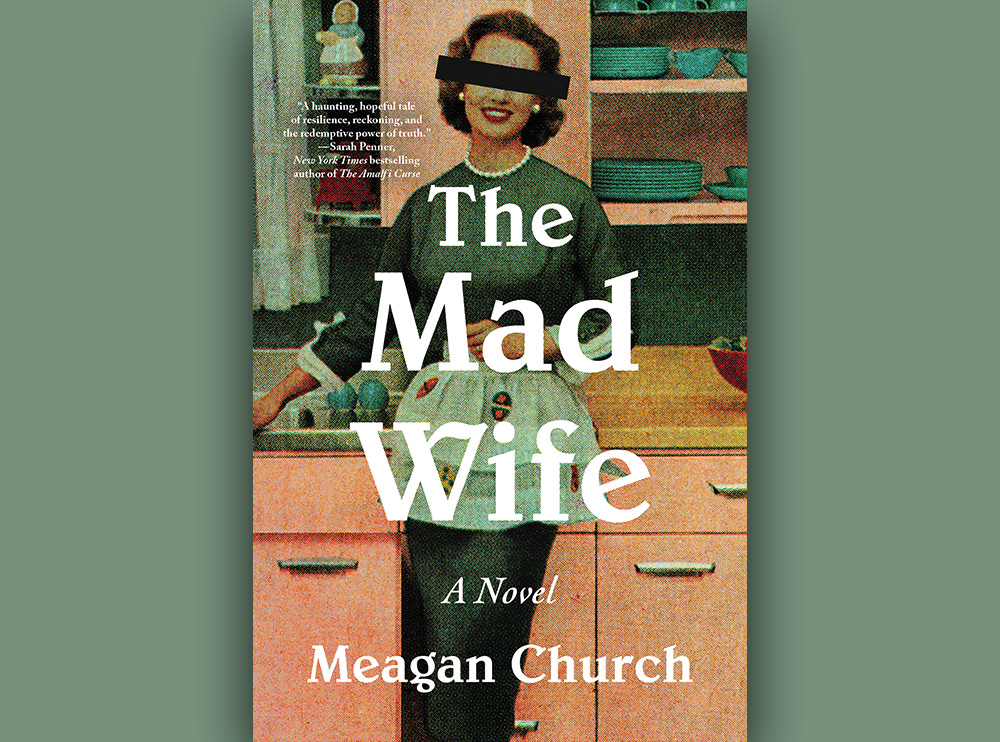
With odes of The Bell Jar comes a searing historical suspense following a 1950s housewife who, when a mysterious new wife moves across the way, begins to unearth dark secrets about her neighborhood and her own mind.
Intrigued? Well read on to discover the synopsis and an excerpt from Meagan Church’s The Mad Wife, which is out now.
In the 1950s, nothing is valued more than conformity, and Lulu Mayfield has spent the last five years molding herself into the ideal housewife. But after the birth of her daughter, Lulu’s carefully constructed life begins to teeter.
Exhausted by expectations and haunted by tragic memories, Lulu looks to her new neighbor, Bitsy. Bitsy, always the model of a perfect housewife, is not quite what she seems and Lulu knows something dark lurks beneath Bitsy’s constant smile. Increasingly fixated on Bitsy and her perfectly crafted life, Lulu’s mental state begins to fracture, and memories she had suppressed long ago begin to rise to the surface. Soon, Lulu is forced to confront the possibility that she might be headed down a path much darker than she could ever foresee.
Set against the backdrop of a post-war era defined by tradition and constrained femininity, The Mad Wife weaves together a coming-of-age search for identity with a psychological drama so poignant, you won’t be able to put it down.
EXCERPT
I did my hostess duties, but as the clock dragged toward midnight, my insides felt like they were oscillating along with the salad, at least as much as they could, given the girdle restraints. I needed some fresh air, so I escaped to the backyard, welcoming the quiet and solitude despite the bitter cold. A sliver of a crescent moon hung overhead that night, a white curve in the sky, providing little light.
I sat in the darkness and watched the party through the sliding door. I saw the conversations, the laughter, how Mrs. Reilly piled her plate high once again despite the doctor’s advice to drop a few pounds. I saw the way Dennis had his arm around Nora, while he looked across the room at Maureen—the youngest wife in Greenwood, her eyes and breasts so full of perk. I could tell from his sway how many drinks he’d had and that he wouldn’t remember most of the party come morning. I don’t know how long I sat there, but eventually I saw Hatti leave without saying goodbye, probably desperate to get home and check on the little ones she couldn’t bear to be away from for too long.
It seemed like all of Greenwood was there that night, but passing headlights reminded me that we hadn’t invited everyone. We may have thought we did, but of course there were neighbors we hadn’t yet met, names we didn’t know, families we didn’t choose to invite over to parties for a whole host of reasons, I suppose.
I had known most of these people for the last five years. On the surface, I would call them friends; they were more than acquaintances. But who within that house did I really know? And who really knew me?
As I sat in the darkness, the cold pricking my bare arms, Wesley found me. Of course he did.
“What’re you doing up?” Henry must not have seen him, or he would have taken his son by his arm and directed him back to bed. I should’ve done the same, but instead I let him climb onto my lap.
“It’s too loud,” he said, his tongue still not cooperating, so the l sounded more like a y. It bothered Henry and his mother so much. I told them my brother, Georgie, used to talk like that and assured them that our son would outgrow it, but they didn’t seem to believe me. Or at least Mrs. Mayfield didn’t and Henry followed suit.
“You need to go back to bed,” I said, but I let him stay. I suppose my mother-in-law would say that was another way I spoiled him. I stroked his hair, stretching his curls out straight before they bounced back as I released them. He looked so much like Georgie—those curls, the long eyelashes, the freckles across his cheeks. Did Georgie still have all those freckles? Or had they begun to fade?
Wesley pushed his body against me, taking as much of my lap as he could. He didn’t know yet that soon his world would change.
Our world.
My world.
Henry would be so pleased with the idea of having a complete family. But did he remember what a baby was like? How some days I was so exhausted I would forget to eat? How Wesley cried for hours every evening? How my nipples chafed from the baby’s constant need to nurse? Of course he didn’t. I didn’t bother him with those details when he got home from the office. After all, I was the mother; caring for the baby was my job.
And I hadn’t told him that sometimes I still woke in the night, swearing I heard a cry. Only a few nights prior, I was nearly out our bedroom door on my way to quiet the sound, when I woke enough to realize there was no baby. No noise at all.
I missed the countdown to the new year as I tucked Wesley into bed for the second time that night. When I rejoined the party in the living room, Henry pulled me to him.
“Where’ve you been?” The syllables slurred into one long word before he pressed his lips into mine, his whiskers poking into my skin. He had shaved just before the party, but those whiskers never stayed hidden for long. “You missed the toast.”
He tried to hand me his glass of champagne, but I told him no thank you. The room was already beginning to spin. The last thing I needed was a drink.
“Are you okay?” he asked.
“Just tired.” I told the partial truth and hoped it was enough, but what I needed then was for everyone to leave before the room spun even more.
In that moment, I don’t know why I did it. Maybe I was trying to hold on. I wished I would’ve had a glass or something to occupy my hands, because as the neighbors chatted and some began to say their goodbyes, Henry looked at me. Even through his champagne haze, he saw my hands reach for my stomach, my subconscious attempt to comfort what had been gripped by my girdle for far too long.
“Lulu—” he began. His eyes widened. I hoped he was too drunk to put the pieces together—the nausea I had failed to hide from him that morning, the curves that better accentuated my dress that night, my hands upon my stomach. “Are you—?”
“Henry—” I tried to interrupt him. Yes, I needed to tell him, but not there, not in front of everyone. Plus, wasn’t it bad luck to tell people before the end of the first trimester? I may have been close to that, but I wasn’t through it yet. “Listen—”
I tried to use words to distract him, but apparently the look on my face had given everything away. He couldn’t listen. Not then. The party. The friends. The champagne, all of it numbed him to my pleas. He turned from me and began to clang his wedding ring against the goblet (one book for a set of six), demanding the room’s attention.
“What’re you doing?” I forced the question past the lump of fear that had lodged in my throat.
“Making a toast.”
“Please, not now.” I begged, but I struggled to find words as my heartbeat quickened.

Henry slumped his arm across my shoulder. “A toast,” he began, “to good neighbors, better friends, and—” He turned to look at me as he said the next words, his eyes sparkling. I couldn’t look. I buried my face in his chest. With my ear pressed against him, I could hear our hearts beating at different rhythms, his slow and steady, mine thumping, panicked. I wanted those beats to drown out what he said next. “And the most perfect wife.”
Did I hear him correctly? Had he listened to me? He tightened his arm around me and kissed my forehead as the thump of my heartbeat slowed. I thought he was done. We all did. A few glasses clinked. Some people took a sip. But then his voice rose higher, above the chatter that tried to resume. “And to the year our family is finally complete.”
An invisible current pulsed through my veins like an electric charge. I prayed they were all too drunk to understand. But, he wasn’t done. To get his point across, he removed his arm from my shoulder, placed his hand on my stomach, and pressed against it.
Unfortunately, the neighbors understood. They gasped and cheered as I wanted nothing more than to dissolve into the carpeting, let it act like a sponge and soak up every part of me. Instead of disappearing, my body began to shake as heat rose from my toes to my cheeks, a storm of unease brewing inside me.
Henry’s words slurred together as he continued, “A-dream come-true.”
That’s when Dennis lifted his glass and toasted, “To dreams!”
“To dreams!” Our living room echoed his cheer, as men kissed their wives, and neighbor toasted neighbor all over again.
But Nora didn’t cheer. She watched me from across the room, her eyes locked on mine, her lips pursed shut. I nodded my head in recognition. She held a hand to her heart and raised her goblet in my direction before Dennis grabbed her and kissed her.
To dreams, the toast echoed through my mind as the final moments of the celebration continued. Those words replayed as I handed the neighbors their coats on their way out the door, as they kissed me on my cheek and congratulated us, even as Nora reminded me that the baby blues don’t happen every time. It whispered to me as Henry went to bed and I gathered the dishes, tossed the empty champagne bottles, and placed the leftovers in the Frigidaire.
To dreams.
Of course, sometimes we forget that dreams and nightmares are two sides of the same coin.
CHAPTER 3
Few things are watched as much as a house for sale in Greenwood Estates. We had all seen potential buyers come and go over the last six months. Nora hoped the older couple with the wood-paneled Ford would move in, thinking that perhaps the woman would offer to watch our kids. Hatti wanted the family with the twins, but Mrs. Reilly countered that those kids might be too loud, like too many others who were already in the neighborhood. I held out hope for a nice couple with a son Wesley’s age. And a friend for me.
None of the comings and goings kept me from imagining the place as my own. During Wesley’s quiet time, my mind would wander about the house, filling it with a crescent-shaped sofa with olive-green upholstery and tapered wooden legs that faced the console television, and with a walnut-veneered elliptical coffee table nestled in its center. Don’t forget the bookcase room dividers and telephone bench in the hall. I would hang artwork, trying different pieces in different places, considering what my own photographs might look like, my own memories on display for all to see. I made sure to remove the bathroom carpet, add a few more cabinets in the kitchen, and plant more trees throughout the yard. I played with the dollhouse of my mind when I couldn’t sleep at night, and sometimes I would visit it in my dreams.
The day of Wesley’s birthday party, yet another car pulled into the driveway with yet another couple ready to take a look. And of course we all watched with interest, but perhaps I was the only one who secretly hoped it remained vacant, a place for my imagination. Even though I knew the house would never be mine, with each month it remained empty, it seemed to belong to me a little bit more.