

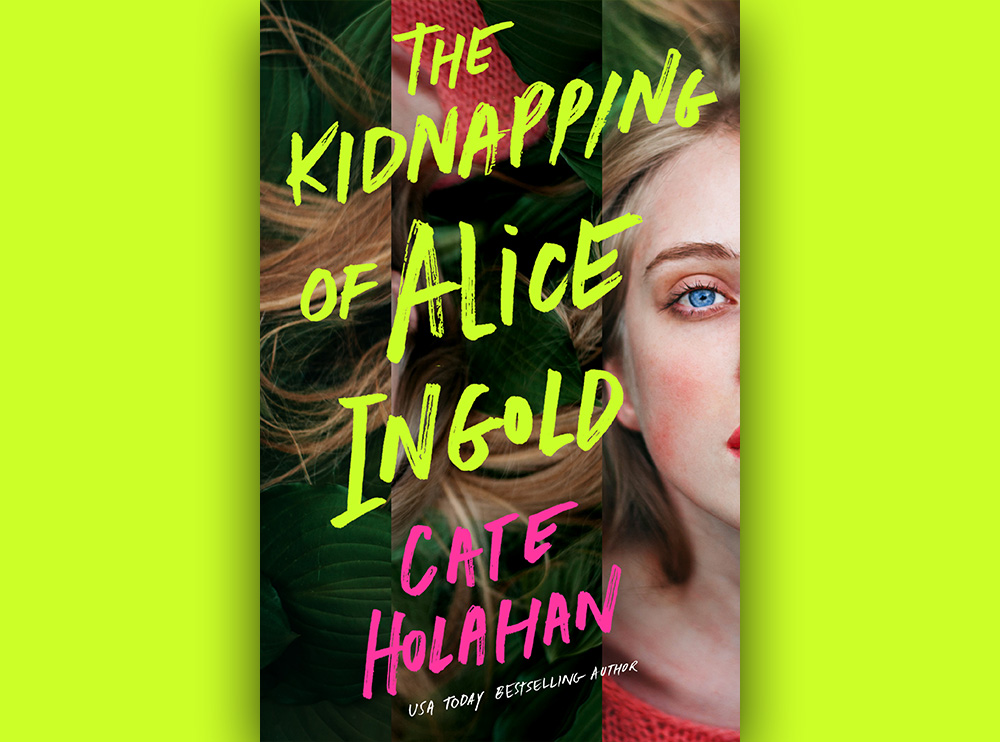
A harrowing abduction becomes a tantalizing nationwide game in a twisty and ingenious novel of suspense by a USA Today bestselling author.
Intrigued? Well read on to discover the synopsis and an excerpt from Cate Holahan’s The Kidnapping of Alice Ingold, which releases on November 1st 2025.
Alice Ingold has been kidnapped. Call the police. Alert the media. You can’t play this game without all the pieces.
Beautiful, blond, and immensely privileged, Alice Ingold is the perfect victim for a true-crime obsessed culture—and for a masked duo with a singular purpose. Instead of a demand for ransom, her captors have a riddle, and they’re inviting the entire country to solve it.
No one is more invested in the search than Alice’s parents: Catherine, a socialite with obscene generational wealth, and Brian, a visionary AI tech guru. But while Brian turns to machines to solve the problem, Catherine tries to crowdsource the solution, stopping at nothing to bring her daughter home. And America isn’t just watching the story unfold…it’s playing along. The nationwide scavenger hunt for Alice is on.
As an increasingly desperate Catherine strives to understand each new clue, a complex picture of the crime develops. Soon, everyone will see the kidnapping of Alice Ingold for what it is—and Alice won’t be the only one who will need saving.
Alice Ingold
Diary Entry One
My first kidnapper smelled expensive. I’m guessing this detail isn’t too helpful, given that detectives only travel with scent hounds in prison-break movies and my olfactory senses aren’t sufficiently honed to identify the exact perfume. But I’ve walked through enough fancy department stores to recognize the complex mix of florals and fruit oils that define high-end spritzes. And it’s the best I’ve got. I’m still unsure of my assailant’s gender. Since taking me, heeled boots have blurred her (his?) height. Bulky sweatshirts have hidden her body. She hasn’t shared anything personal, let alone how she identifies. I haven’t seen her face. I’ve yet to hear her real voice.
Writing demands pronouns, however, so I’m sticking with female ones. She gave me this diary, along with a couple of flimsy pens and the instruction to tell “our story” shortly after locking me in the windowless cage I now find myself in.
I haven’t decided whether writing makes her more or less likely to kill me. I’m staking my life on less. And I need to live. There’s so much I want to do, so much I haven’t had a chance to fail at yet, let alone accomplish.
When she arrived, I was hand-washing plates. The chore was by choice rather than necessity. My mother, I’m sure, is telling police that my apartment is one step up from a meth den. Mattress on the floor inches from an open-air toilet? Truth is, I was kidnapped from a spacious yet-to-be-legalized warehouse conversion, the kind of apartment that’s all over Instagram thanks to original casement windows and an open-plan layout. The kitchen, admittedly, appears a rush job, possibly done under cover of night when no one would notice cabinet installers in front of a property zoned for commercial activities. But it’s equipped with all the necessary appliances: stovetop, sink, microwave. Dishwasher.
Still, my grandma’s heirloom china couldn’t be trusted to a Kenmore. So after having my mother over for lunch, I placed Nana’s plates in the sink, turned on the hot water, and began rinsing.
Trendy or not, the building’s plumbing is temperamental. The temperature instantly shifted from lukewarm to scalding, burning my hand. I switched the faucet to the coldest setting and ran the stream over the red bloom between my thumb and index finger, cursing myself for letting frustration make me careless.
In the short time I’ve been in this cell, I’ve wondered how things may have unfolded differently had I not been washing the dishes. Had the attempt at proving my self-sufficiency over lunch gone surprisingly well and my mom had offered to, say, take me out to buy dish towels. Or had my dad decided to join her, for once. He’d have been there when my assailant arrived. Would that have changed everything?
The water’s rush covered any initial knock. I didn’t realize someone was outside until a Morse code message blared in my apartment. Buzz. Buzz. Buzzzzz.
I hurried toward the door, absentmindedly bringing a dish. Such frantic bell ringing could only be my mom, I thought, and her return—so soon after departing my place in a huff—indicated an emergency. Smash-and-grab was the likely culprit. Someone had probably broken her car’s passenger-side window to check for portable electronics. She’d returned to wait for the cops and complain, again, that my neighborhood is a crime-ridden cesspool.
“Mom?” I opened the door. “Everything alright?”
“That depends.”
A stranger shoved me from the threshold. As I stumbled back, the wet plate slipped from my hand, exploding on the ground like the last scene of an ASMR compressor video, the ones intended to release anxiety via images of destruction. The scene was just as consuming for me, though not at all calming or satisfying. I forgot to dodge the shrapnel—forgot, even, about the invader in my home. I thought only that I’d never be able to replace my grandmother’s dish. Even if I found another at an auction, it wouldn’t be the one held by the woman who’d hosted me each summer in her Newport home, bragging to anyone who’d listen about her granddaughter, the writer.
I heard the door shut. “Don’t you want to know what it depends on?”
The voice was odd. More robotic than human. Every word was followed by a tinny reverb, as if auto-tuned flat. I whirled toward its source, expecting to see some sort of microphone or tracheal tube.
A stranger’s sweatshirt billowed over bootcut jeans. I looked toward the face framed by the cinched hood.
There was no face.
In place of a nose, mouth, and eyes was a black expanse. Not a mask. Balaclavas give the impression of human features: the bump of a nasal bridge, cutouts around the orbital sockets. Rubber masks have plastic prosthetics. This was a void, scarier than any Halloween monster. I stared into an abyss.
“It depends on whether you cooperate,” she continued.
As I tried to process what was happening, she waved a gloved hand in front of the space beneath her fleece hood. Two red circles materialized, along with a glowing grin. I was being robbed by an LED jack-o’-lantern.
“Get out of my apartment!”
My order, delivered while backing away from her, was far less emphatic than needed. In retrospect, I should have yelled it while ramming into her chest. At a minimum, I should have taken my own advice and run past her into the hallway, shouting for my neighbors. Some mix of fear and self-preservation stopped me from going on the offensive, though. While I guessed my uninvited guest was female, she was still bigger than I was. And judging from her digitized expression, meaner.
“That’s the plan.” She waved in front of the screen again. The animation changed to a Pac-Man-style ghost with googly eyes and a wavy line for a mouth. “But you’re going to come with me.”
Her cartoon lips trembled as she spoke, a visualization of a sound wave. Logically, my attacker’s new face made her no less threatening. Yet the sight of an uncertain mouth emboldened me. “I’m not going anywhere. You think because you went to Party City that I’m intimidated?”
I didn’t wait for an answer. My phone sat on the kitchen counter. I strode toward it, arm outstretched.
“Don’t.” A click added the full stop to her command. I froze, a battery-operated toy whose power switch had been flicked off. In the corner of my eye, I caught a glimmer of metal between gloved hands. She was aiming at my torso. “Open the window.”
My stubborn streak immediately turned yellow. I did as directed, moving toward the wall of casement windows and cracking open one of the panes, all the while assessing my likelihood of walking away from the two-story drop to the street. It seemed survivable, but barely. I’d have to jump exactly right.
“What do you want?” I asked.
Ghost Face answered by raising the gun until it pointed between my breasts. “We’re taking the fire escape down.”
Her tacit promise not to kill me won my compliance. I approached the open pane and pulled it up farther, revealing a metal staircase.

She gestured to the first step with her head, keeping the gun focused on my vital organs. “I’ll be right behind you.”
I stepped over the windowsill onto the grate. The metal staircase shuddered with my new weight, an ice sheet in the sun. I grabbed the railing and peered over the edge. If I intended to jump, it was now or never.
A Toyota idled in the alley below. Anyone passing would have figured that a rideshare driver was waiting for a passenger. The only difference I could see between the car and an Uber was a drug-dealer tint on the front window. Seeing through it was impossible.
Metal pressed through my sweatshirt into my spine. “Let’s go.”
Never go to a second location. The warning resounded in my head. Wherever Ghost Face and her waiting partner intended to take me would give them the advantage.
I gripped the banister more tightly. “I—I can’t move,” I stuttered to sell the lie. “I’m afraid of heights.”
My attacker pushed the barrel farther into my back. “Better get to lower ground, then.”
I refused to budge. “Why are you doing this to me?”
The question was a stalling tactic, as the answer was obvious: money. Someone had spotted “that shipping socialite” or “the AI guy’s wife” and realized that Catherine Newhouse Ingold was visiting her daughter.
“Get moving, bitch,” Ghost Face replied.
The voice changer turned her epithet jocular. I looked over my shoulder, half expecting to see the mask removed and one of my (soon-to-be former) friends laughing about “getting me good.”
The digital face was different from before. In place of the ghost’s wide eyes and uncertain mouth were two neon x’s and a sewn-shut smile. “Only two ways out of this.” The voice lowered to a mechanical groan. “Down the stairs or over the side.”
I maintained my position. “I can pay. My phone’s inside. If you’d let me call my mom—”
A laugh erupted from the voice changer, far more frightening than the foulmouthed Siri I’d been speaking with. “Poor little rich girl. Money can’t solve this problem.”
I descended one step, creating distance between me and her gun. “Then what can?”
Again, I felt the cold metal between my shoulder blades. “You’ll see,” she said. “They all will.”
© 2025 by Catherine Holahan