
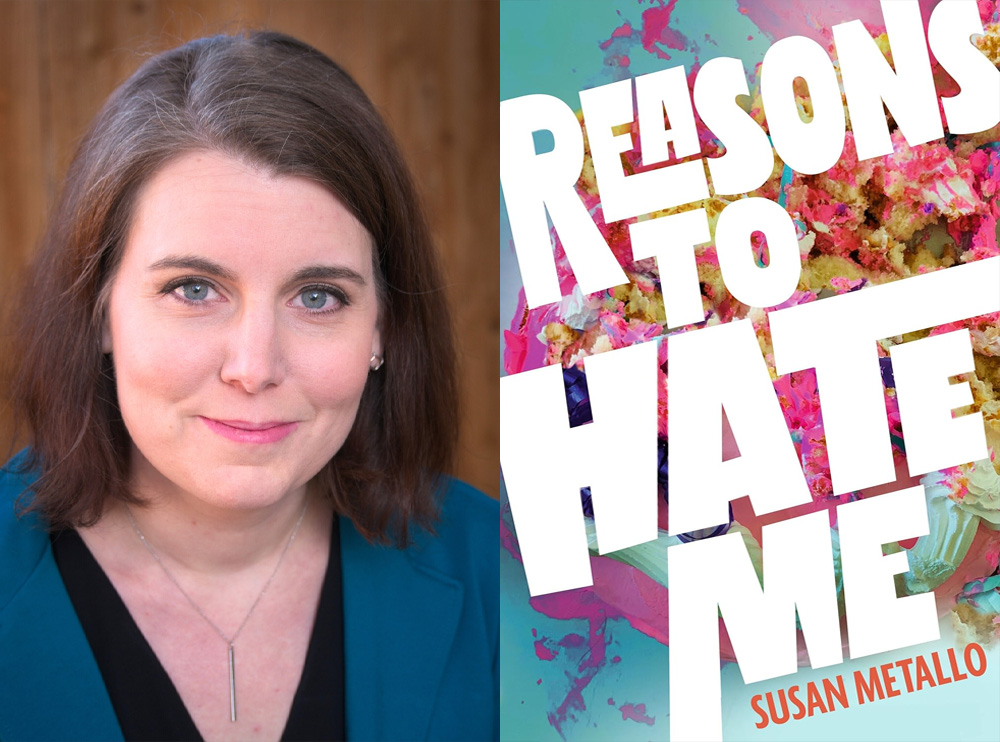
We chat with author Susan Metallo about Reasons To Hate Me, which is a hilarious and heartfelt novel about a neurodivergent theater nerd that tackles slut-shaming, what it means to be a friend, and the power of forgiving others—and yourself.
Hi, Susan! Can you tell our readers a bit about yourself?
Sure. I’m a former youth services librarian, current YA author, and forever nerd. Like me, the main characters of my YA novels are usually queer, neurodivergent nerd girls. I live in New Mexico with my husband, a couple of awesome kids, and the worlds largest and most slobbery lapdog. I’m big into crossword puzzles, and I’m also a member of a symphony chorus. (I was a music major in my past life.)
When did you first discover your love for writing and stories?
I don’t know if there is a moment of discovery for me. I can’t remember a time when I didn’t want to be an author. Both my parents read to me when I was a kid, so books were always part of my life, and I loved them. I think when people asked me “What do you want to be when you grow up?” the obvious answer was I want to make those. I remember I was so excited to get to be a narrator in my kindergarten play because narrators were like authors in that they told the story. I still have some of the books I “published” back then, up in a box somewhere.
Quick lightning round! Tell us:
- The first book you ever remember reading: Go, Dog, Go by P.D. Eastman
- The one that made you want to become an author: All of them. (Or maybe Ramona the Pest by Beverly Cleary?) (But really, actually, all of the books.)
- The one that you can’t stop thinking about: The Poet X by Elizabeth Acevedo.
Your debut novel, Reasons to Hate Me, is out now! If you could only describe it in five words, what would they be?
Madcap, voicey, neurodivergent, poignant, feminist
What can readers expect?
Expect a whole lot of chaos, a good dose of hope, and all the drama in the Drama Club. I hope that readers will experience a huge range of emotions along with this story, from snort-milk-up-your-nose laughter to gut-wrenching sadness. You’ll see a couple of different representations of neurodivergent girls and enby kids, just scratching the surface of the broad range of experiences in our ND community. You’ll also see some queer joy and positive experiences of a kid questioning her sexuality without any pressure to figure it all out. And I don’t pull punches on the theatre references; consider yourself warned.
Where did the inspiration for Reasons to Hate Me come from?
Doomscrolling. It was a few years ago, and I was feeling inundated with stories about people from marginalized communities being mistreated and victim-blamed. Then, there was one news story about a murder, and I scrolled too far down and saw the top comment—which wasn’t even about the murder. It was about the woman who had caught the murder on video, criticizing her tone of voice as though that made her video untrustworthy. Like, just a few words in the background of a livestream, and this poor woman was center stage in the commenter’s drama, having insignificant things about herself pulled into the spotlight. It was almost surreal.
So, I opened a document on my laptop and titled it “Reasons why no one will believe me if I ever witness a murder,” and in that document, I recounted a true story about a ridiculous but also kind of terrible mistake I once made involving a cake. (I won’t say more since aspects of this story made it into the book!) But because I was full of this righteous feminist rage when I was writing, the voice that came out wasn’t really mine. It was sharper, more brazen, more over-the-top—and I fell in love with it. I think the structure helped shape the project, too: titling the document as a “Reason to something-or-other,” but then having a story that feels disconnected from that premise. It called attention to that surreal aspect of the victim-blaming.
When you read Reasons to Hate Me, you’ll see that the idea definitely evolved and developed in the process of turning it into a YA novel, but those themes of who gets believed and why, the different standards that women and people from all marginalized groups are held to, this notion of public shaming and performative hate on the internet—that’s all still a huge part of the book.
Were there any moments or characters you really enjoyed writing or exploring?
So many! I think the ones that gave me particular joy were the moments between Jess and Cam when they’re figuring out how to be good friends to each other. That’s really a theme of the whole book—finding the boundaries of being good to others while also being good to yourself. In some of the other relationships, that exploration is really intense, but with Jess and Cam, there’s a supportive and well-intentioned vibe underlying all of their interactions, even the hard ones. That made their relationship particularly fun to play around with. It was a place I could inject a lot of humor, and over time, they became so real to me that it felt almost like they were having this banter themselves, and I was just the scribe, writing it down.
Did you face any challenges whilst writing? How did you overcome them?
Plotting and pacing a character-driven novel can be challenging—at least it was for me! I cracked the code when I stopped mapping out events and started mapping out turning points in relationships. I discovered that my main character’s relationships with her ex-best friend, her mom, her sister, her crush, and all of her other friends had similar rising and falling arcs. I lined them up so that all of the relationship arcs had their most intense moments around the same time. Then, I had the minor relationships resolve more quickly while the major relationship—Jess and her ex-best friend—kept snowballing into a huge climax to end the novel. Thinking about the story in terms of character relationships instead of specific plot points help me shape it into the story I wanted to tell.
This is your debut novel! What was the road to becoming a published author like for you?
It was a whirlwind! This is not the first novel I ever wrote. (That honor goes to an adult post-apocalyptic Sci-Fi murder mystery about corporate greed and cancer. I wrote it over several years in a spiral notebook with a blue gel pen. No, you may not read it.)
I knew Reasons to Hate Me was special, though. I had queried literary agents once before on another YA project that never went anywhere, but I thought Reasons might stand out in the market— partly because the structure and voice were fun, but also because of how emotionally invested I had been in creating it. Things moved “publishing fast,” which is to say that I had offers of representation within six months of sending it out to agents, and then we had multiple offers from publishers within a month of sending it out on submission.

What came between the spectacularly bad Sci-Fi murder mystery and this actually publishable project was about fifteen years of fiction writing workshops, classes on writing, classes on the publishing industry, and lots and lots of critiques from trusted but brutal writing partners. I’m glad that my first foray into the novel-writing world didn’t end up on bookstore shelves because I became such a better storyteller through this arduous process.
What’s next for you?
I have a YA historical fiction expected to come out in fall 2026—a twisty, queer, neurodivergent revision of Shakespeare’s Twelfth Night set during World War I—and then it’s back to nerdy YA contemporary with a book that I can’t talk about yet but am very excited to get out into the world. It very nerdy and a little bit heisty.
Lastly, what books have you enjoyed reading this year? Are there any you’re looking forward to picking up?
I just read and loved All the Tomorrows After by Joanne Yi. It really blew me away! I’m still thinking about it weeks later. I’m also fan of Khadijah VanBrakle who just came out with My Perfect Family. And I’m excited to read Ruby Martinez’s debut, An Embroidery of Souls, which has been getting great reviews.
Will you be picking up Reasons to Hate Me? Tell us in the comments below!