


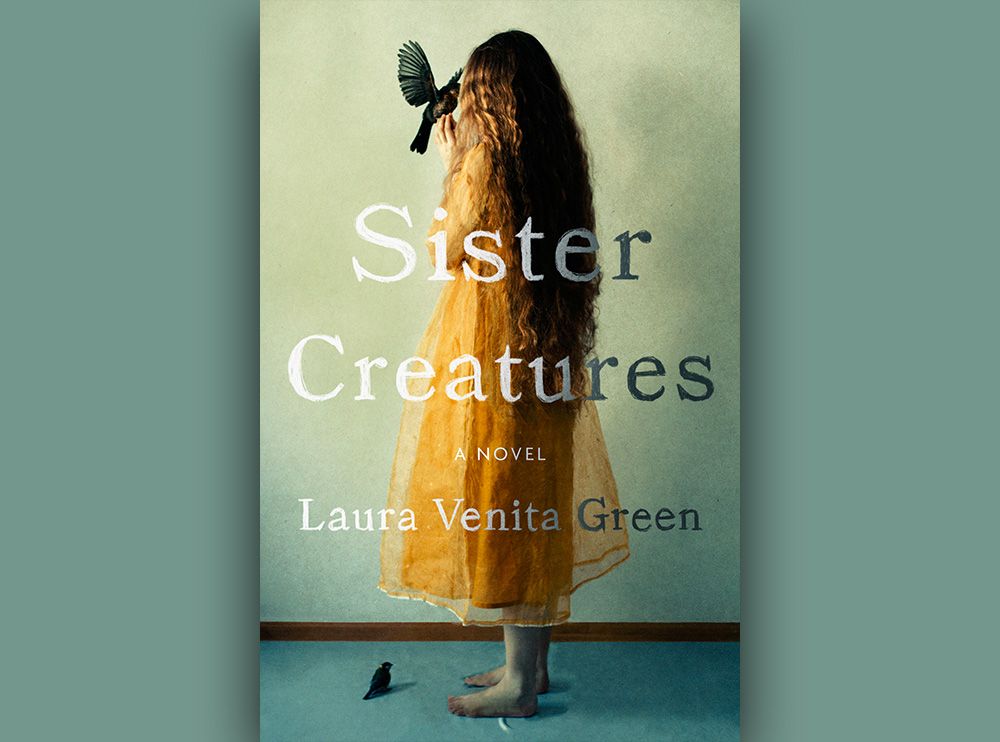
At times atmospheric and eerie, and at others all too real, Sister Creatures is about manufacturing resilience from nothing but the bonds that tie us together.
Intrigued? Well read on to discover the synopsis and an excerpt from Laura Venita Green’s Sister Creatures, which releases on October 7th 2025.
In the muggy, insect-ridden town of Pinecreek, Louisiana, college dropout Tess Lavigne is watching two bickering siblings while their parents are away. Her listless day drinking is interrupted when someone emerges from the woods behind the house. Filthy and feral, the daughter of religious fundamentalists, the girl known in town as Sister Gail convinces Tess to take her in for the night. The strange events of that evening will set the course for Tess’s future, and Sister Gail’s ultimate fate.
Meanwhile, other residents of Pinecreek try to cobble together a future from what little they have, their lives intersecting in small and not-so-small ways. Sisters fight to define independence for themselves (and from each other), while two young women on a bicycling trip wonder what their relationship promises, or threatens. Throughout, a deeply unsettling presence connects the characters to the buried secrets of Pinecreek: the ominous Thea, a malevolent shape-shifting entity whose rage and despair stems from a tragic history of misogyny, maternal loss, and stolen ambitions.
As time marches forward, so does Tess, creating a new path for herself while accepting what can never be entirely left behind.
Excerpted from Sister Creatures, by Laura Venita Green. Unnamed Press, 2025. Reprinted with permission.
When the Rodgers family landed in München, Tess stopped her German language lessons and took off her headphones. Paul sat next to her in the aisle seat, their thirteen-month-old son, PJ, straddled her in the middle seat, and Summer sat by the window. Paul was checking his phone, and she could tell something was off before he relayed the news, because his posture went from traveling-for-sixteen-hours disheveled to rigid, upright, militärisch. He adjusted his shirt collar, straightened the magazines and brochures in his seat-back pocket. Then, with a voice a notch deeper—his officer’s voice—he relayed the facts: the duplex with the private yard they’d secured months ago got flooded by a burst pipe. The army housing officer realized it only that morning, and the damage was extensive. They were now assigned to a sixth-floor walk-up apartment on the northern border of the Garmisch-Partenkirchen base.
Sixth-floor walk-up. Tess closed her eyes and rolled her head in a slow circle, trying to force some mobility back into her fucked-up neck and shoulders. PJ was fast asleep. For the entire flight he’d stayed there, calm against her belly, unless they’d needed to eat or use the bathroom. Any parent’s dream child. Except that PJ had never cried once since the day he was born, a fact that worried Tess daily, even if the doctors hadn’t yet found anything wrong.
The captain made an announcement, in German and then in English, to expect a long wait on the tarmac, and Tess got to learn the words for long wait: langes Warten.
While the plane taxied, Summer read a picture book titled Der Struwwelpeter that she’d picked out from the children’s section of the library on the California base where they’d been stationed. It hadn’t been checked out in years, one of those disintegrating, dust-gathering hardbacks that librarians were always trying to weed out of circulation. Seven-year-old Summer had wanted it because it was Deutsche, and they were moving to Deutschland, and they were all learning Deutsche—except for Paul, who already knew German, and PJ, who had yet to even say Mama. Tess hadn’t realized how creepy the thing was when she’d scanned it out of library rotation for her daughter. This version of the book, which was first published in the mid-1800s, featured parallel text, the original German next to an English translation. Summer had the book open to the titular story, illustrated with a dead-eyed troll boy, a shock of blond hair frizzing from his head and fingernails that curved out, long and sharp. A nineteenth-century Freddy Krueger. The charming text read:
Der Struwwelpeter
Sieh einmal, hier steht er,
pfui, der Struwwelpeter!
An den Händen beiden
ließ er sich nicht schneiden
seine Nägel fast ein Jahr;
kämmen ließ er nicht sein Haar.
Pfui, ruft da ein jeder:
Garstger Struwwelpeter!
Slovenly Peter
Just look at him! There he stands,
With his nasty hair and hands.
See! his nails are never cut;
They are grim’d as black as soot;
And the sloven, I declare,

Never once has comb’d his hair;
Any thing to me is sweeter
Than to see Slovenly Peter.
Summer, who’d acquired a hopefully short-lived habit of pointing out her mother’s many flaws, reached over and took Tess’s hand, studiously comparing her mom’s jagged nails with those of the boy in the illustration before turning back to her book. Her nails were pretty scruffy, Tess had to admit. She should have clipped and filed them be- fore they’d left, but everything about the move had been hectic. She bit into a hangnail, pulled at the skin with her teeth, but instead of coming loose it ripped deeper into the meat, almost to her knuckle, and drew blood. She sucked at her finger and watched Summer flip through the book that featured kids with various slovenly habits who all got their comeuppances. Summer stopped on “The Story of Little Suck-a-Thumb” and began to knock the side of her head rhythmically against the Plexiglas window as she studied the scissor man “Snip! Snap! Snip!” off the thumbs—“klipp und klapp”—of a naughty little thumb-sucking Daumenlutscher. Tess thought maybe she should take the book away from her daughter, but she didn’t. The only thing Tess could remember reading as a kid that young was Anne of Green Gables, over and over, and she had turned out neither good nor happy.
“What do you think?” Paul asked. “About the apartment?” He reached across Tess and PJ over to Summer and tugged on her sleeve to make her stop hitting the window.
“Well, first off I’m thinking about your knee. Six floors is a lot,” Tess said. Paul’s left knee was chronically bad. The army doctor in California warned him he’d probably need surgery in the near future.
“My knee’s fine.”
Paul’s voice cracked an octave higher at the word fine. Really convincing. Tess pulled her daughter to her side. The captain made an announcement that their wait on the tarmac would be indefinite, infinite; that this would be their final resting place and that eventually the nose of the plane would angle straight down, break through the asphalt, and carry them all to the underworld. Die Unterwelt. Summer leaned into Tess and snatched her little brother’s thumb out of his mouth. He blinked his eyes open and calmly reinserted it, and she snatched it again. Tess let this go on awhile, always hopeful that PJ would cry so she could know that nothing was truly wrong. But he didn’t, of course, and so Tess took Summer’s hand and gave her the stop it look.
Paul thrust his phone in Tess’s face, showing her a map of the base. He pointed at a rectangle that was presumably their new apartment complex. “It’s next to a playground and closer to the elementary school.”
Paul’s new assignment was to teach Russian at the Partner Language Training Center Europe, known as PLTCE. Paul was a military linguist and Mandarin was his specialty, but the current PLTCE Russian instructor was retiring, so Paul was to teach Russian, which was only one of his secondary languages. Since Paul was prone to panic attacks and he’d been inches from one ever since he got the transfer notice—and since Tess had, just a few days ago, concluded a months-long affair that had ended in a feeling of disgust despite it not being her first but simply the longest in duration—she threaded her fingers through his and said, “I think it’s for the best. Good location, great exercise, you know? Really wunderbar.”
ABOUT THE AUTHOR
Laura Venita Green is a writer and translator with an MFA from Columbia University, where she was an undergraduate teaching fellow. Her fiction won the Story Foundation Prize, received a Pushcart Prize Special Mention, and appears in The Missouri Review, Story, Joyland, Fatal Flaw, and translated to Italian in Spazinclusi. Her translations appear in World Literature Today and The Apple Valley Review. Born in San Angelo, TX, she’s lived in New Orleans and now lives with her husband in New York City. Sister Creatures is her debut novel.