


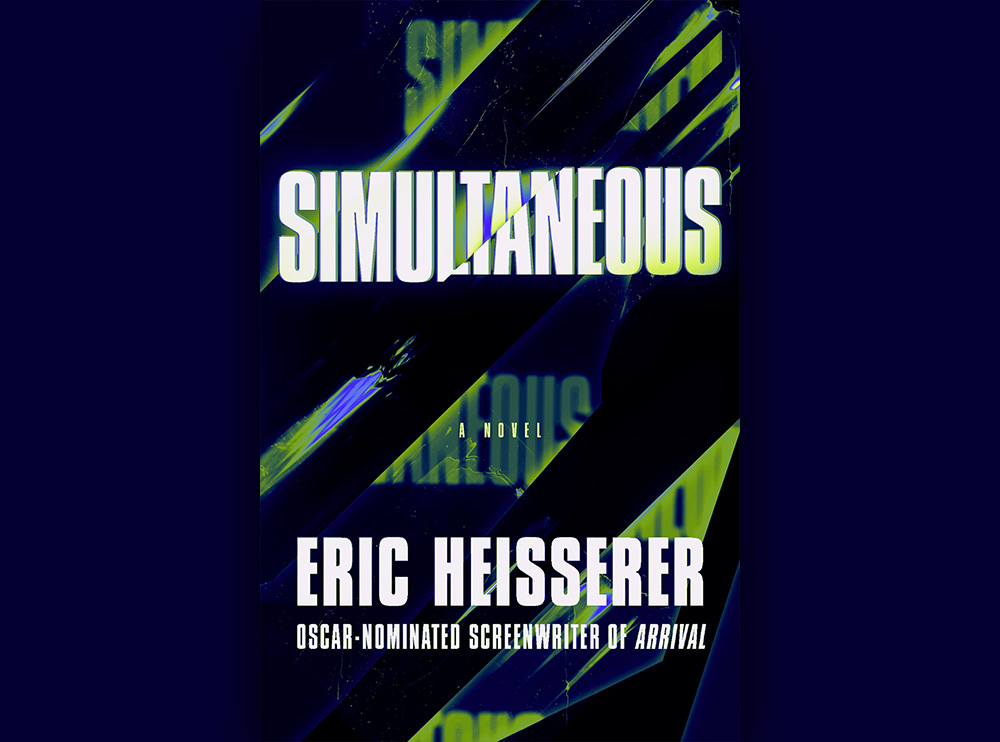
From the Oscar-nominated screenwriter of Arrival comes a phenomenal speculative thriller about a federal agent and a therapist who team up to stop an otherworldly killer.
Intrigued? Well read on to discover the synopsis and an excerpt from Eric Heisserer’s Simultaneous, which releases on October 28th 2025.
Federal agent Grant Lukather works for an unknown department of Homeland Security called Predictive Analytics. They look for patterns in tips and chatter to prevent a terrorist event before it happens. One of these calls, about a possible explosion in New Mexico, leads Grant to a case with unimaginable consequences.
He meets Sarah Newcomb, a therapist who uses past-life hypnosis in her treatment but has recently stumbled upon a phenomenon that seems to defy logic. Grant follows this thread to another crime: a copycat killer case in Colorado. With the help of one of Sarah’s patients, they embark upon an investigation that spans multiple states, timelines, and consciousnesses. With limited time and only a tenuous grasp of how this phenomenon works, the unlikely trio are in a race for their lives―past, present, and future.
Full of thrilling reveals, stunning plot twists, and a mordant sense of humor, Simultaneous is a mind-bending, one-of-a-kind thriller by a true genre star.
PROLOGUE
THERAPY SESSION 4
TRANSCRIPT EXCERPT
Client: Marigold Chu
Date: September 21, 2023
Therapist Annotations: This is the first time I began to suspect her condition was real beyond her own experience of it. Next session I’ll begin observational experiments with Brian.
//
SN: Tell me again about your symptoms. Have they persisted since we began? MARIGOLD: I haven’t collapsed again since that first incident, and I’m not missing time. SN: Good, that’s good.
MARIGOLD: Yes. But the headaches, I’m still dealing with those.
SN: What about the nightmares?
MARIGOLD: Still having those, too.
SN: Did you do like we discussed last week?
MARIGOLD: I’ve kept a notebook on the nightstand, yes. But the nightmares don’t make sense in the context of reality.
SN: That’s okay. They rarely do, you know. They’re just road maps to what you’re dealing with today. Or it’s whatever trauma carried over from before, like excess baggage, and now it’s arrived at your door.
MARIGOLD: I get it. But, this feels like something else. Something . . . stranger. SN: I’m listening.
[silence for several seconds]
MARIGOLD: You know what the Mandela Effect is?
SN: I’m familiar. You’re talking about a type of false memory shared by many people and believed to be fact.
MARIGOLD: Yes.
SN: Are you experiencing that lately?
MARIGOLD: Not quite, no.
[rustling of fabric]
MARIGOLD: It’s a false memory, but no one else has it. And not relating to something meaningful, really. I went to a convention on Monday and I swore one of the speakers was a different person. Like, they had a speaker—this was for an app that helps track electronic and EM temperature spikes as an early-warning system for residential fires—anyway, the speaker was a man named Daryl.
SN: Do you know him?
MARIGOLD: No. I was certain the speaker was a woman named Alice. Like, I remember reading her bio in the program and thinking, “All right, another female face, yes.” She was from Boston, but other details were hazy.
SN: Daryl replaced her?
MARIGOLD: No. I mean—yes, I guess?
SN: Sorry, keep going.
MARIGOLD: I mean to say, there is no Alice. No one remembers her. I spoke with Daryl later, he said they don’t have an Alice at the company. She wasn’t in the program, either, even though I can remember her.
SN: And you think you just had a dream about Alice speaking at the conference?
MARIGOLD: Maybe. But my dreams are usually weirder, you know? Like, mixed in with the mundane setting there’s an ostrich tending bar or everyone starts singing. There’s always some element that makes it clear I’m dreaming. This felt more like a false memory.
[shuffling of papers]
MARIGOLD: I imagined her. And when I think about her too much, the headaches come back, stronger than ever.
SN: Perhaps you knew her from before, or knew her family? We can explore it.
MARIGOLD: This is all what’s developed since we started our sessions.
[silence]
MARIGOLD: I don’t think this is trauma that happened a long time ago. I mean, it feels like that sometimes, but also it feels new. Like something in my world broke, recently— last month—and it’s too much for me to handle so I’ve blocked it.
SN: That’s how you got here. How you sought me out. I can help you with that, but I want to hear what has led you to this idea.
MARIGOLD: Do you think I’m wrong? Am I just rationalizing or internalizing or whatever? SN: Don’t overthink it, just tell me what you’re feeling and we can navigate it together.
MARIGOLD: I’ve also been having intense déjà vu. Like I’ve heard something already, or I recognize a person or a place on TV when I’ve never met them, never been there. I’ve had a version of this since
forever, my mom called it some mystical intuition, but I’ve grown out of the person I was who believed in my mom’s worldview.
SN: So what do you think this is?
[silence]
MARIGOLD: I’m a software engineer, and what we do in our line of work when we run into a problem we can’t crack is, we look online to see if it’s already been solved, or at least if others have encountered the same problem. And so that’s how I read about this quantum physics experiment that’s been repeated recently, using a type of light photon and a beam splitter. They call it the time-flip circuit. The experiment suggests that when this photon splits, it travels both forward and backward in time. Like an echo of the event is carried in both directions. There’s no evidence of this sort of event happening beyond a closed experiment with a very specific particle, but . . . But what if something happened to me, and it’s affecting my past and my future at the same time?
SN: What would that be?
MARIGOLD: That is the scariest part. What if I will never know?
1
THE EXPLOSION HEARD
A THOUSAND MILES AWAY
AND A DAY BEFORE
The place is called Ghost Ranch. A simple house made of adobe sits like an ancient relic, nestled in a snow-salted plain. Long shadows make giants of the stoic mesas in the distance. While the land and sky are painted in sun tones of the early morning, the world feels cold to the touch.
A lone sedan slumbers in a lot nearby, its windows fogged, its tires and undercarriage dressed with dirt from a hundred highways.
Inside, Grant Lukather exhales warm air into his cupped hands and shakes off the night of restless sleep. He glances at his two-week beard and wrinkled clothes in the rearview mirror. He’s barely thirty-five, but looks older here. The interior smells of fast food and stale coffee, emanating from the small trash bin wedged in front of his passenger seat under the glove box.
The rear window is obscured by a suitcase propped up and tied down with a seat belt. Collared shirts dangle from hooks over the back doors. A small travel iron is bound by its own cord atop a small, collapsible board. It draws the eye—a talisman for tidiness and normalcy amid the chaos of the car-that-is-his-home. Like a crucifix in a drug den.
Grant steps out into the brisk New Mexico air and stretches his back until his neck pops. His breath plumes like cigarette smoke. The countryside is quiet. Desolate. A wind scrapes over the plain, past him, and he adjusts his wrinkled coat.
An insistent chirp breaks the silence. Grant returns to his car, frowning. He digs into the center console and pulls up a cellular phone anchored to a charger. When he speaks, his voice cracks like he hasn’t talked out loud in several days.
“This is Grant.”
A baritone voice on the other end speaks to him. Grant senses an edge of trepidation in the man’s voice. “Grant. It’s me. Are you in town?”
“No, I’m on the road.”
“I thought I would call. We haven’t talked since the thing. But we got a flag. You don’t have to take it.” Grant clears his throat. “I can work. I’m ready to work. Where is it?”
As Grant listens to the instructions, he opens the glove box, where a Sig Sauer handgun rests atop a leatherbound notebook, pencil, and a small stack of insurance cards. He grabs the notebook, and while keeping the phone tucked between shoulder and ear, he writes the letters NM on a page, with some numbers and a name. On the previous page of the spread, the last thing written is a question in neat, small handwriting: Why am I still here? At the end, near the spine of the book, well beyond the question mark: a detailed sketch of a nine-millimeter bullet, its dimensions shadowed with crosshatch pencil marks.
Grant clears his throat again and speaks into the phone: “That’s a two-hour drive from me. You said it originated as a nine-one-one call?”
“I’ll forward you the recording. Get there in three hours if you want to catch the CST.”
Grant makes a noncommittal noise and ends the call. In the ensuing silence, his gaze returns through the fogged windshield to the adobe house in the distance, beyond the sign over an arch that reads ghost ranch. Grant carefully eases out a folded note tucked in the back of his notebook. Unfolds it. Written on the colored paper, in gentler handwriting, is a list with a title at the top. “Artist Landmarks to Visit Before I Die.” Below, on the list, several locations have been crossed through with rough pencil.
Grant marks through Ghost Ranch, New Mexico, and carefully folds the note again. He replaces everything methodically back into the glove box and starts the car. Its engine thrums to life, the heater kicking on immediately.
As the sedan makes its way out of the property, it passes a sign at the entry.
HOME AND STUDIO OF GEORGIA O’KEEFFE!
Three hours later, Grant stares at his reflection in a locker-room mirror.
His hair is wet and slicked back. His most recent clothes are stuffed into a trash bag. Hanging from a shower stall door behind him is a garment bag with a suit. He recites a mantra in his head: There’s only so much you can do. There’s only so much you can do. He repeats it enough times, it feels less like programming and more like OCD. Grant’s voice is firm in his narration, but his eyes plead with him to stop; to strip off the suit and return to his lived-in travel clothes and crawl back into the hole he’d dug for himself in the dusty sedan.
There’s only so much you can do. There’s only so much you can do.
“So, go do it,” Grant says to his reflection. His voice is still raw.
He slathers shaving foam over his beard and brings up a razor.
Twenty minutes later, Grant returns to his car outside a 24 Hour Fitness gym near Albuquerque. He tosses the trash bag of clothes he’d just worn in a bin on his way. With the exception of two other cars, the lot is unpopulated. The strip mall once contained a Blockbuster Video, but no other business has come to claim its spot, and so the shadow prints of the block letters remain, etched into the stucco by twenty years of sun damage. The only other survivors in this oversize shopping district are a nail salon, a convenience store, and a pawnshop.
Grant holds up a small camera and takes a photo of the faded Blockbuster Video lettering.
Sounds of traffic from a nearby expressway fill a small dogwalking park carpeted with mostly brown, dead grass. Grant bites into a deli sandwich on a bench, reading the remnants of a New York Times newspaper left by someone. In a suit, and clean-shaven, he seems almost professional. His hair still badly needs a cut, and his fingernails need trimming, but he comes off as someone on his first job interview after being displaced. “The move forces a vote within days on whether to keep the Speaker in his post,” he reads aloud. Getting more comfortable with his own voice. With his mask of confidence.
“A challenge that only two other House Speakers have faced in the history of the chamber.”
What he reads is inconsequential; it’s words on a page. Grant’s interest in the news is cursory and fleeting, only to introduce himself back into a world that pays attention to current events. As he continues, he adjusts his posture to seem more assertive. He wears the suit now, instead of the suit wearing him.
The sounds of hissing water and industrial air dryers fill this space—across the street, a full-service car wash is in full swing.
A pair of uniformed employees with cloth rags wipe down Grant’s sedan. One of them looks up at the rising sun bearing down on the day. No cloud cover in sight.
The other employee waves his rag in the air. Grant takes the last bite of his sandwich and approaches. “Sir, this your car?”
Grant nods.
“We got it as clean as could be, but I don’t know what to tell you about this damage on the side here. You see this?”
He points at where the paint had blistered, cracked, and torn off. Plastic around the driver’s-side wheel well looked badly warped.
“I see it.”
“I don’t know what did this, but you’d have to go to the dealer to see if they can put a new coat on for you.”
Grant gave the man a tip and took his car keys. “Fire.”
“What, sir?”
“It was fire damage.”
Less than ten minutes later, Grant’s cleaned-up sedan pulls into a suburban neighborhood called Sandia Heights.
No other part of New Mexico had felt populated except for those in their cars on the road; this is the first time Grant notices other people outside. On their lawns or in their driveways. Entire blocks of residents outside—wives holding umbrellas to shelter from the sun, husbands bent over with dust brooms or oven mitts, on their knees. Some cursing, some quietly in shock. One woman dabs her ear with a tissue.
That’s when Grant notices: All the glass in every home window has been blown out. Even car windows have shattered, leaving thousands of shards glinting in the sunlight. Some homeowners glare at Grant as he slows, passing them by.
At the end of a cul-de-sac, a line of emergency vehicles sits with their lights flashing. It feels like a dead end to nowhere. The housing development is unfinished here, with a wide-open view of the dirt and shrubs all the way to a mountain range that rises like a wall along the east.
Grant pulls next to a squad car, boxing it in.
Before he’s fully stepped out, a uniformed officer steps to his door.
“Sir, you can’t park there.”
Grant pulls out an identification badge from his breast pocket and casually hands it to the officer. “I got the call on this a couple of hours ago.”
The officer reads Grant’s badge.
“Homeland Security?”
Grant plucks the badge from him and returns it to its home in Grant’s pocket.
The officer narrows his eyes. “I’m First Sergeant Beale, I was first officer on the scene. If you’re here about a gas main rupture, should I be worried?”
Grant shrugs. “Let me do the worrying.” He steps past the man, toward the wilderness beyond this housing development. “Now, is the crime-scene tech still here?”
In a field, the tall grass has flattened, all in the same direction.

Grant stands and looks around him. He notices trees a quarter mile away collapsed atop one another like a thousand toppled dominoes.
Something detonated aboveground, close by.
“Happened early this morning,” Beale says, catching up to Grant and pointing. “About half a mile from the plant. Over there. A team from the gas company was out working diagnostics when it blew.”
“Casualties?”
“A few, yeah. So far, just the workers. But it woke a lot of people up, that’s for sure.” “Hmm.”
The elevated pipeline stands out like a white line in the distance, before the earthy rise of the mountains beyond. From here,the material looks like a child’s toy; as if the pipeline were much closer but made of LEGO bricks, or some other plastic thing.
Beale glances at Grant, curious about him. Noting the unruly hair over the back of his blazer and the small shaving cut under his chin.
“I’ve never even heard of your agency. Predictive Analytics. That sounds more like some sorta research firm. So, uh, if you don’t mind me asking, how much of what I just told you did you already know?”
Grant shrugs again. “Enough to be here.”
Two hundred steps later, Grant and Beale arrive at a macabre, artistic scene. Ground zero. Two ends of the pipeline have bloomed like flower petals, leaving a gap the length of a dozen men laid head to foot. This is where the grass flattens out in a radius, creating a kind of clockface mosaic, but instead of analog clock hands, it’s deep black burns in a stripe from some thrown bit of debris.
Most of the ground has flash-burned around it: The tips of grass and trees are burned, but the rest is untouched. Grant muses that this scene must look like a giant asterisk from a bird’s-eye view.
“There’s only so much you can do,” he whispers. And what’s done is done, his thoughts continue as he scans the scene.
A group of paramedics works with two men in light jackets that read crime scene tech, all of them bent over, rooting around with metal rods or with their own gloved hands, seeking evidence.
A series of plastic crime-scene trays have been lined up neatly on a folding table, where several dozen baggies of found evidence have been collected. Little neon-colored flags with numbers dot the area.
It’s time, he realizes. Time to go to work again. Grant holds his phone to his ear and one-touch dials a number.
As it rings on the other end, he ventures closer to the rupture and peers into one open end of the pipeline. It goes dark quickly.
“Play the call,” Grant says to a voice on the other end.
Beale steps to him with a questioning look on his face.
Grant makes a snap decision and holds the phone before him, putting the call on speaker. Beale gets close in time to hear an automated female voice:
“This message was recorded yesterday at eight fourteen a.m.”
A moment later, the voices of two different women—first, the flat, businesslike emergency operator, followed by someone exasperated.
“Nine-one-one, what is your emergency?”
“There will be an explosion.”
“Did you say an explosion?”
“Tomorrow morning. On the edge of town, the Manover pipeline. It will kill seven people.” “Ma’am? Tomorrow?”
“Please look into it. You can stop it.”
A series of clicks ends the recording, and Grant ends the call.
“Hang on—that was from yesterday?” Beale asks, nodding to Grant’s phone.
Grant doesn’t directly answer, his mind focused on other questions. He replies with one for Beale. “Is there any evidence of an explosive device?”
“Well, I mean . . .” Beale reluctantly gestures to the gas main. “The whole pipeline. But if you mean a bomb, I dunno.”
“You said a crew was working here. Anyone else mixed in with them?”
“If they were, they were dressed like the others. You can have a look yourself.” “I will. Thank you, Sergeant.”
First Sergeant Beale follows him. “My guys will need to know soon. Either we start handing over paperwork or we just clean this up.”
Grant frowns, momentarily confused. “Know what?”
“Is this a federal case? Everyone’s waiting on you, Agent.”
Grant looks around. Indeed, the other uniformed officers and two of the techs stare at him. Grant returns his attention to Beale. “Maybe.”
Grant steps to where an ambulance has driven off the road to get close to the scene. There, five bodies concealed in body bags are lined up while the coroner takes photographs. “Maybe not.”
Grant begins to write 5 bodies, not 7 in his notebook.
A whistle gets his and Beale’s attention: From the group of emergency vehicles back at the cul-de-sac, another officer hurries back.
Beale calls to him, “Hollister! What’s up?”
Hollister calls back, “Just heard from the hospital!”
Beale snaps his fingers, remembering. He brings Grant up to speed: “The pipeline foreman and another tech were alive when we got here. Rushed them to Saint Mary’s.” Calling out to Hollister: “Are they gonna make it?”
“They both died on the table.”
Beale looks back to Grant, eyes widening. That makes seven. But Grant is already on his phone again, marching back to where he parked his car.
“This is Special Agent Grant Lukather calling in on the Manover case. I need the number used to make that nine-one-one call. You capture that information automatically, yes?”
He stops in his tracks a few steps later. Grant turns back, utterly baffled, and looks toward ground zero once more. He asks into his phone, “California? Are you sure?”
EXCERPTED FROM SIMULTANEOUS. COPYRIGHT © 2025 BY ERIC HEISSERER. EXCERPTED BY PERMISSION OF FLATIRON BOOKS, A DIVISION OF MACMILLAN PUBLISHERS. NO PART OF THIS EXCERPT MAY BE REPRODUCED OR REPRINTED WITHOUT PERMISSION IN WRITING FROM THE PUBLISHER.