


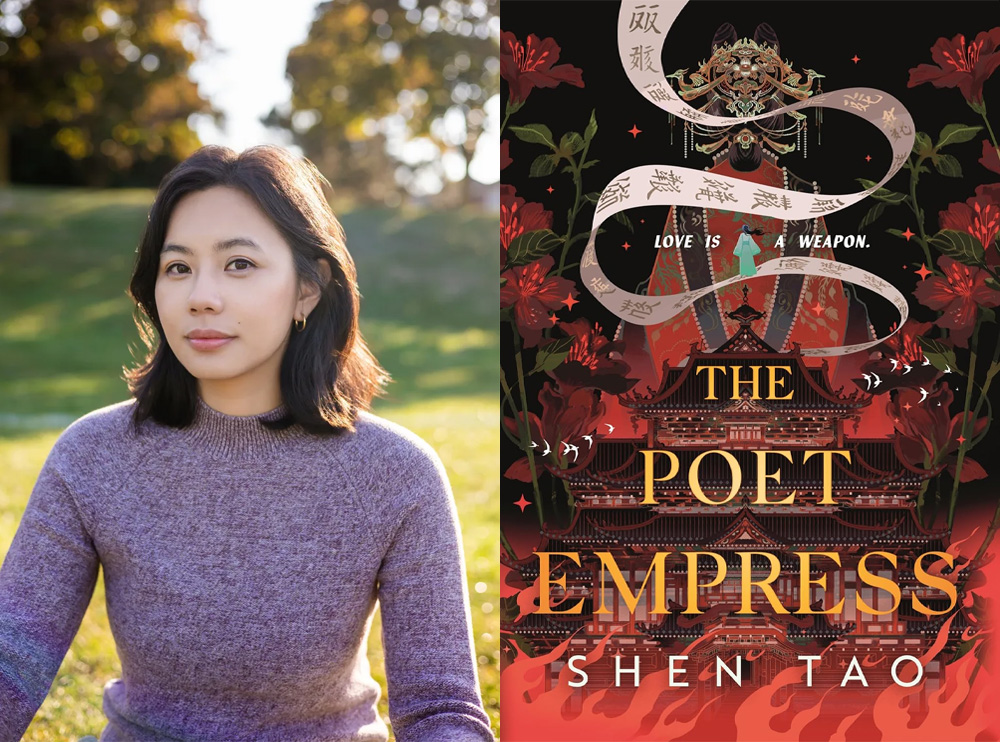
Guest post written by The Poet Empress author Shen Tao
Chinese-Canadian author Shen Tao has dreamed of publishing fantasy stories since she was seven. An engineer with roots in Nanchang and Toronto, she later moved to Seattle to be closer to the mountains and the ocean, where she currently resides with her partner, her piano, and her menagerie of stuffed critters. Shen is a finalist for the Mike Resnick Memorial Award for science fiction, a two-time finalist for the PNWA unpublished novel contest, and a graduate of several speculative fiction workshops including Taos Toolbox, Viable Paradise, and Odyssey.
About The Poet Empress: Debut author Shen Tao introduces readers to the lush, deadly world of The Poet Empress, a sweeping, epic and intimate fantasy perfect for fans of The Serpent & the Wings of Night, The Song of Achilles and She Who Became the Sun. Out now! You can read our review here.
Who gets to tell stories? Whose stories get to be told?
You look at your shelf. You think of the books you’ve read recently. Well-worn hardcovers, paperbacks with creases of love on their spines, the ebooks in your reader, the audiobooks paused on your phone. You notice that certain characters are more likely to be written about. A plucky, pulls-himself-up-by-the-bootstraps hero, depending on what genres you love. A chosen one with ancient magic. A secret heir. You think about history. You think about who gets to be remembered, who doesn’t. You think about all the countless millions buried in the ashes of millennia, who lived their lives and loved and lie forgotten, who have been burned by the rise of empires and have drowned with them as they’ve sunk.
I was never so conscious about the process of storytelling itself until I started writing a book about poetry magic. In the fictional world of the The Poet Empress, how powerful a spell is depends on the truth and emotion woven in its verses—but women are forbidden from reading and writing. And so begins the story of young Wei, only sixteen at the start of the novel, the daughter of a rice farmer amidst a famine, unremarkable, knowing nothing about magic or politics or the world of men.
And she doesn’t win the day spectacularly. It’s not realistic in her world, where the lush imperial court cares little about the plight of the common people and women vanish in the shadows of its opulence. In Wei’s world, she can’t aspire to overturn wicked empires by herself or become a burning figure of history. She can only tell stories, in the quiet way she can, and hope her words leave a small but indelible mark. She begins to learn to read in secret.

Maybe the way the world is changed is one poem at a time.
And what of our world? If things seem bleak and progress impossible, can words become magic and move us? If there comes a day when people at the top insist on writing our histories, when reading becomes treason and writing rebellion, can we find the quiet stories, the missing ones, and tell them? Can we look past the noise and find the voices long silenced? Can we transmit empathy when empathy becomes scarce?
You pick a book off your shelf. Your favorite book, perhaps—or perhaps an author you’ve never read before. A beloved character, or perhaps one very different from yourself. You learn a new way of thinking, a distant way of living. A new poem begins singing in your blood. Somewhere out there, from some other corner of the world, truth and emotion has found its way to your open heart, because you have decided that this story matters. With every turn of the page, you make magic.